



If you need uk student visa document translation, the smartest approach is not to translate everything blindly. It is to identify exactly which supporting documents must be translated, make sure the translation pack is complete, and submit evidence that is easy for a caseworker and university compliance team to review.
For most students, the real pressure points are not the visa form itself. They are the documents behind it: bank letters, financial evidence, academic transcripts, degree certificates, parental consent letters, sponsorship documents, and any supporting records that are not in English or Welsh. That is where delays happen, and that is where a clean, well-prepared certified translation can save time, stress, and repeat costs.
If you are getting your file ready now, send your scans for a quick quote and get a document-by-document review before you submit anything.
Where to get certified translations for UK student visa applications
If you are asking where to get certified translations for a UK student visa application, the safest route is to use a professional translator or translation company that can provide a fully certified translation that can be independently verified by the Home Office.
A practical way to find a suitable provider is to search the public directories of recognised UK professional bodies and trade associations, including the Chartered Institute of Linguists (CIOL), the Institute of Translation and Interpreting (ITI), and the Association of Translation Companies (ATC). These directories help students find qualified professionals or established translation companies instead of relying on informal or unverified providers.
It is also useful to know that the UK does not operate a general system of “sworn translators” in the way some other countries do. For UK student visa purposes, what matters is that the translation is professionally prepared, complete, and includes the required certification details.
What usually needs translation for a UK student visa
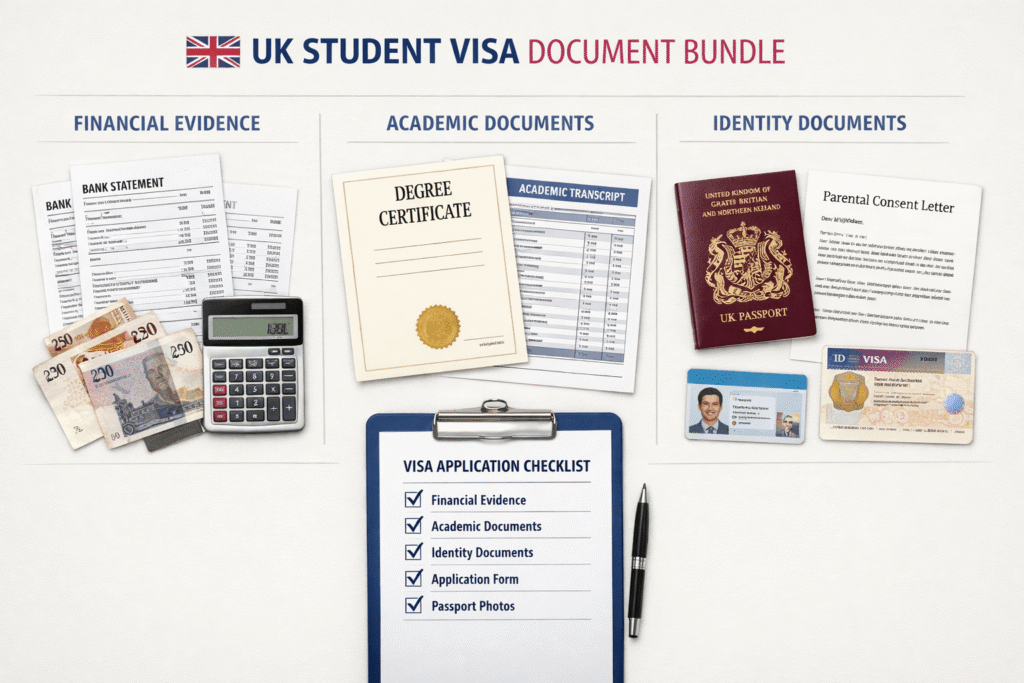
A useful rule is this:
Translate every supporting document you rely on if it is not in English or Welsh.
That sounds simple, but many students still over-translate some items and miss others. The easiest way to avoid that is to work from your visa evidence bundle rather than from a generic checklist.
The documents students most often need translated
These are the documents most commonly sent for student visa-related translation work:
- Bank statements
- Bank letters
- Proof of funds documents
- Scholarship or sponsorship letters
- Parental consent letters
- Birth certificates for dependants or family-link evidence
- Academic transcripts
- Degree certificates
- Diplomas
- ATAS-related supporting papers, where relevant
- Tuberculosis test certificates, where relevant
- Name-change or civil status documents if they explain a mismatch across records
Documents students often do not need translated
Some items are often already in English or issued in a form that does not usually need translation:
- Your passport, if it is already in an accepted format
- Your CAS reference from your course provider
- UK-issued university communications
- English-language bank letters already produced by your bank
- English-language academic records from your institution
The practical point is this: your CAS pack may contain documents that do and do not need translation. The CAS itself is typically issued by the university in English, but the supporting evidence behind your application may still need certified translation.
A better way to think about your CAS pack
Many students use the phrase “CAS pack” to describe the full set of documents connected to their offer, compliance checks, and visa preparation. That is a useful way to organise your thinking.
Instead of asking, “What should I translate for my UK student visa?” ask:
- Which documents prove the claims in my application?
- Which of those documents are not in English or Welsh?
- Which of those documents must be easy for a reviewer to verify quickly?
That small shift prevents two expensive mistakes:
- paying for unnecessary translations
- missing one critical non-English document that slows down the application
When CAS-related evidence needs translation
For Student route applications, Home Office caseworker guidance makes an important practical point: if documents used to assess and issue the CAS are not in English, the applicant must provide a certified translation of those documents.
That matters because many students correctly assume the CAS itself is usually issued in English, but then miss the supporting records behind it. In practice, the qualifications, transcripts, references, or other supporting documents used by the sponsor to assess the student may still need translation if they are part of the evidence relied on in the application.
A simple CAS-led translation workflow
Start with these three folders:
1. University documents
Offer letters, CAS details, tuition payment confirmations, admissions requests.
2. Financial evidence
Bank letters, bank statements, sponsor letters, scholarship letters, loan documents.
3. Identity and academic evidence
Transcripts, diplomas, birth certificates, parental consent, relationship documents.
Then translate only the non-English or non-Welsh documents that support the application. This is usually faster, cheaper, and cleaner than sending a mixed batch without context.
Bank letters, statements, and financial evidence translation
This is where many student applications become messy.
A bank statement may look straightforward, but if it contains non-English transaction descriptions, bank stamps, account-holder details, or local formatting that is unclear to a UK reviewer, the translation must still be complete and readable.
What a strong financial evidence translation should capture
A proper financial evidence translation should clearly reflect:
- Account holder name
- Bank name and branch details
- Dates
- Currency
- Closing or available balance
- Transaction history where relevant
- Official stamps, seals, and annotations
- Any handwritten notes or endorsements
If a bank letter confirms funds, the translation should also preserve wording about:
- the current balance
- how long funds have been held, if stated
- whether the letter is official and signed
- account numbers or partial account identifiers as shown in the original
Bank letters vs bank statements: why both matter
Students often ask whether they should translate the bank letter, the bank statements, or both.
The answer depends on what you are relying on.
- If your bank letter summarises the key facts clearly and is accepted by your university or adviser, that may be the main document.
- If your application depends on balance history or dated evidence, the supporting statements may also matter.
- If your funds come from a parent or official sponsor, additional relationship or sponsorship documents may be needed too.
A complete translation set is usually stronger than a patchwork file where one supporting document is left untranslated.
Mini example: where students lose time
A student has:
- a bank certificate in their home language
- three months of statements
- a translated university offer
- a passport in English characters
They only translate the certificate.
Later, the reviewer still needs to understand the statements because the balance history matters. The result is a second translation order, more urgency, and more stress. A better approach is to review the financial evidence as one bundle from the start.
If you want to avoid that, upload the full financial set together and ask for a quick quote on the whole pack, not one document at a time.
Academic documents translation for student visa and university checks
Academic documents translation is often needed twice in the student journey:
- first for university admissions or compliance checks
- later for visa-related evidence or post-offer verification
That is why accuracy matters beyond literal word-for-word translation. The reviewer must be able to follow the academic story without guessing.
Academic documents that often need translation
- Academic transcripts
- Degree certificates
- Diplomas
- Marksheets
- Grading scales
- Internship or placement letters, where relevant
- Official enrollment or graduation confirmations
What makes academic translations stronger
A good translation of academic records should keep:
- Course titles
- Credit or module information
- Grades and grading legends
- Dates of study
- Institution names
- Seals, stamps, signatures, and registrar notes
This is especially important when names vary slightly across documents. If your passport uses one spelling and your academic records use another, the translation should be consistent and the file should be reviewed as a full set.
Case-style insight
A common problem is not the translation itself. It is inconsistency across the bundle.
For example:
- the transcript uses one transliteration of the surname
- the bank letter uses another
- the birth certificate uses a third form
Even when each translation is technically accurate, the overall file can look fragmented. Reviewing the documents together before certification helps reduce that risk.
Tier 4 replacement guidance: what changed and what did not
Many students still search for Tier 4 replacement guidance because older articles, forum posts, and adviser notes continue to use the previous term.
The key point is simple: the old Tier 4 route was replaced by the Student route, but the practical translation question remains the same for applicants today.
If your supporting evidence is not in English or Welsh, it should be translated in a form that can be checked easily and accepted without follow-up.
So if you are reading older “Tier 4 visa translation” articles, use them carefully. The terminology may be dated even if some of the document logic still overlaps.
What should be in a student visa translation pack

A strong translation pack is more than converted text. It should look organised, complete, and submission-ready.
A reliable pack usually includes
- A full translation of the original document
- A certification statement confirming accuracy
- The date
- The translator’s or provider’s full details
- Signature or signed certification page where required
- Clear rendering of stamps, seals, and handwritten notes
- Matching page order
- Clean formatting that mirrors the original where possible
UKVI translation requirements at a glance
For a UK student visa, the translation should be prepared so it can be independently verified by the Home Office. In practical terms, that means the translation should include confirmation that it is an accurate translation of the document, the date of translation, the full name and signature of the translator or an official from the translation company, and the translator or translation company’s contact details.
Small details that make a big difference
These details often help reduce questions later:
- Consistent spelling of names across all translated documents
- Clear labels for stamps and seals
- Visible page numbering for multi-page sets
- One merged PDF per document set where possible
- Logical filenames, such as Bank-Statement-Jan-to-Mar-English.pdf
When a reviewer can understand the file quickly, your application feels lower-risk and easier to process.
Common mistakes that cause delays
The most frequent problems are surprisingly avoidable.
1. Translating only part of the document
Students often assume the bank balance line is enough. It usually is not if the rest of the statement helps prove the evidence.
2. Using a self-translation
This can create avoidable doubts around independence and verification.
3. Ignoring stamps, seals, handwritten notes, or side annotations
These details can matter, especially on financial or academic documents.
4. Sending poor scans
Blurry or cropped images increase the chance of rework.
5. Leaving the translation order until the final week
Urgency is sometimes unavoidable, but last-minute work limits your room to correct inconsistencies across the bundle.
6. Treating every document as separate
Student visa files work better when identity, academic, and financial documents are reviewed together.
How to get a faster quote and smoother turnaround
If speed matters, prepare your files before requesting pricing.
What to send for a quick quote
Send:
- Clear scans or PDFs of every page
- A note saying the documents are for a UK student visa
- Your deadline
- Any university or adviser instructions
- Whether you need digital delivery only or hard copies too
How to package your files
Use this format:
- Folder 1: Financial evidence
- Folder 2: Academic documents
- Folder 3: Identity and supporting records
This makes it easier to review the bundle properly and price it accurately the first time.
If you are unsure whether a document needs translation, include it anyway and ask for a file review. That is usually faster than ordering twice.
London service, nationwide support
If you want a London service with nationwide reach, look for a provider that can handle certified document translation digitally while still offering clear support, secure file handling, and a real contact point.
For students, that combination matters more than a flashy promise of speed. You want:
- a clear document review process
- practical advice on what to translate
- a compliant certification format
- responsive support when your deadline is close
UK Certified Translation supports clients from its London office while handling projects remotely across the UK and internationally, which is ideal for students applying from overseas or preparing documents before travel.
Why students choose a specialist document translation service
Students do not just need words translated. They need confidence that the pack will make sense to the person reviewing it.
That is why specialist support matters most for:
- financial evidence translation
- academic documents translation
- multi-document packs with different naming formats
- urgent applications close to a visa deadline
- mixed files involving family sponsorship or dependants
A good student visa translation service helps you avoid over-ordering, under-ordering, and submitting a bundle that looks inconsistent.
A practical checklist before you submit
Use this final check before sending your documents off:
Student visa translation checklist
- I have listed every document I rely on in my application.
- I have identified every document not in English or Welsh.
- I have included financial evidence, not just the headline bank letter.
- I have checked whether academic records need translation too.
- I have reviewed names and dates across the full pack.
- I have clear scans of every page.
- I have asked for the whole bundle to be checked, not one page in isolation.
- I know whether I need digital delivery, hard copies, or both.
If you are at the final stage now, upload your files and request a quick quote for the full student visa bundle. It is the fastest way to find gaps before they become delays.
Frequently Asked Questions
Do I need UK student visa document translation for bank statements?
Yes, if the bank statements you rely on are not in English or Welsh, they should usually be translated in full. This is especially important where the statements support your financial evidence and show dates, balances, stamps, or account-holder details.
Does a CAS need translation for a UK student visa?
Usually, your CAS reference and university-issued CAS information are already in English. The bigger issue is the supporting evidence linked to your CAS pack, such as bank letters, sponsorship documents, and academic records.
Can I translate my own documents for a UK student visa?
It is safer to use a professional certified translation service. A student visa file should be easy for a reviewer to verify, and self-translations can create unnecessary questions.
What academic documents translation is usually needed for a student visa?
The most common academic documents translation requests are transcripts, degree certificates, diplomas, marksheets, and grading information. If the university or visa process relies on those records and they are not in English or Welsh, translation is usually the sensible route.
Do I need notarisation for student visa documents?
In many student visa cases, certified translation is the key requirement rather than notarisation. Notarisation is usually only relevant when a specific authority, embassy, or institution asks for it.
How fast can I get a quick quote for student visa document translation?
A quick quote is usually fastest when you send clear scans, all pages in one batch, your deadline, and a note that the documents are for a UK student visa. Multi-document review at the start helps prevent delays later.
Where can I get a certified translation for a UK student visa application?
You should use a professional translator or translation company that can provide a fully certified translation suitable for Home Office review. A practical way to look for a provider is through recognised UK directories such as CIOL, ITI, or ATC.
Who can certify a translation in the UK for student visa documents?
For UK student visa purposes, the translation should come from a professional translator or translation company and include the required certification details. In the UK, there is no single universal “sworn translator” system for this type of work, so the focus is on professional certification wording and verifiable translator details.
Can I use a translator from outside the UK for a UK student visa application?
The key issue is not whether the translator is based in the UK. The important point is whether the translation is professionally prepared, fully certified, and includes the details needed for independent verification by the Home Office.
Do I need a full translation or just the important parts of the document?
If a document is part of the evidence you rely on, the safer approach is to provide a complete certified translation rather than a selective extract. That helps the reviewer understand the document properly and reduces the risk of follow-up questions.