


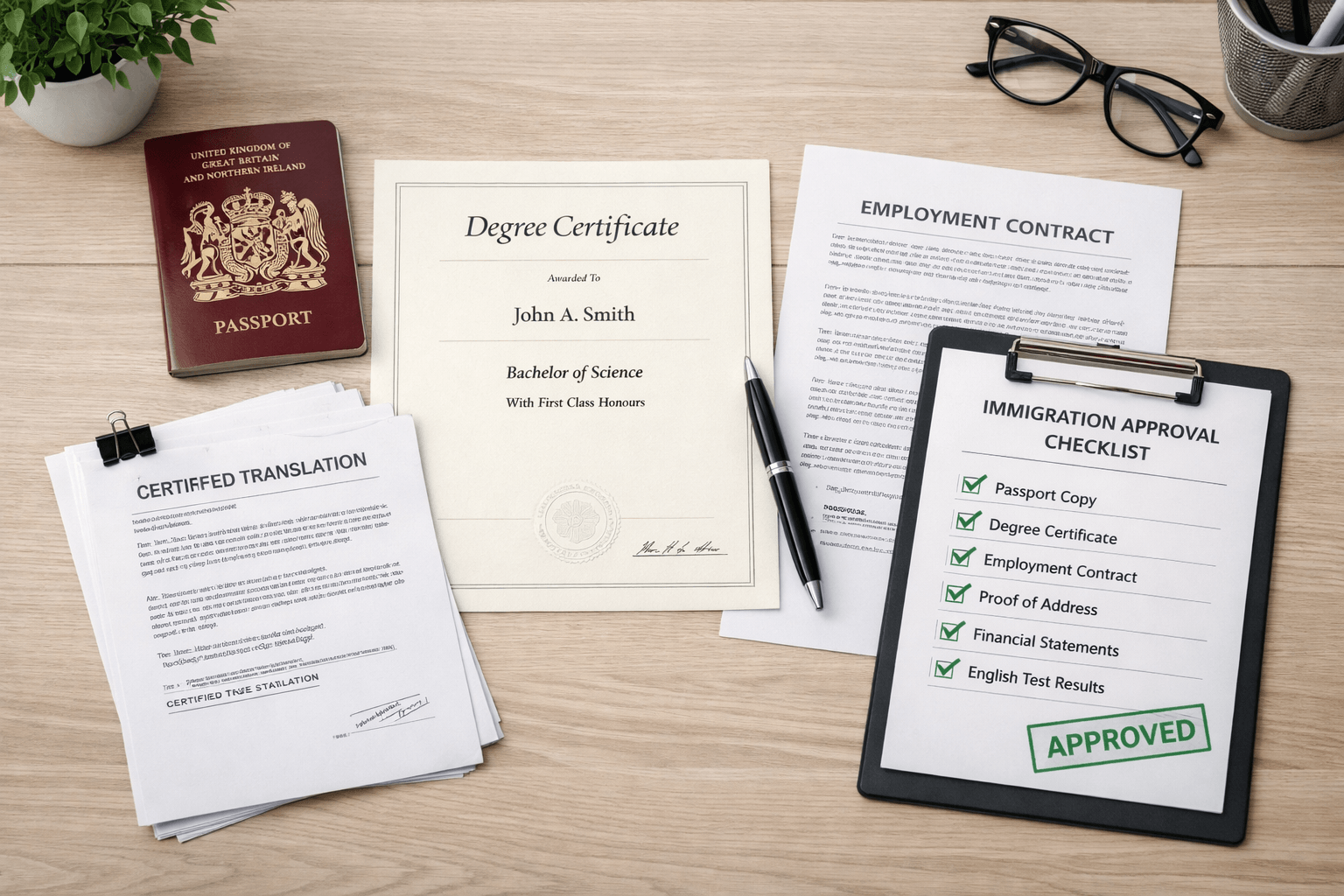
Skilled worker visa document translation is one of the easiest parts of a UK visa application to get right — and one of the easiest to get wrong if you leave it too late. If any supporting document is in a language other than English or Welsh, it needs a fully certified translation that matches the original document clearly, completely, and in a format that can be checked if needed.
That sounds straightforward, but the practical questions are where applications often slow down. Which documents actually need translating? Do HR letters translation and contract translation UK documents need the same treatment as personal records? Is notarisation necessary, or is certified translation enough? And how do you handle urgent document translation without sacrificing accurate formatting, names, dates, figures, or official stamps?
This guide answers those questions in plain English so applicants, sponsors, HR teams, and advisers can prepare the right document pack the first time.
The short answer most applicants need
If you are applying for a Skilled Worker visa and any supporting document is not in English or Welsh, submit:
- the original document or a clear copy of it
- a full certified translation
- a translation that includes the translator’s confirmation of accuracy
- the date
- the translator or company representative’s name and signature
- contact details for verification
The safest approach is to translate every non-English supporting document you plan to rely on, not just the pages you think matter most. That includes stamps, seals, annotations, tables, and handwritten notes where relevant. A partial or loosely formatted translation can create unnecessary follow-up questions at exactly the point you want the application moving forward.
What documents require translation for a UK Skilled Worker visa?
For a UK Skilled Worker visa, the practical rule is simple: if you submit a supporting document and it is not in English or Welsh, it should be accompanied by a full certified translation.
That usually includes non-English documents used to support:
your maintenance funds, such as bank statements
your relationship to a partner or child applying with you
your tuberculosis test results, where required
your criminal record certificate, where required
your qualification evidence, where relevant to the application
your overseas civil status or identity-related records
If a document is already in English or Welsh, it does not normally need translation. If a document is not being submitted as part of the application, it does not need translation simply because it exists.
This section is useful because it answers the exact question many applicants ask: not “do I need translation in general?” but “which documents do I actually need to translate for a Skilled Worker visa?”
Which supporting documents usually need translation for a Skilled Worker visa?
The exact document pack varies by case. Some applicants have a very lean file. Others need to submit qualifications, financial evidence, family records, or employer paperwork as part of the wider application.
What matters is this: if the document supports your application and it is not in English or Welsh, it should be translated properly.
Core application documents that may need translation
Common examples include:
- degree certificates
- academic transcripts
- professional licences or registrations
- criminal record certificates
- tuberculosis test certificates
- bank statements used as maintenance evidence
- birth certificates
- marriage certificates
- documents for dependants applying with you
- overseas identity or civil status records
Your Certificate of Sponsorship itself is normally generated through the UK sponsorship system and does not usually create a translation issue. The translation question usually arises around the evidence behind your identity, qualifications, background, or family relationship.
Employment and sponsor-side documents that often create confusion
This is where many applications become more document-heavy than people expect. Depending on the case, applicants or sponsors may need supporting evidence such as:
- employer reference letters
- HR confirmation letters
- overseas experience letters
- salary evidence
- payslips
- employment certificates
- job descriptions
- signed contracts or contract amendments
- internal assignment letters for transferred staff
This is why HR letters translation and contract translation UK work should not be treated like a simple one-page certificate. These documents often contain structured clauses, dates, salary figures, reporting lines, signatures, attachments, and compliance wording that need to be carried over with accurate formatting.

Documents for dependants and family-linked applications
If a partner or children are applying with the main applicant, the translation pack often expands to include:
- marriage certificates
- birth certificates
- custody documents
- proof of address
- family register extracts
- adoption papers where relevant
A strong translation pack makes the family relationship easy to follow at a glance. The point is not just linguistic accuracy. It is administrative clarity.
A practical document-by-document translation checklist
| Document type | Usually translated? | Why it matters |
| Degree certificate | Yes, if not in English/Welsh | Helps show qualification evidence where relevant |
| Academic transcript | Yes | Supports degree details, dates, grades, and institution information |
| Employer reference or HR letter | Yes | Clarifies role, dates, salary, duties, and employment history |
| Employment contract | Yes | Useful where contract terms or job details support the case |
| Bank statement | Yes | Needed if used to prove maintenance funds |
| Criminal record certificate | Yes | Required in some roles, especially certain health, education, therapy, and social care jobs |
| TB certificate | Yes | Required for applicants from listed countries |
| Marriage or birth certificate | Yes | Needed for dependant applications |
| Passport or ID document | Only if relevant and not already accepted as issued | Depends on document language and submission context |
What a compliant translation should include

A strong skilled worker visa document translation does not just convert words from one language into another. It should make the translated document usable for official review.
At minimum, the translation should include:
- a statement confirming it is an accurate translation of the original document
- the date of translation
- the full name of the translator or an authorised representative
- a signature
- contact details for verification
In practice, a good translation pack also makes it easy to see:
- what document was translated
- which language pair was used
- that every page has been covered
- where stamps, seals, logos, handwritten notes, or unclear sections appear
- that names, reference numbers, dates, and totals are reproduced consistently
If you are using a provider for UK work visa translations, ask to see a sample certification statement before ordering. It removes guesswork and helps you check that the final pack will be submission-ready.
What happens if you do not provide a certified translation?
This point deserves its own section because it answers one of the most important practical questions in Skilled Worker cases.
If a document is not in English or Welsh and you do not provide a proper certified translation, the risk is not just delay. The document may effectively stop helping your application at all.
In real terms, that means an untranslated or poorly translated bank statement may fail to support maintenance funds. An untranslated marriage certificate may fail to support a dependant application. An untranslated criminal record certificate may fail to satisfy a role-specific requirement.
That is why visa translation should be treated as part of the evidence itself, not as an afterthought added at the end.
What “full translation” really means in real cases
A full translation does not mean “the important bits.” It means the document is translated in a way that preserves the substance of the original.
That matters most when the original contains:
- page headers and footers
- official stamps or embossed seals
- handwritten notes
- abbreviations
- tables
- attached statements
- margin comments
- signature blocks
- company letterheads
This is especially important for contract translation UK work and employer letters. A translation that preserves the text but ignores structure can make a professionally drafted document look incomplete or unreliable.
Accurate formatting is not cosmetic. It helps the reader compare the translation to the source and understand the document quickly.
Certified, sworn, or notarised: which one does a Skilled Worker visa applicant need?
For most Skilled Worker visa applications, certified translation is the relevant standard for supporting documents.
That is the level most applicants need because the key requirement is that the translation is fully certified and can be independently verified if necessary.
Sworn translation and notarised translation are different services. They may be needed for other destinations, foreign authorities, court matters, or separate legal formalities, but they are not the default answer just because a visa application feels high stakes.
A simple rule works well here:
- if the requirement is a UK visa supporting document, start with certified translation
- if a solicitor, embassy, court, or foreign authority has specifically asked for notarisation or sworn status, upgrade only then
- if you are unsure, send the destination requirements with the file before you order
That keeps the process proportionate and avoids paying for a higher level of certification that the receiving authority did not ask for.
Why HR letters translation and contract translation need extra care
A one-page birth certificate and a six-page employment contract do not fail for the same reasons.
With HR letters translation and contract translation UK projects, the risk is usually in the detail:
- inconsistent job titles between documents
- salary figures translated but not formatted clearly
- contract clauses collapsed into plain paragraphs
- benefits, allowances, or probation terms omitted
- signatures, initials, annexes, and references not carried through
- date formats interpreted incorrectly
- names transliterated differently across the file
Those are not small issues. They are exactly the kinds of inconsistencies that force applicants to answer avoidable questions later.
For employment documents, a professional layout matters because the reader is often looking for alignment between several pieces of evidence at once: contract, HR letter, payslips, references, and qualification documents. When the translation preserves structure, the entire pack becomes easier to trust.
When urgent document translation is worth doing — and how to do it safely
Urgent document translation is common in visa work. Deadlines move. Sponsors need documents fast. Applicants discover at the last minute that a missing translation is holding up submission.
Speed is useful. Rushed mistakes are not.
If your timeline is tight, the safest way to move quickly is to send:
- clear scans of every page
- the destination of the translation
- the deadline
- the language pair
- confirmation of whether you need digital PDF only or hard copy as well
That allows the translation provider to confirm turnaround and certification level without avoidable back-and-forth.
For time-sensitive visa files, do not fragment the work across multiple freelancers unless you have to. A single managed pack usually gives you better consistency across names, dates, employer details, and formatting. That matters more in a Skilled Worker case than many applicants realise.
Common mistakes that delay visa document translation
The most common problems are avoidable:
- Translating only selected pages
If the document is being relied on, the safer route is a full translation. - Using a translation that lacks certification details
A plain translation file is not the same as a certified submission document. - Ignoring stamps, seals, and handwritten notes
These details often carry evidential value. - Submitting inconsistent spellings of names
This is especially common across academic, HR, and civil documents. - Leaving contract formatting too loose
In contract translation UK work, structure helps prove completeness. - Ordering the wrong certification level
Certified is usually right for UKVI supporting documents; higher levels should be added only where specifically requested.
A smarter way to prepare your file before you order
Before you request a translation, check these five points:
1. Decide which documents you are actually relying on
Do not translate blindly. Translate the documents that support eligibility, identity, finances, family relationship, or background.
2. Gather every page
Include front and back pages, annexes, stamps, inserts, and handwritten amendments.
3. Match names and dates across the pack
Spotting inconsistencies before translation is cheaper than correcting them after certification.
4. Tell the provider where the documents are going
A UKVI submission, an employer onboarding process, and an overseas authority may not want the same format.
5. Ask for a fixed quote and confirmed turnaround
This is the easiest way to control both cost and deadline risk.
If your application is moving soon, upload the full pack early and ask for a review of the certification level before work starts. That single step prevents many last-minute delays.
Why applicants and employers use UK Certified Translation for visa-related files
When the destination is official, the translation has to do more than read well. It has to look dependable, complete, and easy to verify.
UK Certified Translation positions its service around exactly that practical requirement:
- certified translations for official UK use
- a UK-wide team focused on document certification
- a three-stage process covering translation, proofing, and certification
- standard delivery in 2–4 business days with express options available
- support for related services where a case later requires notarisation or sworn translation
That combination is particularly useful for Skilled Worker applications because the document mix often spans personal records, academic evidence, and employer-side paperwork.
“I needed a notarised translation of my degree certificate for immigration, and UK Certified Translation made it so easy. Uploaded my file in minutes and got the signed PDF back the next day. Solid service.”
Emma B., Operations Manager
If your file includes certificates, HR letters, and contract pages in the same pack, sending everything together usually leads to a cleaner result than ordering each document separately over several days.
The bottom line
A Skilled Worker application does not fail because a document was in another language. It fails when the translation pack is incomplete, inconsistent, or not properly certified.
The safest route is simple:
- translate every non-English or non-Welsh supporting document you rely on
- use a full certified translation
- preserve accurate formatting
- make sure names, dates, salary figures, and document references line up across the whole file
- order early if you have employer letters, contracts, or urgent submission deadlines
If you already have the scans, the next practical move is to upload your file for a fixed quote and turnaround check. That gives you clarity on both timing and certification before the application window gets tighter.
FAQs
Do I need a certified translation for every Skilled Worker visa supporting document?
You need a certified translation for every supporting document you submit that is not in English or Welsh. The safer approach is to translate every non-English document you plan to rely on, including attachments, stamps, and notes where relevant.
Can I use a normal translator for skilled worker visa document translation?
What matters is not a casual translation alone, but a fully certified translation that includes the required certification details and can be independently verified if needed. For official submissions, use a professional translator or translation company that regularly handles official documents.
Do employment contracts and HR letters need translation for a UK work visa?
Yes, if those documents are being submitted in support of the application and they are not in English or Welsh. HR letters translation and contract translation UK work should preserve the original meaning, document structure, signatures, dates, and salary information.
Is notarisation required for Skilled Worker visa document translation?
In most Skilled Worker cases, certified translation is the key requirement for supporting documents. Notarisation is usually only necessary if another receiving authority specifically asks for it.
How fast can urgent document translation be completed?
Turnaround depends on document volume, language pair, formatting complexity, and whether hard copies are needed. The quickest route is to send clear scans, confirm the destination, and request a fixed quote with an express turnaround option.
What should I check before submitting translated visa documents?
Check that the translation is complete, certified, dated, signed, and easy to match against the source. Also confirm that names, dates, employer details, and document numbers are consistent across the full application pack.
What documents require translation for a UK Skilled Worker visa?
Any supporting document you submit for a Skilled Worker visa that is not in English or Welsh should be translated. That commonly includes bank statements used for maintenance funds, marriage or birth certificates for dependants, TB test certificates, criminal record certificates, qualification documents, and other overseas civil status records that support the application.
Does a degree taught in English still need translation for a Skilled Worker visa?
If you are relying on a degree from outside the UK to prove English, you will usually need an Ecctis assessment. If the degree certificate, transcript, or related academic evidence you submit is not in English or Welsh, it should also be translated. The qualification route and the translation requirement are related, but they are not the same thing.
Do documents in Welsh need translation?
No. The Skilled Worker rule is based on whether a document is in English or Welsh. If it is already in one of those languages, translation is not normally needed.
What happens if I do not provide a certified translation?
The practical risk is that the document may not help your application in the way you intended. If a supporting document is not in English or Welsh and is not properly translated, it can create delay, follow-up questions, or leave an important part of the evidence pack unsupported.
Can I translate only the pages I think matter?
That is risky. The safer approach is a full translation of any document you rely on, including stamps, notes, signature pages, and annexes where relevant. A partial translation can make a document look incomplete or harder to verify.
Which documents do not need translation?
Documents already issued in English or Welsh do not normally need translation. Documents you are not submitting as evidence do not need translation either. The practical rule is simple: if it is part of the application pack and it is not in English or Welsh, translate it.