


If you are searching for welsh translate, you probably need one of three things: a quick phrase, a reliable way to translate Welsh or translate into Welsh, or help with a document where mistakes are expensive. The problem is that these are not the same job.
A short social caption, a tourism message, a school letter, a website button, and a certified document all demand different levels of precision. What looks like a simple word swap can quickly turn into the wrong tone, the wrong formality, or the wrong meaning altogether.
This guide gives you a practical shortcut. You will find common Welsh phrases, a smarter way to check accuracy, and a clear rule for when self-service is fine and when professional help is the safer move.
Looking for a fast answer on your own document or text? Send it for a quick review and get clear guidance on whether a standard, certified, sworn, or notarised route makes the most sense.
Why Welsh translation is harder than it looks
Welsh is not just English with different words. Sentence structure, mutations, register, and regional usage all affect how natural the final line feels.
A few things catch people out immediately:
- Formal vs informal wording: the right choice changes depending on who you are speaking to
- North and South variation: both are valid, but one may feel more natural for your audience
- Context-dependent vocabulary: one English word can map to different Welsh options depending on use
- Public-facing sensitivity: awkward Welsh is noticeable quickly, especially in customer-facing or community-facing content
- Official document standards: for legal or administrative use, accuracy is not enough on its own; format and verification matter too
That is why the best Welsh translation is rarely the fastest one. The best Welsh translation is the one that fits the audience, purpose, and level of risk.
A quick rule: use the right level for the job
Before you translate anything, ask this question:
What happens if this wording is wrong?
If the answer is “not much,” a quick tool or dictionary may be enough.
If the answer is “it could look unprofessional, confuse readers, damage trust, or get rejected,” slow down and use a higher-accuracy route.
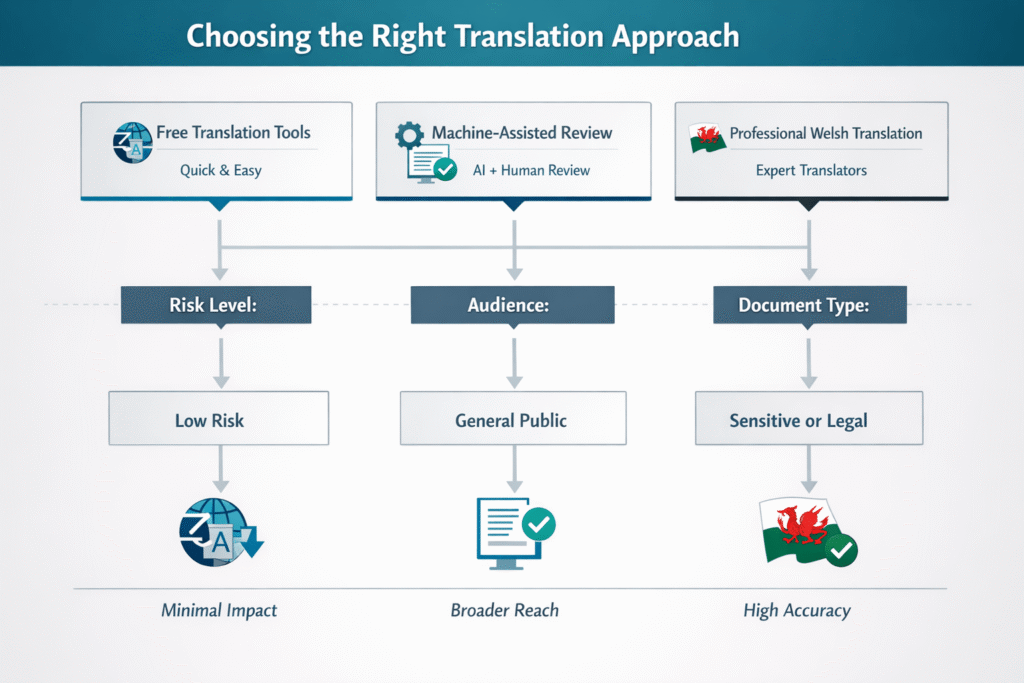
Here is the simplest framework:
Level 1: quick lookup
Best for:
- casual messages
- greetings
- learning basic vocabulary
- checking a single word or phrase
Good tools:
- bilingual dictionaries
- terminology databases
- Welsh learning resources
Level 2: machine-assisted draft
Best for:
- low-risk internal drafts
- idea generation
- first-pass website copy for later review
- checking alternative wording before editing
Use this when speed matters, but only if a human will still review the result.
Level 3: professional Welsh translation
Best for:
- website copy that represents your brand
- public sector or community-facing content
- legal, academic, financial, or medical documents
- marketing campaigns
- immigration, passport, or compliance paperwork
- any content where acceptance, trust, or nuance matters
If you need a document people can rely on, skip guesswork. Upload your file and get a professional recommendation before you submit anything.
Common Welsh phrases you can use right away
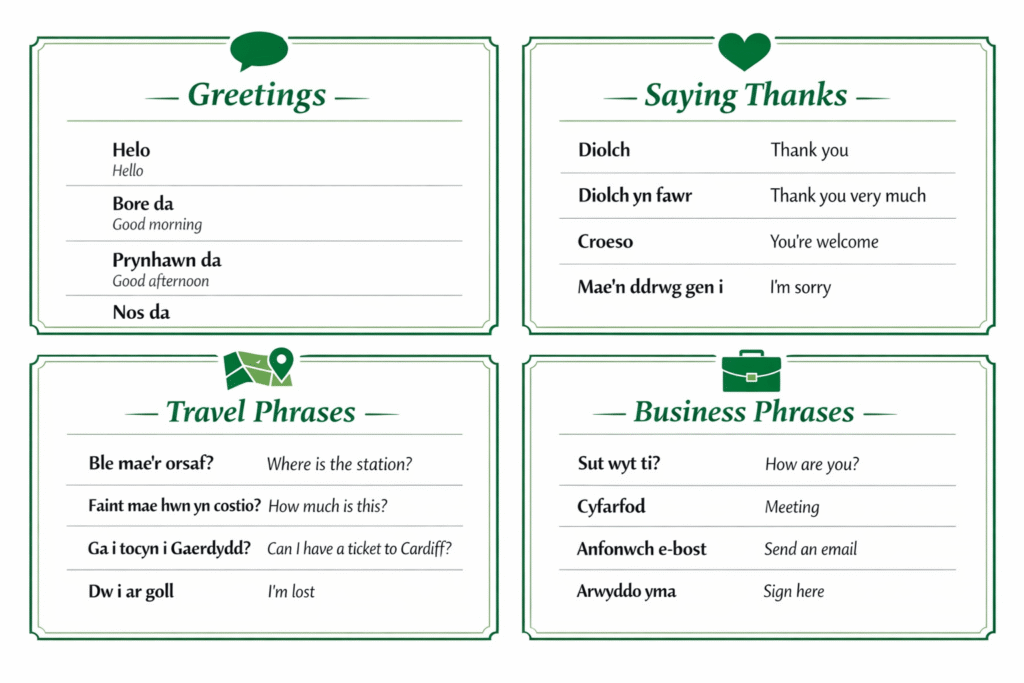
Below are some practical phrases that people often want when they search translate in to Welsh, translate Welsh, or Welsh translation into English.
Everyday greetings and polite phrases
| English | Welsh | Notes |
| Hello | Helo / Shwmae | “Shwmae” is common and conversational |
| Good morning | Bore da | Safe, standard greeting |
| Good afternoon | Prynhawn da | Polite and neutral |
| Good evening | Noswaith dda | Useful in formal settings |
| Goodbye | Hwyl fawr | Friendly and common |
| Thank you | Diolch | One of the most useful essentials |
| Thank you very much | Diolch yn fawr | Stronger, warmer version |
| Please | Os gwelwch yn dda | Formal, widely accepted |
| You’re welcome | Croeso | Also used for “welcome” |
| Sorry | Sori / Mae’n ddrwg gen i | The longer form is more formal |
Useful conversation starters
| English | Welsh | Notes |
| How are you? | Sut wyt ti? | Informal singular |
| How are you? | Sut ydych chi? | Formal or plural |
| I’m fine | Dw i’n iawn | Natural everyday reply |
| What is your name? | Beth ydy eich enw chi? | Formal/polite |
| My name is… | Fy enw i yw… | Standard introduction |
| Nice to meet you | Braf cwrdd â chi | Formal and widely useful |
| Do you speak English? | Ydych chi’n siarad Saesneg? | Helpful for travel and service contexts |
| I’m learning Welsh | Dw i’n dysgu Cymraeg | Useful for beginners |
Travel and service phrases
| English | Welsh | Notes |
| Where is the station? | Lle mae’r orsaf? | Practical travel phrase |
| How much is this? | Faint ydy hwn? | Retail and everyday use |
| I need help | Dw i angen help | Simple and direct |
| Can you help me? | Allwch chi fy helpu i? | More polite/request-based |
| I would like… | Hoffwn i… | Good for restaurants and formal requests |
| Water | Dŵr | Useful standalone word |
| Toilet | Tŷ bach / toiled | Context and region can affect preference |
Work and website phrases
| English | Welsh | Notes |
| Contact us | Cysylltwch â ni | Common website CTA |
| Get a quote | Gofynnwch am bris | Better reviewed for commercial nuance |
| Upload your file | Uwchlwythwch eich ffeil | Strong candidate for professional review |
| Start your project | Dechreuwch eich prosiect | Useful for service pages |
| Learn more | Dysgwch fwy | Common navigation phrase |
These examples are useful starting points, but they are not a substitute for a full review when the copy is public-facing. A phrase can be technically understandable and still sound awkward, over-literal, or not quite right for the audience.
The biggest mistakes people make when they translate into Welsh
The most common Welsh translation problems are not dramatic errors. They are subtle ones that make the text feel off.
1. Translating word by word
This is the fastest path to unnatural Welsh. Good translation follows meaning first, not surface word order.
2. Ignoring formality
“Sut wyt ti?” and “Sut ydych chi?” both mean “How are you?” but they do not serve the same audience. One is informal. One is more respectful and broadly appropriate in professional settings.
3. Treating every synonym as interchangeable
English often allows broad synonym swapping. Welsh choices can be narrower, more context-specific, or register-sensitive.
4. Forgetting that buttons, labels, and headings need context too
Short UI strings are often mistranslated because they seem too small to matter. In reality, website labels, menus, and call-to-action buttons shape trust quickly.
5. Using a tool output without back-checking into English
A smart habit is to test the line in reverse. If your Welsh translation into English comes back with the wrong sense, your original Welsh probably needs work.
6. Assuming “understandable” means “publishable”
For internal notes, maybe. For public copy, legal use, or branded content, no.
How to improve Welsh translation accuracy
If you want better results without slowing everything down, use this checklist.
Start with purpose, not words
Ask what the sentence needs to do.
Is it meant to:
- greet
- reassure
- instruct
- persuade
- comply
- sound formal
- sound friendly
This one step instantly improves translation quality because the target line can be chosen for function, not just dictionary similarity.
Decide on audience and tone early
Before you translate in to Welsh, define who the reader is:
- a customer
- a local resident
- a public authority
- a university
- a legal reviewer
- a patient
- a website visitor
Tone decisions should happen before the translation, not after it.
Use reference tools for terms, not just generic translators
For higher-confidence Welsh wording, check:
- Welsh dictionaries
- official terminology databases
- recognised Welsh language resources
These are especially helpful for sector-specific wording, titles, policy language, and public-facing terminology.
Keep names, dates, numbers, and official fields consistent
This matters hugely in document translation. A single mismatch in a name spelling, date format, reference number, or qualification title can create delays and follow-up questions.
Review for natural flow, not just raw accuracy
Ask a second question after “Is it correct?”
Would a Welsh speaker actually write it this way?
That is often the difference between acceptable and excellent.
Use human review for anything public or permanent
If the text is going on a website, poster, brochure, contract, or official form, human review is usually the best-value step you can add.
Translate Welsh into English: why the reverse direction matters too
People often focus on English-to-Welsh translation, but Welsh translation into English has its own risks.
This matters when you are dealing with:
- certificates
- school documents
- local authority correspondence
- legal notices
- medical records
- historical or archive material
- bilingual forms where English must match the Welsh meaning precisely
The biggest issue in reverse translation is false confidence. A rough English rendering may sound fluent while quietly missing a legal, administrative, or cultural detail.
If the English version will be submitted, relied on, or signed off, the translation needs the same level of care as the original Welsh version.
When a free Welsh translator is good enough
A free tool can be perfectly useful when:
- you are exploring vocabulary
- you need a rough draft for yourself
- the text is short and low risk
- nobody is relying on it as a final version
- you are using it as a first step before human review
This is where quick lookup and speed matter more than polish.
For learners, this is often the right place to start. It helps build momentum.
When you should go professional
This is where people save time, stress, and rework.
Professional Welsh translation is the smarter choice when any of the following apply.
Official documents
If the document is being reviewed by an authority, institution, employer, court, or immigration team, professional handling is the safe route.
Examples include:
- birth, marriage, and divorce certificates
- passports and identity documents
- academic transcripts and diplomas
- court papers
- company records
- financial statements
- compliance paperwork
Public-facing business copy
If your audience sees it, your reputation is attached to it.
That includes:
- website pages
- brochures
- digital ads
- social posts
- app interfaces
- signage
- service emails
A weak Welsh line does more than look odd. It can make a brand feel careless.
Legal, medical, financial, or technical text
These fields do not forgive approximation. Accuracy, terminology, and consistency all matter at a higher level.
Content for Wales-based communities or public services
If you are communicating with Welsh-speaking audiences in an official, local, or public setting, natural and respectful wording matters just as much as literal accuracy.
Any project where revision costs more than getting it right first time
That includes tenders, campaigns, product launches, submissions, and bilingual materials that will be reused across teams.
A better way to choose: the risk test
If you are unsure whether to use a tool or a professional, use this quick test.
Go professional if the text is:
- official
- public
- regulated
- brand-sensitive
- long-term
- high-stakes
Stay self-service if it is:
- private
- temporary
- low-risk
- for learning only
- being reviewed later anyway
That one filter removes most of the confusion around welsh translate decisions.
What a professional Welsh translation service should help you with
A good provider does more than translate words.
They should help you:
- confirm the correct service level
- identify whether standard, certified, sworn, or notarised translation is needed
- preserve names, stamps, headings, and formatting where required
- deliver a version suitable for the real destination
- reduce the chance of rejection, confusion, or expensive edits later
If your translation is meant for official use, this matters even more. In many cases, the issue is not only language quality. It is whether the final document can be accepted and independently verified.
Why clients choose UK Certified Translation for higher-stakes work
When the outcome matters, clients are usually not looking for the cheapest possible line of text. They want a service that is clear, traceable, and built for real-world use.
UK Certified Translation supports individuals and organisations with certified, sworn, and notarised translations, along with interpreting and transcription support where needed.
What clients often value most:
- clear guidance on the correct service route
- support for official and time-sensitive submissions
- secure handling of documents
- practical turnaround expectations
- professional accountability
“I needed a notarised translation of my degree certificate for immigration, and UK Certified Translation made it so easy. Uploaded my file in minutes and got the signed PDF back the next day. Solid service.” — Emma B., Operations Manager
“Sent over a batch of legal documents for sworn translation. The team kept me updated at every step and delivered exactly what I needed. Pricing was given upfront.” — Maria L., Legal Executive
If you have a Welsh document, a bilingual requirement, or content that needs to be publication-ready, upload your file and get a clear next step.
Final word
The smartest approach to welsh translate is not choosing between speed and quality. It is choosing the right level of translation for the job.
Use quick tools for learning, testing, and low-risk wording.
Use professional help for anything official, public-facing, brand-sensitive, or high-stakes.
That is how you avoid awkward phrasing, reduce rework, and get a Welsh translation that actually does what you need it to do.
Need a reliable answer on your text or document? Upload your file, request a review, and get clear guidance on the fastest safe route.
FAQs
What is the best way to welsh translate short phrases?
For short everyday phrases, start with a recognised Welsh dictionary or terminology resource, then sense-check tone and audience. For public or branded copy, have a professional review the final wording before publication.
Can I use a free tool to translate into Welsh?
Yes, for low-risk content such as learning, rough drafts, or private notes. If the text is going on a website, sign, brochure, application, or official document, professional review is the safer option.
How do I check if my Welsh translation into English is accurate?
Check meaning, tone, names, dates, and context rather than word-for-word similarity. Reverse-checking the line, comparing terminology, and using a second human review are the best ways to catch hidden errors.
When do I need a professional Welsh translator?
You should use a professional Welsh translator for official documents, legal and medical content, customer-facing copy, and any project where mistakes could cause rejection, confusion, or reputational damage.
Is certified translation different from normal Welsh translation?
Yes. Standard translation focuses on language accuracy. Certified translation is prepared for official use and is delivered in a format that supports verification and submission requirements.
Can UK Certified Translation help with Welsh and English documents for official use?
Yes. If your document needs to be translated for submission, review, or formal use, the team can confirm the right service level and advise whether certified, sworn, or notarised handling is needed.