



London is one of the strongest language-services markets in the UK, but most pages ranking for translation jobs london are job-board listings, not practical career guides. If you’re trying to figure out what roles actually exist, what the pay signals mean, and how to break in, this guide gives you the missing context.
Whether you’re searching for jobs london translation, looking for translation jobs in london uk, or planning a move from freelance work into an in-house role, the biggest mistake is treating “translation” as one job title. In London, the market is broader: translation, interpreting, localisation, project coordination, language QA, transcription, and sector-specific document work all overlap.
This guide helps you read the market properly, choose the right route, and move faster.
Why London Is Different From the Rest of the UK
London has a concentrated mix of employers and clients that creates more language demand than most UK regions:
- International law firms and immigration practices
- NHS providers and healthcare contractors
- Local councils and public service providers
- Global finance, media, and tech firms
- Universities and research institutions
- Recruitment agencies hiring cross-border talent
- Language service providers (LSPs) managing multilingual projects
That mix matters because it creates different entry routes and different pay models. Some jobs are salaried in-house roles. Others are part-time interpreter assignments, remote bookings, agency shifts, or freelance translation by the word.
If you only look at one job board, you’ll miss half the market.
The Main Types of Translation Jobs in London
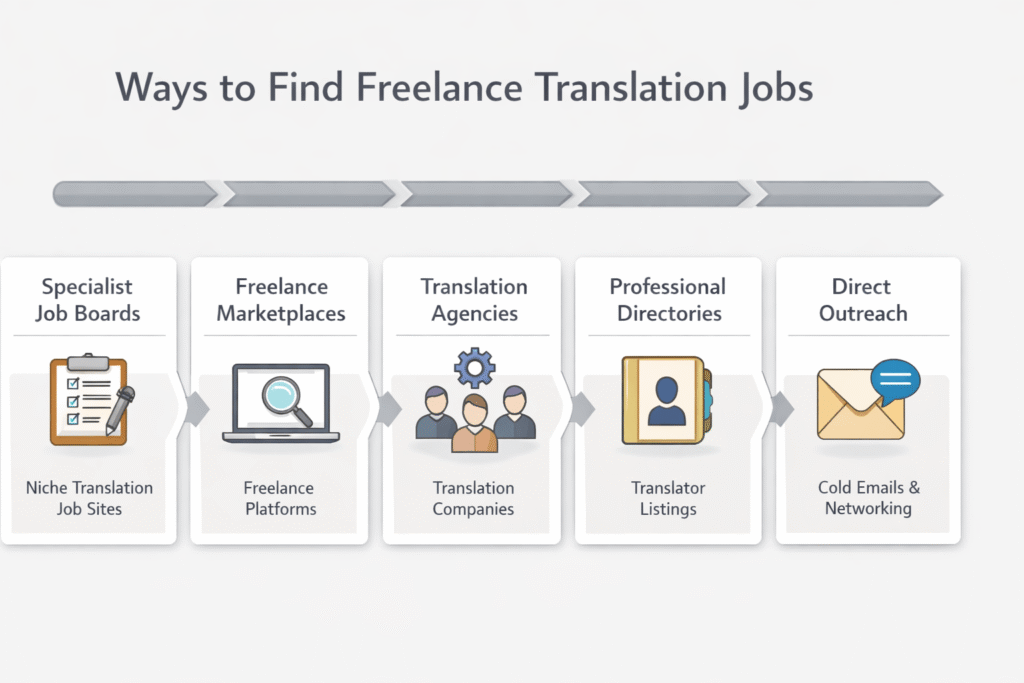
1) In-house Translator
These are salaried roles inside a company, agency, or institution. You’ll usually work on recurring content and collaborate with legal, marketing, or operations teams.
Typical responsibilities
- Translating business or legal documents
- Editing and reviewing translations
- Maintaining terminology and style consistency
- Working with CAT tools and translation memories
- Supporting multilingual content workflows
Who hires for this
- Investment firms
- Global brands
- Corporate comms teams
- Language agencies
- Public-sector suppliers
Good fit if you want
- Stable income
- Predictable workflow
- Team-based work
- Career progression into QA or localisation management
2) Public Service Interpreter (London demand is strong)
A lot of “translation jobs” searches in London actually surface interpreting roles. That’s because employers and agencies often use the terms loosely in job titles and ads.
Public service interpreters work in:
- Healthcare appointments
- Social services
- Local authority meetings
- Police or legal settings
- Community support services
This route is often one of the fastest ways into paid language work in London, especially for in-demand community languages.
3) Freelance Document Translator
This is the most common long-term path, but not always the easiest first step.
Typical work
- Certificates and official documents
- Legal contracts and witness statements
- HR and onboarding packs
- Academic records
- Marketing or website content
- Technical manuals
How pay usually works
- Per word
- Per page
- Per hour (editing/revision)
- Minimum job fee
- Rush surcharge
- Specialist premium (legal/medical/technical)
If you want to build a document-heavy portfolio, it helps to understand how certified-document workflows operate. You’ll learn a lot by studying real-world service categories like certified translation services,sworn translation services, and notarised translation services.
4) Localisation Project Coordinator / Project Manager
This is one of the best “non-obvious” entry routes into London language work.
You may not translate much at first, but you learn:
- Client communication
- File prep and QA
- Vendor management
- Scheduling and quoting
- MTPE workflows (machine translation post-editing)
- Multilingual delivery standards
It’s a strong route if you’re bilingual but still building translation confidence.
Career path
Project Coordinator → Project Manager → Senior PM / Account Manager / Operations
5) Transcreation, Marketing Localisation, and Language QA
These roles are common in London’s media, retail, and tech sectors.
They often sit under titles like:
- Localisation Specialist
- Language QA Tester
- Content Localisation Manager
- Multilingual Copy Editor
- Transcreation Linguist
These jobs usually pay more than general translation because they require:
- Tone control
- Brand sensitivity
- Market adaptation
- Copywriting instincts
- Fast revision cycles
6) Adjacent Roles That Lead Into Translation Careers
If you need a practical first step, don’t ignore adjacent work. In London, these roles often convert into core language careers:
- Bilingual administrator
- Immigration caseworker support
- Recruitment language support
- Subtitling assistant
- Interpreting services coordinator
- Transcription services assistant
- Customer support for multilingual accounts
These roles help you build experience in confidentiality, terminology, and turnaround discipline.
Pay Signals in London: What Job Ads Are Really Telling You
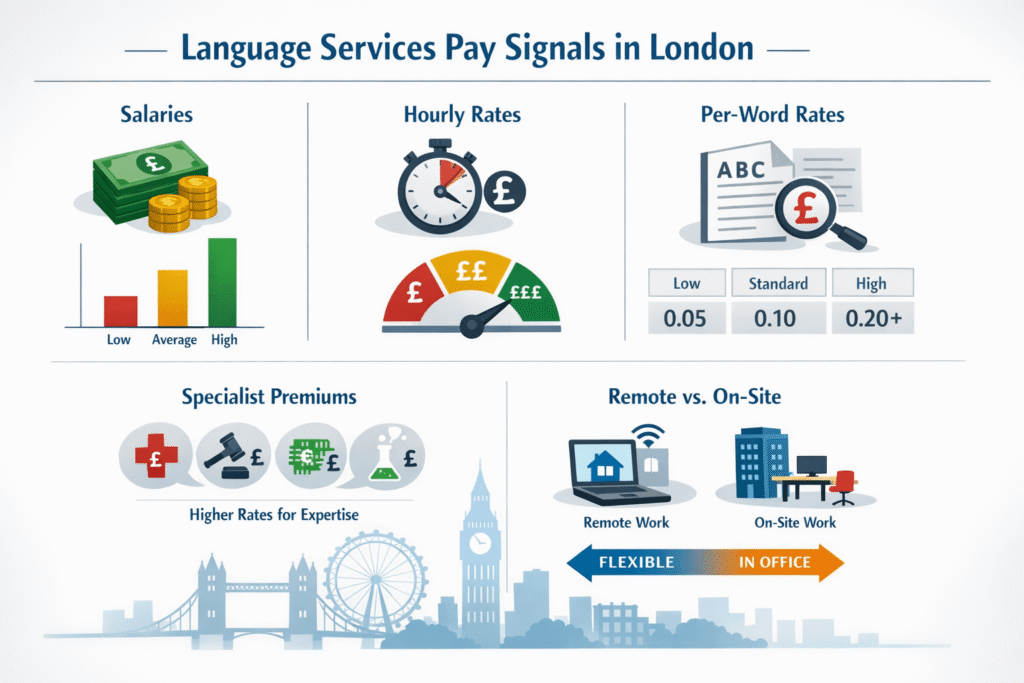
The salary number in a London listing is only part of the picture. You need to read the pay signal, not just the headline figure.
The 5 pay signals that matter most
1) Pay model
Different roles use different pricing models:
- Salaried (common for in-house and localisation roles)
- Hourly (common for interpreting)
- Per word / per page (common for freelance translation)
- Day rate (conference or specialist interpreting)
- Assignment minimums (agencies, courts, healthcare bookings)
2) Specialism premium
General translation pays less than:
- Legal
- Medical
- Financial
- Technical
- Regulatory/compliance
- Public service interpreting with verified qualifications
3) Language-pair supply and demand
Rates often rise for:
- Lower-supply languages
- Urgent availability
- Evening/weekend assignments
- Short-notice bookings
- Rare specialist combinations
4) Clearance and checks
Some London roles pay more because they require:
- DBS checks
- Security screening
- Public-sector onboarding
- Proven experience in sensitive settings
5) “Hidden scope”
A job ad may say “translator,” but the role may include:
- Proofreading
- QA
- Client emails
- Formatting and DTP fixes
- Glossary work
- Terminology maintenance
If the scope is wider than pure translation, the rate should be higher.
London Pay Snapshot (How to Read It Properly)
Here’s the useful way to interpret London pay signals:
Salaried in-house translator roles
In-house translator salaries in London tend to sit in a broad band, with stronger packages in finance, legal, and specialist sectors.
Typical pattern
- Entry / junior: lower salary bands, admin-heavy, mixed duties
- Mid-level: stronger salary, consistent translation output, QA responsibilities
- Senior / specialist: higher salary plus domain expertise (finance/legal/tech)
Job-board signal (London)
A practical benchmark from major job boards is that London translator roles often cluster around the high-£20k to low-£50k range depending on specialism, with average figures landing around the high-£30k range.
Interpreting roles (London)
Interpreting roles are frequently advertised as:
- Hourly rates
- Assignment-based work
- Part-time / self-employed structures
- Remote and on-site combinations
This means two interpreters can both be “earning well” but have very different monthly income depending on availability, sector, and booking volume.
A Better Way to Estimate Your Real Earnings
Instead of asking, “What does a translator make in London?”, ask:
- What kind of role am I targeting?
- In-house translator
- Public service interpreter
- Freelance document translator
- Localisation PM
- How many paid hours/words per week are realistic?
- Not your ideal week
- Your likely booked week
- What % of work is specialist vs general?
- Specialist work lifts averages
- General work fills schedule
- How much unpaid time is built into the role?
- Admin
- QA
- Travel
- Platform onboarding
- Test translations
- What’s my minimum accepted job fee?
- This protects you from low-value jobs that consume half a day
Entry Routes: How People Actually Get Into Translation Work in London
Most people do not follow the same route. London employers hire from multiple pathways.
Route A: Degree + Portfolio + Agency Tests
This is the classic route.
Best for
- Language graduates
- People switching from teaching or international studies
- Bilingual professionals with strong writing skills
What to do
- Build 3–5 portfolio samples (different domains)
- Learn CAT tools and QA basics
- Pass agency tests
- Start with revision, overflow, and lower-risk projects
- Specialise within 6–12 months
Tip
Your writing quality in English matters as much as your second language.
Route B: CIOL Qualification Track (Strong for Document Translation)
If you want a structured route into translation, the CIOL track is one of the clearest:
- CertTrans (good early-career benchmark)
- DipTrans (widely recognised advanced qualification)
This route is especially useful if you want:
- Credibility with agencies
- Stronger client trust
- A qualification-led pathway into specialist translation
It also helps if you plan to work in certified document translation, where quality assurance and accuracy are non-negotiable.
Route C: Community Interpreting → DPSI → Public Service Work
This is one of the most practical London entry routes for interpreters.
Typical progression
- Community-based experience (paid or voluntary)
- Interpreting training / course
- Public service specialisation
- DPSI pathway (especially law-focused routes)
- Agency onboarding and repeat assignments
- Registration route where relevant (public service credibility matters)
If you’re bilingual and already active in your community, this can be a faster route than trying to start with high-end conference interpreting.
Route D: Start in an Agency Operations Role
This route is underrated and highly effective.
Start in:
- Project support
- Vendor management
- QA coordination
- Client services for an LSP
Then move into:
- Review and QA
- Translation production
- Specialised project handling
- Senior PM / account growth
This route gives you commercial awareness fast — and that matters in London.
The Skills London Employers Actually Screen For
Language fluency is only the entry ticket. Employers and agencies screen hard for reliability and workflow skills.
Core skills they look for
- Excellent written English
- Accuracy under deadline
- Terminology discipline
- Research ability
- Confidentiality awareness
- Clear communication
- File handling competence
- CAT-tool familiarity
- Cultural judgment
- Professional tone with clients
For interpreters, they also look for
- Listening accuracy
- Composure under pressure
- Memory and note-taking
- Neutral delivery
- Confidence in healthcare/legal/community settings
A 90-Day Plan to Start Getting Translation Jobs in London
Days 1–15: Build your foundation
- Pick one target route (translation / interpreting / localisation)
- Choose one specialism to explore (legal, medical, business, public service)
- Create a simple professional CV
- Build a one-page linguist profile
- Prepare 2 portfolio samples (before/after style)
Days 16–30: Get visible
- Apply to London-focused agencies and language service providers
- Create profiles on reputable professional directories
- Start tracking applications and test outcomes
- Prepare a clear rate sheet (with minimum fee and turnaround rules)
Days 31–60: Improve your credibility
- Take a relevant qualification step (course, exam prep, or CPD)
- Build a terminology sheet for your chosen niche
- Add 2 more portfolio samples
- Get feedback from a reviewer or senior linguist
Days 61–90: Start specialising
- Focus applications on one vertical (e.g., legal, healthcare, finance)
- Tighten your CV and portfolio around that vertical
- Raise your minimum standards (scope, timelines, quality)
- Aim for repeat clients or repeat agency bookings
This is where momentum starts.
Common Mistakes That Slow Down New Linguists in London
1) Applying to everything called “translator”
Many listings are actually interpreting, admin, or multilingual support roles. Read the tasks.
2) Quoting rates without a minimum fee
London jobs often include admin and formatting. Minimum fees protect your time.
3) Ignoring specialist terminology
General bilingual ability won’t carry you through legal or medical work.
4) Using one generic CV
Your CV should match the route:
- Translator CV
- Interpreter CV
- Localisation/PM CV
5) Skipping professional credibility signals
Clients and agencies trust signals like:
- Professional qualification pathways
- Clear processes
- Confidential handling
- Quality checks
- Consistent file delivery standards
What a Strong London Translation CV Looks Like
A strong CV for London language roles is usually skills-first and evidence-based.
Include:
- Language pairs (clear directionality)
- Specialisms (only real ones)
- Tools (CAT, QA, subtitling if relevant)
- Document types handled
- Sector experience
- Turnaround examples
- Interpreting settings (if applicable)
- Qualifications / exams in progress
- DBS or relevant checks (where appropriate)
Add a mini proof section
A simple section like this helps:
Selected language work
- Translated HR onboarding packs (employment contracts, policies, ID documents)
- Interpreted remote healthcare appointments
- Built bilingual glossary for recurring legal terms
- Completed urgent same-day certified document sets
Even if you’re early-stage, this format reads better than vague statements.
London Career Paths You Can Grow Into
Translation careers in London don’t stop at “translator.”
You can grow into:
- Senior Translator
- Reviser / Reviewer
- Language Lead
- Terminologist
- Localisation Project Manager
- Vendor Manager
- Multilingual Content Manager
- Public Service Interpreting Specialist
- Legal or Medical Language Specialist
- LSP Operations Manager
That progression is one reason London remains attractive even when entry-level competition feels high.
Practical Examples: How People Break In
Example 1: Language graduate → agency translator
A graduate with Arabic and English builds three portfolio samples (legal, business, education), passes two agency tests, and starts with overflow document work. Within months, they narrow into legal and immigration content and raise rates.
Example 2: Community bilingual speaker → interpreter
A bilingual speaker starts with community interpreting exposure, completes structured training, and begins agency assignments in healthcare and local services. They then move toward formal public service interpreting qualifications.
Example 3: Admin professional → localisation PM
A multilingual admin joins an LSP in project support, learns quoting and QA, and progresses into localisation project management without starting as a full-time translator.
Where UK Certified Translation Fits Into This Topic
If you’re learning the market, it helps to study how real document workflows are structured — especially for compliance-heavy work.
For example:
- Certified translation services show how official document jobs are packaged and quality-checked
- Sworn translation services show how country-specific requirements affect workflow
- Notarised translation services show how legalisation steps change turnaround and pricing
- Interpreting services and transcription services show how adjacent services create extra job routes
If you’re an employer, recruiter, or HR team hiring internationally and need compliant language support for onboarding packs, visa documents, or interview support, UK Certified Translation can help you handle the document side quickly and clearly through the relevant service pages above.
Final Takeaway
The London market rewards linguists who read the job title and the commercial model behind it.
If you want better results faster:
- Pick one route first (translation, interpreting, or localisation)
- Build proof, not just a CV
- Learn the pay model for your target role
- Use qualifications strategically
- Specialise early enough to stand out
That’s how you turn “translation jobs london” searches into actual work.
FAQ Section
Are there translation jobs in London without a degree?
Yes. Some London roles value language proficiency, writing quality, and proven experience more than a degree. For translation, a portfolio and agency tests can open doors. For interpreting, community experience plus training can be a practical entry route. Qualifications still help, especially as you move into specialist or higher-paid work.
What is the difference between translation jobs and interpreting jobs in London?
Translation is written language work. Interpreting is spoken language work (in person, phone, or video). Many job ads use the terms loosely, so always check the duties. If the role mentions appointments, call-outs, or live meetings, it is usually interpreting.
What do translation jobs in London UK usually pay?
Pay varies by role type, language pair, specialism, and contract model. In-house translator roles typically show annual salary bands, while interpreting roles are often hourly or assignment-based. Specialist legal, medical, and finance work usually pays more than general content work.
How can I start getting jobs London translation agencies will trust me with?
Start with a clear route: build a focused CV, create portfolio samples, learn workflow tools, and apply for agency tests. A small but strong portfolio in one niche (such as legal or healthcare) usually performs better than a general portfolio with no specialism.
Do I need DipTrans or DPSI for translation jobs in London?
Not always, but they can significantly improve credibility and access to better work. DipTrans is highly valued for translation roles, while DPSI is especially relevant for public service interpreting routes. They are often the difference between “getting occasional work” and “being shortlisted consistently.”
Can I work remotely and still target translation jobs in London?
Yes. Many London agencies and employers now mix remote, hybrid, and on-site work. This is especially common in document translation and some interpreting assignments. Just be clear in your applications about your availability, location, and whether you can travel for in-person bookings.