


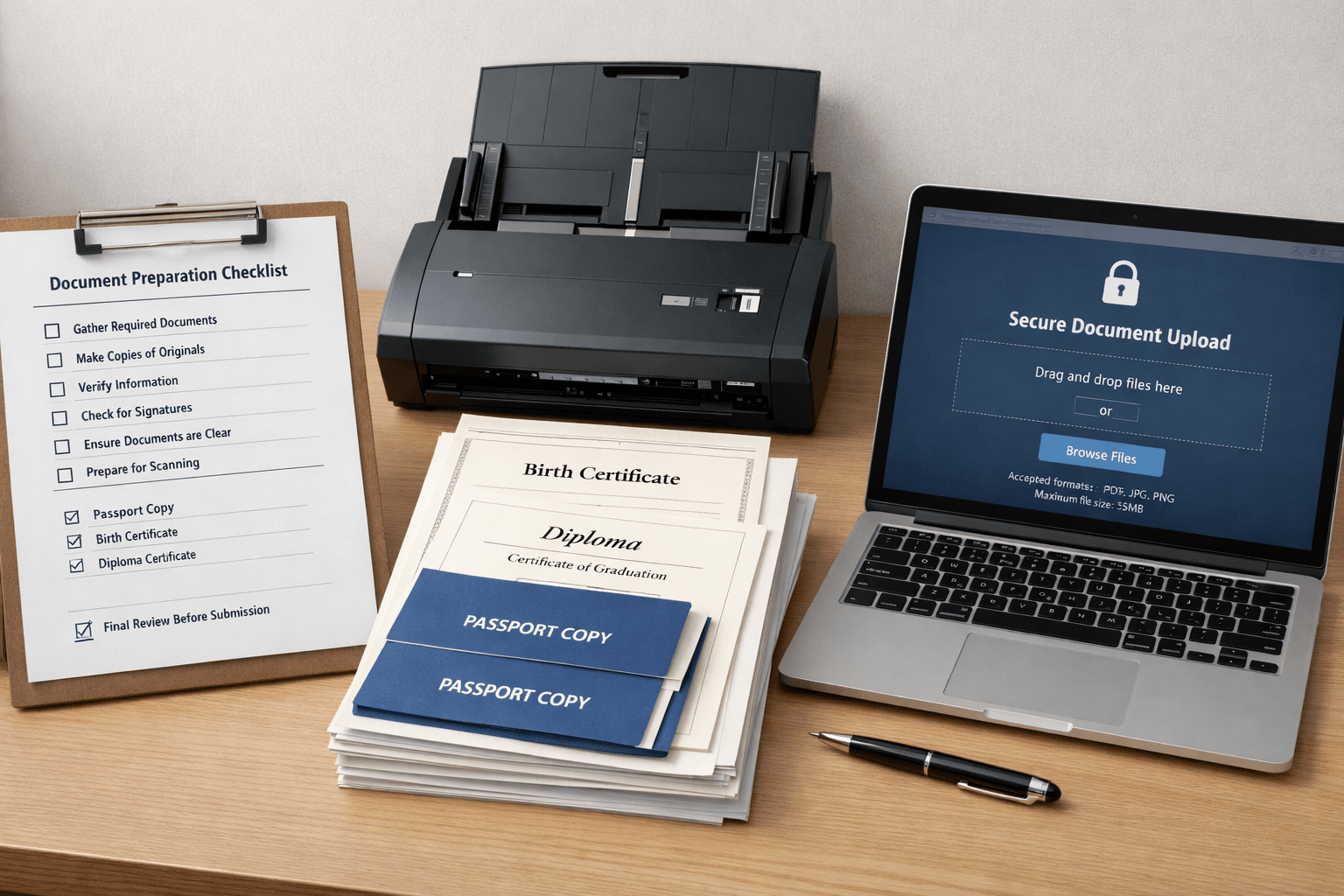
If you’re getting documents for translation for a visa, passport, university, court, or overseas authority, the biggest mistakes usually happen before the translator starts. Missing pages, blurry scans, inconsistent names, and the wrong certification level can all cause delays, extra charges, or rejected submissions.
This guide gives you a practical checklist for translating documents properly, plus a clear breakdown of what affects cost so you can budget accurately and avoid unnecessary upgrades.
If you want a fixed quote based on your exact documents, the fastest route is to upload clear scans and get the service level confirmed before you pay.
Start with one question: who will receive the translation?
Before sending anything, identify the receiving body and the purpose of the submission.
Examples:
- UK visa or Home Office submission
- HM Passport Office / passport-related application
- USCIS immigration filing
- WES credential evaluation
- University admissions office
- Court, solicitor, notary, or overseas authority
This matters because document translation certification requirements are not the same everywhere.
A good rule:
- Certified translation is often enough for UK official use
- Sworn translation may be needed for certain court/legal systems
- Notarised translation is only needed when the receiving authority explicitly asks for notarisation (or legalisation/apostille)
Send this to your translator in your first message:
- Where the translation will be submitted
- What type of document it is
- Whether the authority asked for certified, sworn, or notarised
- Your deadline
- Whether you need PDF only or printed copy too
The complete checklist for preparing documents for translation
Use this before requesting a quote. It saves time, reduces revisions, and makes pricing more accurate.
1) Make sure the document is complete
Do not send only the “main page” if the back page, stamp page, notes page, or annex is part of the original.
Include:
- Front and back pages
- Stamps and seals
- Handwritten notes
- Marginal notes
- Attached pages
- Legends / grading keys (for academic documents)
Incomplete bundles are one of the top reasons documents translation projects get delayed.
2) Check image quality before you upload

For official submissions, reviewers compare the translation against the original. If the original is blurry, the translation can be questioned even if the language work is accurate.
Minimum quality checklist
- Text is readable at 100% zoom
- No cut-off edges
- No glare on laminated documents
- No fingers covering text or stamps
- All corners visible
- Straight scan/photo (not skewed)
- Color scan preferred for stamped/sealed documents
If your scan is poor, re-scan it now. It is faster than paying for a reissue later.
3) Keep names exactly as they should appear in the translated file
Name mismatches are a common source of rejection or follow-up questions.
Before you send your file, note:
- Passport spelling of all names
- Any previous spellings / aliases (if relevant)
- Date format preference (DD/MM/YYYY vs MM/DD/YYYY)
- Whether the authority expects transliteration conventions
This is especially important for:
- Birth and marriage certificates
- Immigration bundles
- Academic transcripts and diplomas
- Legal affidavits
4) Confirm the target language and variant
“Spanish” or “Arabic” is sometimes not enough for official or business use.
Specify:
- Source language
- Target language
- Regional variant (if relevant)
- Whether English UK spelling is required
Examples:
- Arabic → English (UK)
- Spanish (LatAm) → English (UK)
- Russian → English (for UK visa application)
5) Tell the translator the exact submission purpose
A translator can prepare the same source file in different ways depending on where it is going.
For example:
- Visa/immigration: strong focus on completeness, names, stamps, and certification wording
- University/WES: exact word-for-word translation and table/grade alignment
- Court/legal use abroad: may require notarisation or a sworn format
- Corporate/compliance: may require stamped PDF + printed copy + reference number
The clearer your purpose, the fewer revisions you’ll need.
6) Decide the right service level before ordering

This is where many people overspend.
Certified translation
Usually the standard option for UK official submissions and many institutions. It includes the translation plus a signed certification statement.
Sworn translation
Used where a legal system requires a sworn/authorised translator format.
Notarised translation
Adds a notary step. Only order this if the authority explicitly requires notarisation (or apostille/legalisation).
Important: “More expensive” does not mean “more acceptable.” If the authority asks for certified only, notarisation may add cost and time with no benefit.
7) Ask what is included in the quote
Not all quotes include the same deliverables.
Ask whether the price includes:
- Full translation of all visible text
- Stamps/seals/handwritten notes
- Formatting to mirror the original layout
- Certification statement
- Signature/date/contact details on the certificate
- QA/review stage
- Digital PDF delivery
- Printed copy (if needed)
- Reissue policy for minor authority requests
This step prevents “cheap” quotes from becoming expensive later.
8) Finalise the source document before translation starts
If you’re translating a business, legal, or technical file, avoid sending drafts that are still being edited.
Late changes cause:
- Re-translation costs
- Inconsistent wording
- Missed deadlines
- Version confusion
For official personal documents (birth certificate, diploma, passport copy), this is less about editing and more about ensuring you have the final, complete version.
9) Organise multi-document bundles properly
If you’re sending several files (for example, passport + birth certificate + marriage certificate), label them clearly.
Use file names like:
- 01-Passport.pdf
- 02-Birth-Certificate.pdf
- 03-Marriage-Certificate.pdf
Add a short note explaining:
- Which are mandatory
- Which are supporting
- Which names must match exactly across the bundle
This helps the translator maintain consistency across all documents.
10) Flag anything unusual upfront
Tell the translator if your documents contain:
- Handwriting
- Mixed languages on one page
- Old stamps or faded seals
- Damaged sections
- Non-Gregorian dates
- Multiple people with similar names
- Court references or legal citations
These are all manageable, but they affect turnaround and quote accuracy.
11) Ask for a sample certification format if the case is high-stakes
For immigration, passport, university, and legal submissions, request a sample of the certification statement layout before you pay.
A proper document translation certification page should clearly include:
- True and accurate translation statement
- Source and target language
- Translator/agency name
- Signature
- Date
- Contact details
This simple check can prevent last-minute rework.
12) Confirm delivery format before work begins
Some authorities accept a signed PDF. Others want a posted hard copy.
Ask:
- Is PDF acceptable?
- Do you need wet-ink signature?
- Do you need stamp/reference number?
- Do you need courier delivery?
- Do you need notarisation/apostille after translation?
Do this before translation starts, not at the end.
What a complete translation pack should look like
When clients think about translating documents, they often focus only on the translated text. For official use, the finished pack matters just as much.
A clean, acceptance-ready pack usually includes:
- The source document copy (where needed for reference)
- The translated document (complete and legible)
- The certification page (signed and dated)
For academic and official records, completeness means:
- All visible text translated
- Stamps and seals identified
- Handwritten notes included
- Tables and labels preserved clearly
- No “summarised” content
That’s the difference between a document that gets processed and one that gets bounced back.
Documents translation costs: what affects the quote?
There isn’t one universal price because different files require different levels of work. But pricing becomes predictable once you know the main drivers.
The 5 biggest cost drivers
1) Length and pricing model (per page vs per word)
Short personal records are often priced per page.
Longer legal, academic, or business files are often priced per word.
2) Language pair
Some language pairs are easier to source quickly than others, which affects cost and turnaround.
3) Complexity
These increase cost:
- Dense legal wording
- Technical terminology
- Complex tables
- Handwriting
- Poor scan quality
- Multi-document consistency checks
4) Turnaround speed
Express and same-day work usually costs more because it needs priority scheduling and faster QA.
5) Service level and add-ons
Certification, notarisation, apostille/legalisation, hard-copy printing, and courier delivery are usually separate cost components.
Illustrative UK budgeting examples
These examples are for planning only. Your fixed quote should always be based on the actual file, language pair, and deadline.
Example A: One-page personal certificate (standard)
- Typical pricing model: per page
- Usually includes: translation + certification statement + PDF
- Best for: birth/marriage certificates, basic civil records
Example B: Multi-document visa bundle (urgent)
- Typical pricing model: per page (bundle pricing may apply)
- Cost usually increases because of:
- multiple files
- name consistency checks
- faster turnaround
- formatting and stamps
Example C: Academic transcript + diploma for evaluation
- Typical pricing model: per page or per word (depends on layout)
- Cost usually increases if:
- transcript tables are dense
- grading scales/legends are included
- multiple pages must align exactly
Example D: Legal/court documents for overseas use
- Typical pricing model: per word + formatting + certification
- Additional costs may apply for:
- notarisation
- apostille/legalisation
- printed copies/courier
How to reduce cost without increasing risk
If you want cheaper documents translation without sacrificing acceptance, do this:
- Send high-quality scans the first time
- Confirm the exact service level (certified vs notarised)
- Finalise your documents before ordering
- Bundle documents in one request
- Give a realistic deadline
- Tell the translator the destination authority upfront
What not to do:
- Order notarisation “just in case”
- Send incomplete pages
- Request same-day delivery for a non-urgent case
- Hide the purpose (visa, WES, court, etc.)
A quick checklist by submission type
UK visa / Home Office-style submissions
Focus on:
- Complete document bundle
- Clear scans
- Full translation (no omissions)
- Certification statement with translator details
- Matching names across all files
Best next step: Upload your files and request a fixed quote with the submission purpose included.
Passport-related submissions
Focus on:
- Whether the issue is a translated supporting document or a translated passport copy
- Exact name matching
- Date formatting consistency
- PDF vs hard-copy requirement
Best next step: Send the passport page(s) and supporting documents together so spelling stays consistent across the pack.
WES / academic credential evaluations
Focus on:
- Official versions of transcripts and diplomas
- Transcript legends / grading scales
- Exact, word-for-word translation
- Clear table alignment
- Professional third-party translation (not self-translation)
Best next step: Submit the same official version to your translator that matches the documents being reviewed.
Legal / overseas authority use
Focus on:
- Certified vs sworn vs notarised requirement
- Whether apostille/legalisation is needed
- Page-by-page completeness
- Names, references, and dates
- Hard-copy delivery requirements
Best next step: Ask the receiving authority for the exact wording: “certified,” “sworn,” “notarised,” or “legalised.”
Common mistakes that cause delays (and how to avoid them)
Mistake 1: Sending screenshots instead of full scans
Fix: Send complete PDFs or clear full-page photos.
Mistake 2: Translating only the “important parts”
Fix: Official submissions usually require a full translation of all visible text.
Mistake 3: Ordering notarisation without being asked
Fix: Confirm the required service level first.
Mistake 4: Ignoring stamps, notes, and back pages
Fix: Include everything in the original document set.
Mistake 5: Using different spelling for the same name across documents
Fix: Provide the passport spelling and ask for consistency across the bundle.
Mistake 6: Waiting until the deadline to ask for a quote
Fix: Get the quote and requirements checked early—even if you plan to submit later.
The 10-minute pre-submission check
Before you send your documents for translation, run this final check:
- I know where the translation will be submitted
- I know whether I need certified, sworn, or notarised translation
- I included all pages, stamps, and notes
- My scans are clear and complete
- I shared the correct name spellings
- I confirmed target language/variant
- I gave the deadline and delivery format (PDF/hard copy)
- I asked what is included in the quote
- I requested a sample certification format (if needed)
- I bundled and labelled files clearly
If all 10 are checked, your project is already in much better shape than most first-time submissions.
Ready to send your documents?
If you want a clean, acceptance-ready translation pack without back-and-forth, send your files with:
- submission purpose
- deadline
- destination country/authority
- required service level (if known)
You’ll get a clearer quote, faster turnaround, and fewer surprises.
Upload your file and request a fixed quote today.
Need help deciding the right service level? Contact us and we’ll confirm whether you need certified, sworn, or notarised translation before you pay.
“Their certified translation was flawless and accepted immediately by the Home Office.” — Rachel Bennett, Immigration Consultant
“Fast, reliable and fully compliant. Exactly what our university needed.” — Dr. Stephen Clarke, Admissions Officer
“Transparent pricing and clear communication from start to finish.” — Mark Evans, Corporate Secretary
FAQs
What does “documents for translation” usually include?
“Documents for translation” can include personal records (birth, marriage, passport pages), academic documents (transcripts, diplomas), legal documents (contracts, affidavits), and business documents. For official use, send the full document set, including stamps, notes, and back pages.
Can I translate my own documents for official use?
For many official submissions, self-translation is risky or not accepted. A professional third-party translation is usually the safer option, especially for immigration, university, or legal submissions.
What is document translation certification?
Document translation certification is the signed statement attached to a translation confirming it is a true and accurate translation of the original. It typically includes the translator’s or agency’s name, signature, date, and contact details.
How much does translating documents cost?
The cost of translating documents depends on length, language pair, complexity, turnaround time, and whether you need certification, notarisation, or hard-copy delivery. Short personal documents are often priced per page, while longer files are often priced per word.
Do I need notarisation or is certified translation enough?
Only order notarisation if the receiving authority specifically asks for it. In many UK cases, certified translation is enough. Notarisation is usually for overseas legal or embassy-related submissions.
What file format should I send for documents translation?
A clear PDF is usually best. High-quality JPEGs can also work if all text is legible and the whole page is visible. Avoid cropped screenshots and low-resolution photos.