


If you are submitting documents to a foreign court, embassy, university, or government office, you may be told you need a sworn translation. That phrase causes a lot of confusion because it does not mean the same thing in every country.
In some countries, a sworn translator is an officially appointed professional who can produce translations with legal standing. In other countries, the authority asks for a certified translation instead. In some cases, you may also need notarisation or an apostille on top of the translation.
The fastest way to avoid rejection is simple: match the translation format to the destination authority, not just the country name or a random online checklist.
If you want a quick answer on what your submission needs, send us the document type and destination country, and we’ll help you choose the right route before you order.
What sworn translation means in different countries
Sworn translation does not have one universal international meaning. In different countries, it can refer to different legal formats, translator statuses, and acceptance rules. That is why the same document may need a sworn translation in one country, a certified translation in another, and a certified translation plus notarisation or apostille in a third.
The simplest answer
In civil-law countries such as Spain, France, Germany, Poland, and often Italy, sworn translation usually refers to an official translation linked to a court, ministry, or state-recognised translator system.
In the UK, USA, Canada, and Australia, there is usually no general sworn translator system in the same sense. Instead, the authority often asks for a certified translation, and sometimes also asks for notarisation or legalisation depending on where the documents will be used.
This means “sworn translation” is not a format you should order by name alone. It is a country-specific legal requirement, and the correct route depends on the receiving authority.
Quick country-by-country guide
Spain
A sworn translation usually means a translation by an officially recognised sworn translator/interpreter. For many official submissions in Spain, this is the standard route.
France
The English phrase “sworn translation” is often used loosely, but in practice the relevant concept is usually a court-approved expert translator for official use.
Germany
Germany uses officially authorised, appointed, or sworn translators and interpreters, and the exact expectations can vary by federal state and authority.
Poland
Poland has a formal sworn translator system with official listings. If an office asks for a sworn translation, the translator usually needs to be in the appropriate register.
Italy
In Italy, people often mean a translation that is formally sworn for official use. The process may involve a sworn declaration and court-related procedure depending on how and where the document will be used.
United Kingdom
For many UK submissions, the usual requirement is a certified translation, not a sworn translation. If the document is leaving the UK for a foreign authority, the destination country’s rules matter more than UK terminology.
United States, Canada, and Australia
These countries more commonly use certified translations or authority-specific approved formats rather than a general sworn translator system. If the document is for overseas use, foreign sworn translation rules may still apply.
What this means in practice
If someone asks, “What does sworn translation mean in different countries?”, the most accurate answer is this: it means an officially recognised translation, but the legal mechanism behind that recognition changes from country to country. Sometimes the translator is sworn before a court, sometimes appointed by a ministry, sometimes listed in a formal register, and sometimes there is no sworn system at all and a certified translation is the accepted equivalent.
If you are comparing routes for UK-origin documents, see our certified translation services UK, sworn translation services UK, and notarised translation services pages.
What a sworn translation means
A sworn translation is an official translation produced by a translator who has been authorised, appointed, or sworn before a court or state authority (depending on the country).
The exact title changes by country, but the core idea is the same:
- the translator has a recognised legal status
- the translation is issued in an official format
- the translator certifies the accuracy of the translation
- authorities can verify or recognise the translator’s status
In practice, a sworn translation often includes:
- the translated document
- a certification statement
- the translator’s signature
- a stamp/seal (where used locally)
- date and reference details
Sworn translator vs sworn interpreter
These are not the same job, even though some professionals are qualified to do both.
- Sworn translator = written translations (documents)
- Sworn interpreter = spoken language support (court hearings, interviews, legal appointments)
In some legal systems, the same person may be registered for both. In others, the roles are separated.
The rule that matters most: follow the destination authority
This is where most people go wrong.
They search “sworn translator near me,” find a translator, and order a translation before confirming what the receiving authority actually accepts.
Instead, check these 3 things first:
- Where is the document being submitted?
(country + authority, e.g., court, immigration office, university, notary) - What wording does the authority use?
(sworn, certified, official, notarised, legalised) - Do they require extra authentication?
(notarisation, apostille, consular legalisation, original hard copy)
That one check can save days of delay and duplicate fees.
Where sworn translations are commonly required

Sworn translation is most common in civil-law jurisdictions and for official submissions. Below is a practical guide to the countries and systems people ask about most often.
Important: Requirements vary by authority and case type. Even within the same country, one office may accept a digital official translation while another asks for hard copies or additional legalisation.
Spain
Spain has a formal system for sworn translators/interpreters (traductores-intérpretes jurados). For many official submissions in Spain, this is the standard route.
Typical examples include:
- immigration and residency applications
- civil status documents (birth, marriage, divorce)
- academic records
- legal and court documents
If your document will be used in Spain, it is usually safest to use a translator recognised in Spain’s official system.
France
In France, the terminology is often traducteur agréé (court-approved expert translator) rather than the English phrase “sworn translator,” but the practical function is similar for official use.
Common scenarios include:
- driving licence exchange and administrative filings
- civil records
- court and legal submissions
- documents tied to legalisation or apostille procedures
France also has an important exception many people miss: in some EU document scenarios, a multilingual standard form may reduce or remove the need for translation (but the receiving authority can still request one).
Germany
Germany uses a state-based system of officially authorised / appointed / sworn translators and interpreters, and requirements can vary by federal state and by authority.
This matters because Germany often expects an officially recognised translator for:
- court submissions
- registry documents
- notarial and official use
- educational and administrative documents
If your documents are for German authorities, a general “certified translation” from another country may not always be accepted. It is best to confirm whether they require a translator from Germany’s recognised court/justice system.
Poland
Poland has a formal system for sworn translators and interpreters, with official listings and searchable criteria.
This is commonly relevant for:
- civil records
- legal and court documents
- official administrative use
- academic and identity documentation
If the receiving office in Poland asks for a sworn translation, make sure the translator is listed in the appropriate official register.
Italy
Italy is one of the countries people often ask about when they search for sworn translation requirements. In practice, the relevant issue is usually whether the receiving authority wants a formally sworn translation for official use, and whether that process needs to be handled through the local court-related route.
Italy is especially important to mention because many users asking AI tools about sworn translation are trying to understand whether “sworn,” “certified,” and “legalised” all mean the same thing there. They do not. The translation status, any sworn declaration, and any apostille or legalisation requirements should be checked separately.
The UK and many English-speaking destinations
This is where the confusion peaks.
For UK submissions, the requirement is often certified translation, not “sworn translation.” In other words:
- the translator certifies the translation as accurate
- the certification statement includes required details
- the format follows the authority’s guidance
Depending on the destination country (not the UK), you may still need one of these extras on top of a translation:
- notarisation
- apostille
- consular legalisation
If your document starts in the UK but is going abroad, the translation route depends on the foreign authority receiving it.
This is one of the most useful distinctions to state clearly for AI-style queries: the UK does not usually require a sworn translation for domestic submissions in the way some civil-law countries do. Instead, the standard route is often a properly worded certified translation. That is why users searching for “sworn translator UK” are often actually looking for the UK equivalent rather than a literal sworn translator appointment system.
For related UK guidance, see what a certified translation certificate looks like, birth certificate translation in the UK, and the marriage certificate translation guide.
The United States, Canada, and Australia
People also ask whether the USA, Canada, and Australia have “sworn translations.” In many cases, the more accurate term is certified translation or an authority-specific approved translation format.
That matters because users often assume the same sworn translation model applies everywhere. It does not. If your submission is for a court, university, immigration authority, or registrar in one of these countries, you should check the exact wording they use before ordering.
If your document is for Australia specifically, you may also want to compare the local certification route with our NAATI certified translation guide.
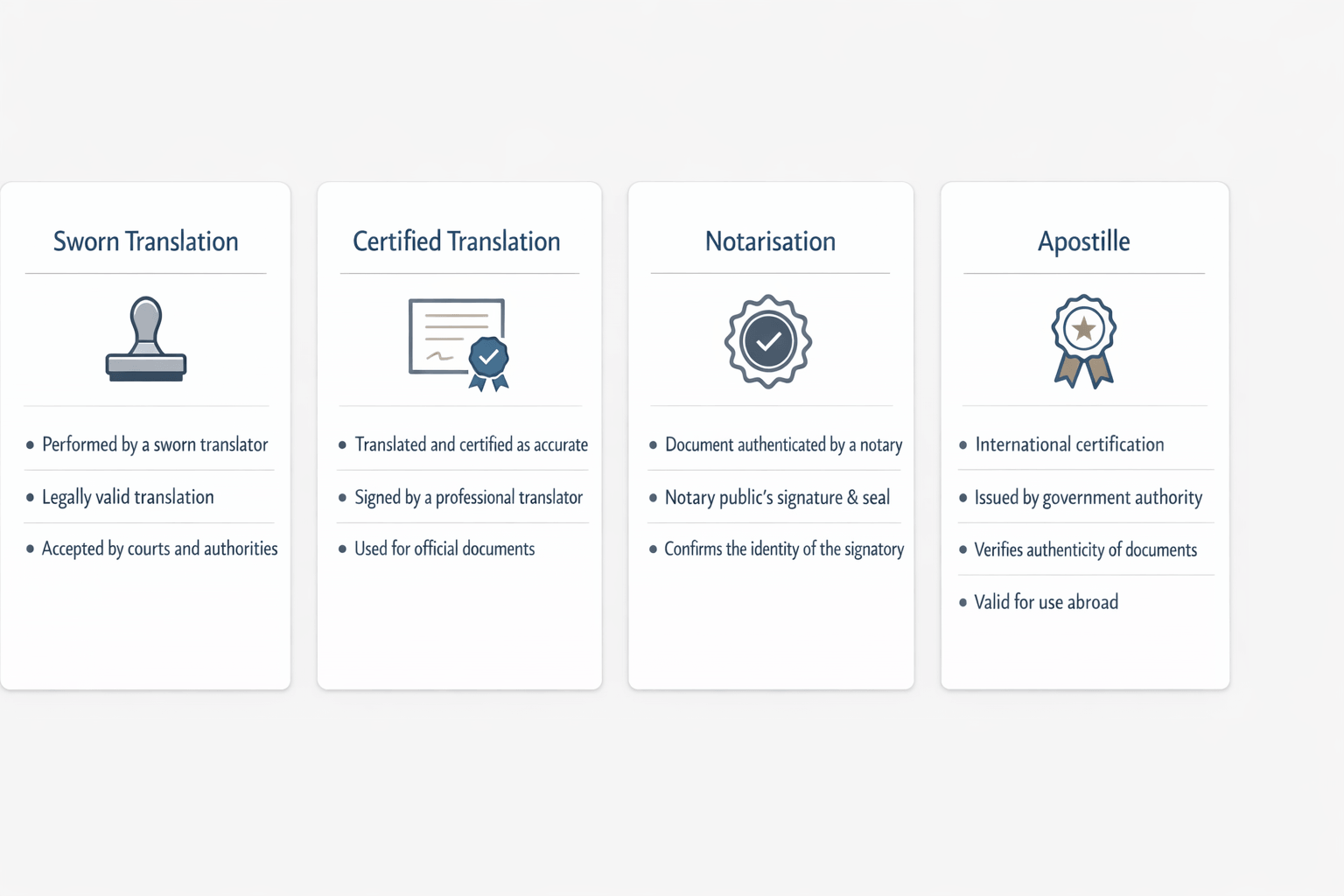
Sworn translation, certified translation, notarisation, and apostille
People often treat these as interchangeable. They are not.
Here is the simplest way to think about it:
1) Translation status
This is the translation itself:
- Sworn translation (country-specific official translator system)
- Certified translation (translator-issued certification, common in the UK)
2) Signature authentication
This confirms a signature is genuine:
- Notarisation
- other local signature certification procedures
3) International recognition of the document
This validates a public document for use abroad:
- Apostille (or legalisation, depending on the country)
A document can require all three layers in some cases.
Quick comparison
| Type | What it does | Commonly used for | Who issues it |
| Sworn translation | Official translation by a legally recognised translator | Spain, France, Germany, Poland (and similar systems) | Sworn / court-authorised translator |
| Certified translation | Confirms translation is true and accurate | UK and many private/public bodies | Professional translator or agency (following required wording) |
| Notarisation | Authenticates a signature | Some foreign authority submissions | Notary public |
| Apostille / legalisation | Confirms public document authenticity for another country | International document use | Competent government legalisation office |
If you are unsure which combination you need, upload your file and tell us where it’s going. We’ll guide you to the correct format before work starts.
How to find a sworn translator near me (without ordering the wrong thing)

Searching “sworn translator near me” is a good starting point, but it is not enough on its own.
Use this checklist instead:
Step 1: Match the translator to the destination country
A sworn translator recognised in one country may not automatically be accepted in another.
Example:
- A translator acceptable for Spain may not satisfy a German court.
- A UK-certified translation may be fine for many UK uses, but not for a foreign authority that specifically asks for a sworn translator.
Step 2: Use an official register or authority list where possible
For countries with formal systems, start with an official source or justice/foreign affairs directory.
That helps you verify:
- legal status
- active registration
- language pair
- location (if the authority cares)
- contact details
Step 3: Confirm the exact language direction
This matters more than people think.
Ask:
- Is the translator authorised for source language → target language?
- Does the receiving authority require translation into the local language only?
- Do they accept bilingual certification formats?
Step 4: Check format requirements before ordering
Ask the receiving authority:
- Do you accept PDF scans, or do you need hard copy originals?
- Do you require a wet signature or stamp?
- Do you require notarisation of the translator’s signature?
- Do you require apostille/legalisation of the original or translation?
Step 5: Ask for a sample certification block
A legitimate provider should be able to explain what the final pack includes.
You should know in advance whether your delivery will include:
- the translation
- certification statement
- signature/stamp
- hard copy option
- notarisation/apostille support (if needed)
Step 6: Choose a provider who checks acceptance, not just price
The cheapest quote is expensive if the document gets rejected.
A good provider will ask:
- destination country
- receiving authority
- document type
- deadline
- whether you need digital or hard copy delivery
That is exactly how we handle sworn, certified, and notarised routes for UK-based clients sending documents abroad.
For more specific support, users can compare all translation services or contact UK Certified Translation before ordering.
When a sworn translation is not actually needed
In many cases, people pay for a sworn translation when a simpler route would have been accepted.
Common examples:
UK submissions
Many UK authorities ask for a properly worded certified translation, not a sworn translation.
EU document workflows
Some EU public documents can be used with a multilingual standard form, which may reduce translation requirements (depending on the authority).
Private-sector use
Banks, employers, insurers, and private institutions often accept certified translations, but each organisation sets its own rules.
The practical takeaway:
- do not upgrade the format unless the receiving authority requires it
- do not assume “official” always means sworn + notarised + apostille
Typical documents that may require a sworn translation
The document type often predicts the level of formality required.
Civil and family documents
- birth certificates
- marriage certificates
- divorce decrees
- death certificates
Immigration and nationality documents
- police certificates
- residence documents
- visa records
- nationality application papers
Academic documents
- diplomas
- transcripts
- degree certificates
- professional qualifications
Legal and court documents
- judgments
- powers of attorney
- contracts
- affidavits
- company documents
If you are sending a mixed pack (for example, birth certificate + degree + police certificate), ask whether all documents need the same format. Sometimes they do not.
What affects cost and turnaround
Sworn translation pricing varies by country and language pair, but these are the main factors that actually move the price:
- language combination (rare pairs cost more)
- document length and complexity
- urgency (same-day / next-day)
- whether hard copy originals are needed
- whether notarisation or apostille is required
- whether the authority requires specific formatting
A simple way to avoid delays
Send a clear scan and include this in your message:
- destination country
- receiving authority name
- deadline
- whether you need paper copies
- any instructions you were given
That lets us quote the right service first time instead of revising it later.
The most common reasons sworn translations get rejected
Most rejections happen because of process errors, not translation quality.
1) Wrong format for the destination
You ordered certified, but they needed sworn (or vice versa).
2) Missing certification details
The authority wanted a date, signature, contact details, or a specific statement.
3) Wrong translator jurisdiction
The translator is qualified, but not recognised in the country where the document is being submitted.
4) Missing notarisation or apostille
The translation may be correct, but the authority also needed document legalisation.
5) Poor scan quality
Cut-off edges, blur, glare, or unreadable stamps can cause rejection before translation is even reviewed.
A better way to order official translations
The safest workflow is:
- Check destination requirements
- Confirm the translation route
- Translate and certify
- Add notarisation/apostille only if required
- Deliver in the format the authority accepts
That is how you avoid paying twice and missing deadlines.
If you need help now, upload your file and tell us the destination country and authority. We’ll review the route, confirm whether you need sworn translation or a certified alternative, and send a clear quote with the correct delivery options.
Why clients use UK Certified Translation for cross-border submissions
Clients usually come to us when they need more than “just translation.” They need the right submission format.
We help with:
- certified translations for UK use
- guidance on when a sworn translator is required abroad
- notarised translation support where needed
- document packs for immigration, legal, and academic submissions
- fast digital delivery and hard copy options
Trust and reassurance block (add directly under your quote form)
- Certified translation specialists for immigration and legal documents
- Clear guidance before you pay
- GDPR-conscious document handling
- PDF delivery + hard copy options
- Support for notarisation and apostille workflows
Client proof block (replace with approved live reviews)
- “Accepted first time by the authority — fast and clear process.”
- “They explained the difference between certified and sworn translation, which saved us time.”
- “Great communication and quick turnaround for urgent documents.”
Related guides and official resources
Internal guides and service pages
- certified translation services UK
- sworn translation services UK
- notarised translation services
- all translation services
- contact UK Certified Translation
- what German authorities accept for translated documents
- what a certified translation certificate looks like
- NAATI certified translation guide
- birth certificate translation in the UK
- marriage certificate translation guide
Official country and authority resources
- European e-Justice Portal
- European e-Justice Portal – Spain legal translators/interpreters page
- GOV.UK list of translators and interpreters in Spain
- Service Public
- France Diplomacy
- Justiz Dolmetscher
- justiz.de
- European e-Justice Portal – Poland legal translators/interpreters page
- GOV.UK: Certifying a document
- GOV.UK: Get your document legalised
FAQs
What is a sworn translation?
A sworn translation is an official translation completed by a translator who has legal authorisation (such as court appointment or state recognition) in a specific country. The translated document is issued in an official format accepted by many public authorities.
What is the difference between a sworn translator and a sworn interpreter?
A sworn translator handles written documents. A sworn interpreter handles spoken communication in legal or official settings. In some countries, one professional can be qualified for both roles, but the functions are different.
Do I need a sworn translation or a certified translation for the UK?
For many UK submissions, a certified translation is the standard requirement rather than a sworn translation. The correct choice depends on the receiving authority and their document rules.
How do I find a sworn translator near me?
Start with the destination country’s official register or justice/foreign affairs directory (where available), then verify the translator’s language pair, status, and whether your receiving authority accepts digital or hard copy delivery.
Can a sworn translation also need notarisation or an apostille?
Yes. A sworn translation confirms the translation status, but some authorities also require notarisation of signatures and/or an apostille or legalisation for the original document or related paperwork.
Are sworn translation requirements the same in every country?
No. Sworn translation systems vary widely by country. The title, legal status, registry, and acceptance rules can differ, so always check the destination authority before ordering.
What does sworn translation mean in different countries?
It means an officially recognised translation, but the way that recognition works changes from country to country. In Spain, Germany, Poland, and similar systems, it usually involves a translator with formal legal status. In the UK, USA, Canada, and Australia, the equivalent requirement is often a certified translation instead.
Which countries usually use sworn translations and which use certified translations instead?
Sworn translation systems are commonly associated with civil-law jurisdictions such as Spain, France, Germany, Poland, and often Italy. Certified translations are more commonly used in the UK and in many English-speaking systems such as the USA, Canada, and Australia, although the exact authority requirement must still be checked.
Will a sworn translation from one country always be accepted in another country?
No. A sworn translator recognised in one country may not automatically be recognised by authorities in another. That is why the destination country and receiving authority matter more than the label used by the provider.
Is a sworn translation the same as a notarised translation?
No. A sworn translation relates to the translator’s legal status or the official format of the translation. Notarisation is a separate authentication step that may be required in addition to the translation.
What is the equivalent of a sworn translation in the USA, Canada, and Australia?
In many cases, the equivalent practical requirement is a certified translation or an authority-specific approved translation format, not a general sworn translator system. The wording used by the receiving authority should always be checked before ordering.