


If you searched certified translation services ltd, you’re usually trying to do one of two things:
- Find or verify a specific company name you’ve seen on an invoice, bank statement, email signature, or document pack.
- Get a certified translation and you typed what “sounds right” (because many translation businesses use similar wording).
Either way, you’re in the right place. This guide shows you how to confirm you’ve found the right organisation, avoid lookalike companies and scams, and get a certified translation that’s accepted for official use.
Why this search is confusing (and why it’s not your fault)
“Certified translation” is a service category, not a unique brand. Add “Ltd” (a common UK company structure) and you end up with:
- Similar company names across the UK and abroad
- Businesses using trading names that don’t match their registered company name
- Old listings that still appear in search results
- Copycat sites that imitate reputable providers
So the goal isn’t to find a result — it’s to match the result to the details you already have.
Step 1: Work out what you’re actually trying to achieve

If you’re trying to verify a company you’ve dealt with
You likely have one or more of the following:
- A payment reference on your bank statement
- An invoice or receipt
- An email thread
- A PDF translation pack with a certificate page
- A WhatsApp message or SMS
Your job is to match the company you found online to the company on those materials.
If you’re trying to order a certified translation (not verify a company)
Skip to: How to get a UK-accepted certified translation (without overpaying)
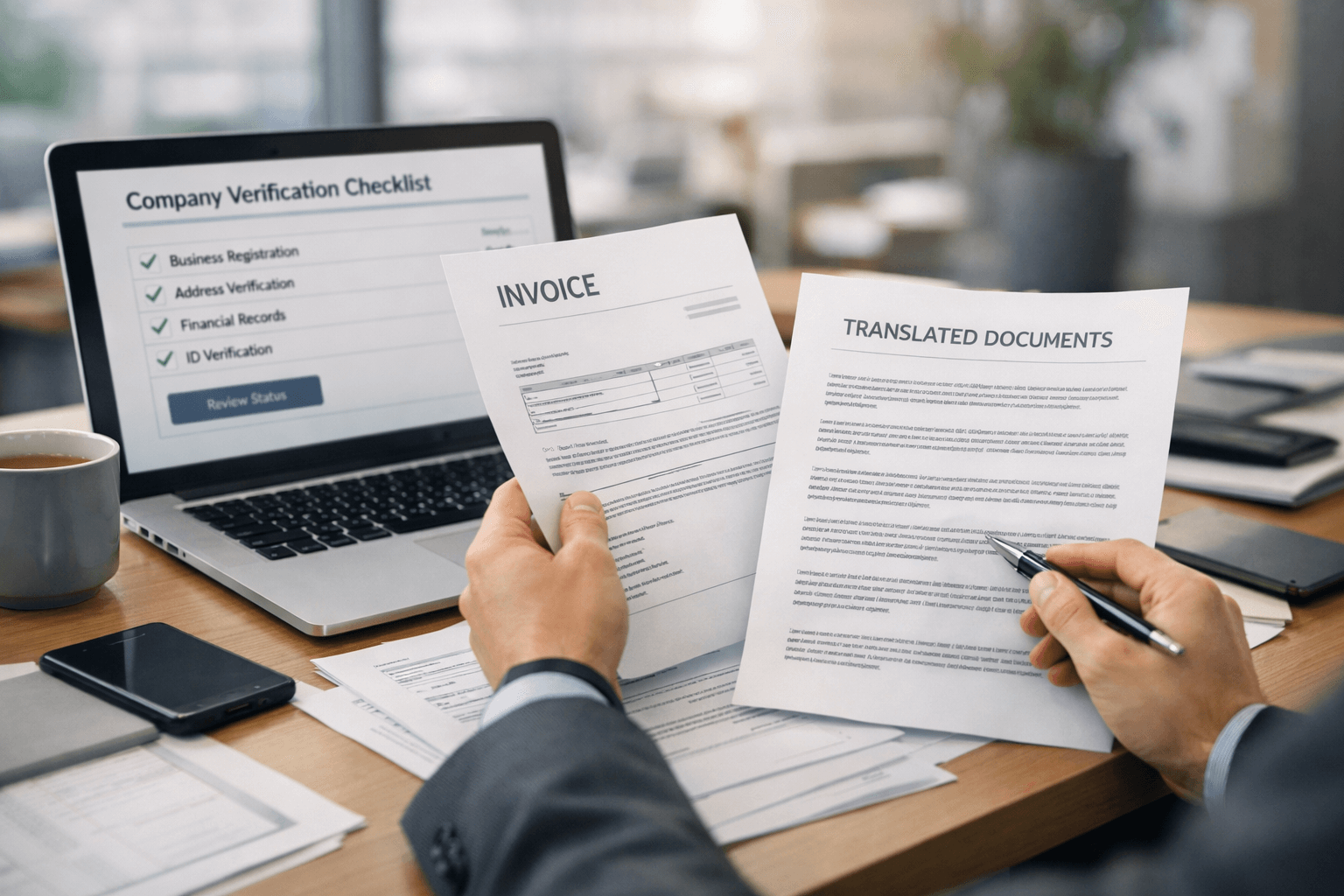
Step 2: The 60-second company verification check

Use this quick checklist before you email documents, pay a deposit, or share ID scans.
Green flags (good signs)
- The website clearly states the registered company name and where the business is based
- You can find a matching listing on the UK public company register (same name/address/status)
- The email address uses the company’s own domain (not a free email account)
- The invoice shows consistent details: company name, address, and a clear reference number
- Payment instructions match the same legal entity (not a random personal account)
Red flags (pause and verify)
- “Ltd” appears in messages, but nowhere on invoices or the website
- The company listing shows a status that doesn’t make sense for a business actively trading
- The website has no address, no terms, and no clear privacy statement
- The “translator certificate” looks generic and doesn’t include traceable contact details
- Heavy pressure tactics: “Pay now or price doubles” / “Only WhatsApp” / “No email”
If any red flags show up: don’t argue — just request clarification in writing (template below).
Step 3: Confirm you’ve found the correct legal entity
When you search certified translation services ltd, don’t rely on the name alone. Match at least two of the following:
- Registered company name (exact spelling and punctuation)
- Registered office address
- Company status (active vs. no longer trading)
- Website domain and email domain
- Phone number
- Invoice header details (especially if you already paid)
Trading name vs. registered name (simple example)
A business can legally trade as “UK Certified Translation” while being registered under a different company name. That’s normal.
What’s not normal is when:
- The “registered company” changes every time you ask
- Payment details don’t match the entity on the invoice
- The certificate page has one name, the invoice has another, and the website shows a third
If the company record you find looks old (or not trading anymore)
Sometimes your search turns up a company listing that appears closed, dissolved, or inactive — but you still have a live website or you’re in an ongoing email thread.
Here’s what to do:
- Don’t assume fraud immediately. Old results can stay indexed for years.
- Ask for the current trading entity details (registered name + address) to match your invoice.
- Ask for a corrected invoice showing the correct legal entity (if you haven’t paid yet).
- If you already paid, match the bank payee name to the entity you can verify.
The key is consistency. Legitimate providers can explain clearly and in writing.
Copy/paste template: Ask a company to confirm their identity
Use this message when you’re unsure you’ve found the right organisation:
Hi, I’m trying to confirm I have the correct company before I share documents/payment.
Please confirm:
- Your registered company name and registered office address
- Your company registration number (if UK-registered)
- The trading name/brand name you use publicly (if different)
- The email domain and website address you use for official correspondence
Once confirmed, I’ll proceed with the order. Thank you.
If a provider reacts defensively to a basic verification request, treat that as information.
How to get a UK-accepted certified translation (without overpaying)
If you searched certified translation services ltd because you simply need a certified translation, focus on what the receiving organisation will accept — and what they don’t require.
What “certified translation” usually means in the UK

Most UK organisations expect a professional translation that includes a certification statement confirming accuracy, plus clear translator/company details.
A typical certified translation pack includes:
- The translated document
- A certification statement page that confirms it’s a true and accurate translation
- Name and signature of the translator or authorised representative
- Date of certification
- Contact details (so it can be verified if needed)
- Optional stamp/reference number (often requested, not always mandatory)
When you might need something extra (and when you don’t)

- Notarised translation: sometimes requested for overseas institutions or formal legal processes
- Sworn translation: commonly required for certain foreign courts/civil-law jurisdictions
- Apostille/legalisation: used when the destination country requires authentication
If you’re not sure, ask the receiving organisation:
“Do you need certified, notarised, sworn, or apostilled?”
That single question can save time and money.
If you need help choosing the right format, start here: certified translation services in the UK and we’ll guide you based on where the documents are going.
What to ask before you place an order
Before you upload documents, get clear answers to these questions:
- Where will you submit the translation? (Home Office, HM Passport Office, university, employer, court, overseas authority)
- Will you provide the certification statement as part of the price?
- Who signs the certificate — translator or agency representative?
- Do you offer a PDF with signature + stamp, and can you post a hard copy if needed?
- What is your turnaround time and what counts as urgent?
- How do you handle corrections (e.g., name spelling consistency across documents)?
- How do you protect sensitive data (passports, bank statements, medical records)?
- What exactly is included in the quote (pages, stamps, delivery, revisions)?
Ready to move? Upload your file via our services page or message us directly on the contact page.
Common problems that cause delays (and how to avoid them)
1) Unclear scans
If text or stamps are unreadable, certification becomes risky. Send:
- A full-page scan (all edges visible)
- No glare/shadows
- All pages included (including backs if there are stamps)
2) Name mismatches across documents
If your name is spelled differently across certificates, passports, and letters, your application can be delayed. We can keep the translation faithful to the document while helping you present names consistently across the bundle.
3) Ordering the wrong “type” of translation
Certified vs notarised vs sworn vs apostilled: order the wrong one and you may pay twice. If the destination isn’t clear, tell us where it’s going and we’ll recommend the correct route (including whether you need notarised translation or a sworn translation).
A practical way to choose a provider (without getting overwhelmed)
When people search certified translation services ltd, they often compare providers by speed and price — but for official documents, reliability is what saves you the most time.
Use this quick decision rule:
- If it’s going to an official body: clarity, traceability, and certificate quality come first
- If it’s urgent: choose a provider that can still deliver a proper certificate (not a rushed screenshot)
- If it contains sensitive data: choose a provider that can explain secure handling and retention
To see how we handle certified packs end-to-end, visit: about UK Certified Translation or start directly with a certified translation quote.
Quick next step
If you came here to verify a company name, use the checklist and the copy/paste verification template above.
If you came here because you need a certified translation today, the fastest way forward is simple:
- Open: Certified Translation
- Upload your file
- Tell us where it’s being submitted
- Receive a clear quote and delivery time
- Get a signed, certificate-backed translation pack ready to submit
FAQ Section
FAQ 1: Why do people search “certified translation services ltd”?
Most people search certified translation services ltd after seeing the name on an invoice, payment reference, email signature, or a certificate page — or because they need a certified translation and assume “Ltd” is part of the service name.
FAQ 2: Is “certified translation services ltd” a single company?
Not necessarily. Similar names can exist, and businesses may use trading names that differ from their registered company name. Always verify using registered details (name, address, status) and match them to your invoice and payment info.
FAQ 3: What should a UK certified translation include?
A UK certified translation typically includes the full translation plus a signed certification statement confirming accuracy, the date, and clear contact details so the translation can be verified if required.
FAQ 4: Do I need notarisation for a certified translation in the UK?
Often, no — many UK submissions only require a properly certified translation. Notarisation is usually requested for specific legal processes or overseas institutions. If in doubt, ask the receiving organisation what they require.
FAQ 5: What if the company I found online looks inactive or not trading?
Don’t assume the worst. Search results can be outdated. Ask the provider to confirm their current registered entity details in writing and ensure the invoice, certificate, and payment details match the same legal entity.
FAQ 6: How can I avoid scams when looking for certified translation services?
Use a simple rule: don’t share documents or pay until the provider’s legal entity details, domain/email, and invoice/payment information match consistently. If they refuse basic verification, choose a different provider.