


If you searched certified translation services gov uk, you’re probably trying to answer one urgent question:
“What kind of translation will a UK authority actually accept?”
That search phrase is common, but it usually reflects confusion about how UK document translation works. Most people are not really looking for a government-run translation company. They are looking for certainty:
- Will my translation be accepted?
- Do I need a certified translation, a notarised translation, or a sworn translation?
- Is there such a thing as a “Home Office approved translation service”?
- How do I avoid delays or rejection?
This guide clears that up in plain English and gives you a practical way to choose the right service the first time.
If you already have your documents ready, you can upload your file and get a clear answer on what format is needed before you pay for anything.
What people usually mean by “certified translation services gov uk”

When someone types certified translation services gov uk, they usually mean one of these things:
1) “I need a translation accepted by a UK government department”
This is the most common intent.
Examples:
- Home Office / UKVI applications
- HM Passport Office applications
- DVLA, HMRC, local councils, courts, or other authorities
- Public-sector or regulated body requests
2) “I want a translator who is legitimate and verifiable”
People often use phrases like:
- official translation services
- registered translator uk
- approved translation services
What they really want is a provider whose work can be checked and trusted.
3) “I’m not sure which level I need”
Many applicants confuse:
- certified translation
- notarised translation
- sworn translation
- apostille/legalisation
This is normal. The wrong choice here is one of the biggest causes of wasted time and extra cost.
4) “I saw something on GOV.UK and don’t want to get it wrong”
This is a smart instinct.
UK authorities often care less about marketing words and more about whether the translation is:
- complete
- accurate
- signed/certified
- traceable to a real translator or agency
That is the standard you should shop for.
The key truth most pages miss
There is no single UK government marketplace of “approved translation services” for general applications.
That is why searches like home office approved translation services can be misleading.
What matters in practice is whether your translation meets the receiving authority’s requirements and can be independently verified.
So instead of asking:
“Is this translator on a government list?”
Ask:
“Does this translation pack contain everything the authority needs to accept it?”
That one change in mindset will save you time and prevent unnecessary upgrades.
What a UK authority usually expects from a certified translation
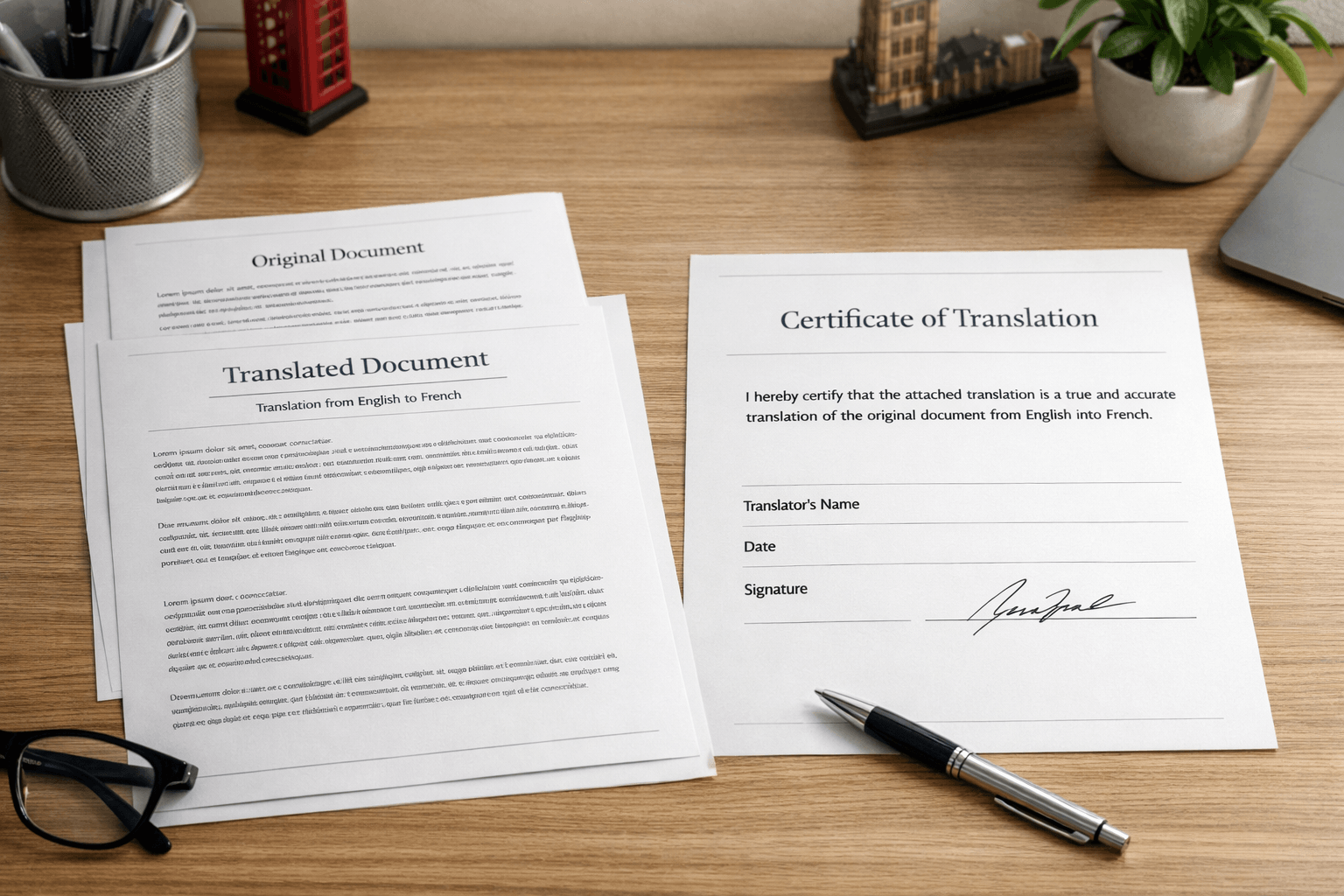
For most UK uses, a certified translation is a complete translation plus a certification statement confirming it is accurate.
A strong certified translation pack usually includes:
- A full translation of the document (not partial unless explicitly allowed)
- A statement that it is a true and accurate translation
- The date
- Translator or agency name
- Signature
- Contact details
- Clear formatting that helps the reviewer compare it with the original
Why “independently verified” matters
Reviewers need to know who produced the translation and how they can check it if needed.
That means your translation should never look anonymous.
A cheap translation that has no named person, no signature, and no contact details can look professional at first glance — but still fail when checked.
“Home Office approved translation services” — what you actually need
This phrase is everywhere, but it causes confusion.
If you’re applying through the Home Office or UKVI, what you usually need is:
- a certified translation
- produced by a professional translator/agency
- with clear certification wording and verification details
A practical rule
For immigration and visa documents, think in terms of acceptance-ready formatting, not brand claims.
Your translation should be:
- complete (including stamps, seals, handwritten notes where relevant)
- consistent (names and dates must match across documents)
- clearly certified
- easy to verify
Common documents for Home Office / UKVI submissions
- Birth certificates
- Marriage certificates
- Divorce decrees
- Police certificates
- Bank statements (if requested)
- Payslips / employment letters
- Academic documents
- Identity documents and supporting civil records
If your file bundle includes multiple documents, it’s often best to submit them as one coordinated project so names, dates, and formatting stay consistent throughout.
Certified, notarised, sworn, or apostilled?

This is the part most people struggle with, so here’s the simple version.
Certified translation
Best for most UK authorities and institutions.
Use this when the requirement says:
- certified translation
- official translation
- signed translation
- translator declaration
- certificate of accuracy
Notarised translation
This is usually needed when a notary must verify the translator’s signature (or the certification process), often for overseas use.
Use this when the requirement specifically mentions:
- notary public
- notarisation
- notarised translation
Sworn translation
This is usually a country-specific requirement outside the UK (for example, jurisdictions where only court-appointed or state-authorised translators can produce valid official translations).
Use this when the receiving country specifically asks for:
- sworn translator
- court translator
- officially appointed translator
Apostille / legalisation
This is not a translation type. It is an authentication step for documents used internationally.
Use this when the authority or country asks for:
- apostille
- legalisation
- embassy legalisation
The mistake to avoid
Many people pay for notarisation or apostille when a standard certified translation would have been enough.
Always check the receiving authority’s wording first. If it only says “certified translation,” do not upgrade automatically.
“Registered translator UK” — what that phrase usually means
In the UK, people often search for a registered translator uk when they want someone credible, qualified, and easier to verify.
In real-world terms, this usually means a translator or agency connected to recognised professional bodies or directories, not a single government licensing list for all document translation.
What you should look for:
- Clear business identity and contact details
- Professional body affiliation (where relevant)
- Experience with official/certified document work
- A sample certificate format (with dummy details)
- A clear explanation of what is included
- Transparent pricing and turnaround
If a provider uses strong claims but avoids specifics, that’s a red flag.
The “acceptance-first” checklist (use this before you order)
This is the fastest way to avoid rejected translations.
Before ordering
- Check the authority name
- Home Office / UKVI
- HM Passport Office
- University
- Court
- Embassy / overseas authority
- Regulator / licensing body
- Read the exact wording
Look for phrases like:- certified translation
- notarised translation
- sworn translation
- apostille/legalisation
- certified copy (different service)
- Confirm whether full translation is required
Some organisations require every page and every visible mark to be translated. - Prepare clear scans
Poor-quality scans lead to avoidable errors and delays.
Before you pay
Ask the provider these 6 questions:
- Will the translation include a signed certificate of accuracy?
- Will the certificate include contact details for verification?
- Will you translate stamps, seals, and handwritten notes?
- Can you match names and dates consistently across multiple documents?
- Do I need notarisation, or is certified translation enough?
- Can you deliver a PDF suitable for online upload?
If the answers are vague, keep looking.
A quick decision guide by scenario
I’m applying for a UK visa and my documents are not in English
You will usually need a certified translation with a proper certificate and contact details.
I’m applying for a UK passport and supporting documents are in another language
You will usually need a certified translation of those supporting documents.
I’m submitting documents to a UK university or regulator
You will usually need a certified translation, but check if they want the translation stamped/signed in a particular way.
I’m sending documents overseas and they specifically mention a notary
You likely need a notarised translation (and possibly apostille/legalisation too).
The requirement says “certified copy”
That is not the same as a translation.
You may need copy certification, translation, or both.
Why some translations get rejected
Most rejections are not because the language is wrong.
They happen because the submission is incomplete or unclear.
Common rejection triggers
- Missing certification statement
- No signature
- No contact details
- Partial translation
- Missing stamps or notes
- Inconsistent spelling of names
- Low-quality scans
- Wrong service level (e.g., certified needed but only plain translation supplied)
A better way to order
Send the provider:
- the document(s)
- the authority name
- the exact wording of the requirement (screenshot or copy/paste)
That makes it much easier to produce the right format first time.
What “official translation services” should look like in practice
If a company offers official translation services, the important question is not the phrase — it is the process.
A reliable service should give you:
Clear scope
They should tell you exactly what you’ll receive:
- translated document
- certificate page
- PDF delivery
- optional hard copy (if needed)
Clear accountability
They should be able to explain:
- who signs the certificate
- what contact details appear
- how the translation can be verified
Clear escalation path
They should also be able to say:
- when notarisation is required
- when sworn translation is required
- when apostille is required
That is what makes a provider genuinely useful, especially for government-facing applications.
A simple example: the same document, different requirements
Let’s say you need to translate a birth certificate in Arabic.
Case A: UK visa application
You will usually need a certified translation with a complete certificate and verification details.
Case B: Marriage registration abroad
You may need:
- certified translation
- notarisation
- apostille/legalisation
Case C: University admissions in the UK
You usually need:
- certified translation
- sometimes a stamp/signature format the university can check quickly
Same source document. Different destination. Different service level.
That’s why the safest question is always:
“Who is receiving it, and what exact wording did they use?”
What to do next (without overpaying)
If you’re unsure whether you need certified, notarised, or sworn translation, the fastest approach is to send the document and the requirement wording together.
A good provider should reply with:
- the correct service level
- what’s included
- turnaround
- a fixed quote
That lets you start your project quickly without paying for extras you don’t need.
If you’re ready to move forward, upload your file and include the authority name (for example: “UKVI spouse visa” or “HM Passport Office”). That one detail helps produce the right format first time.
Frequently Asked Questions
Is there a GOV.UK list of certified translation services?
Not for general UK document translation needs. GOV.UK guidance usually focuses on what the translation must include, not a single national list of approved providers. Some GOV.UK pages do publish overseas service-provider lists, but those are typically informational and not endorsements.
Are “home office approved translation services” a real category?
People use the phrase often, but the safer way to think about it is: a translation service that produces a certified translation in the format the Home Office/UKVI can verify and accept.
What should a certified translation include in the UK?
A proper certified translation usually includes a full and accurate translation plus a certificate/declaration of accuracy, date, signature, and contact details for the translator or agency.
Do I need a registered translator in the UK?
You need a competent, verifiable professional. Many people look for translators affiliated with recognised UK professional bodies or listed in trusted directories because it reduces risk and makes verification easier.
Is a notarised translation the same as a certified translation?
No. A notarised translation adds a notary step. A certified translation is often enough unless the receiving authority specifically asks for notarisation.
Can I use the same certified translation for every authority?
Sometimes, but not always. The wording and format expectations can vary. A translation prepared for UKVI may not automatically meet an overseas authority’s notary or legalisation requirements.