


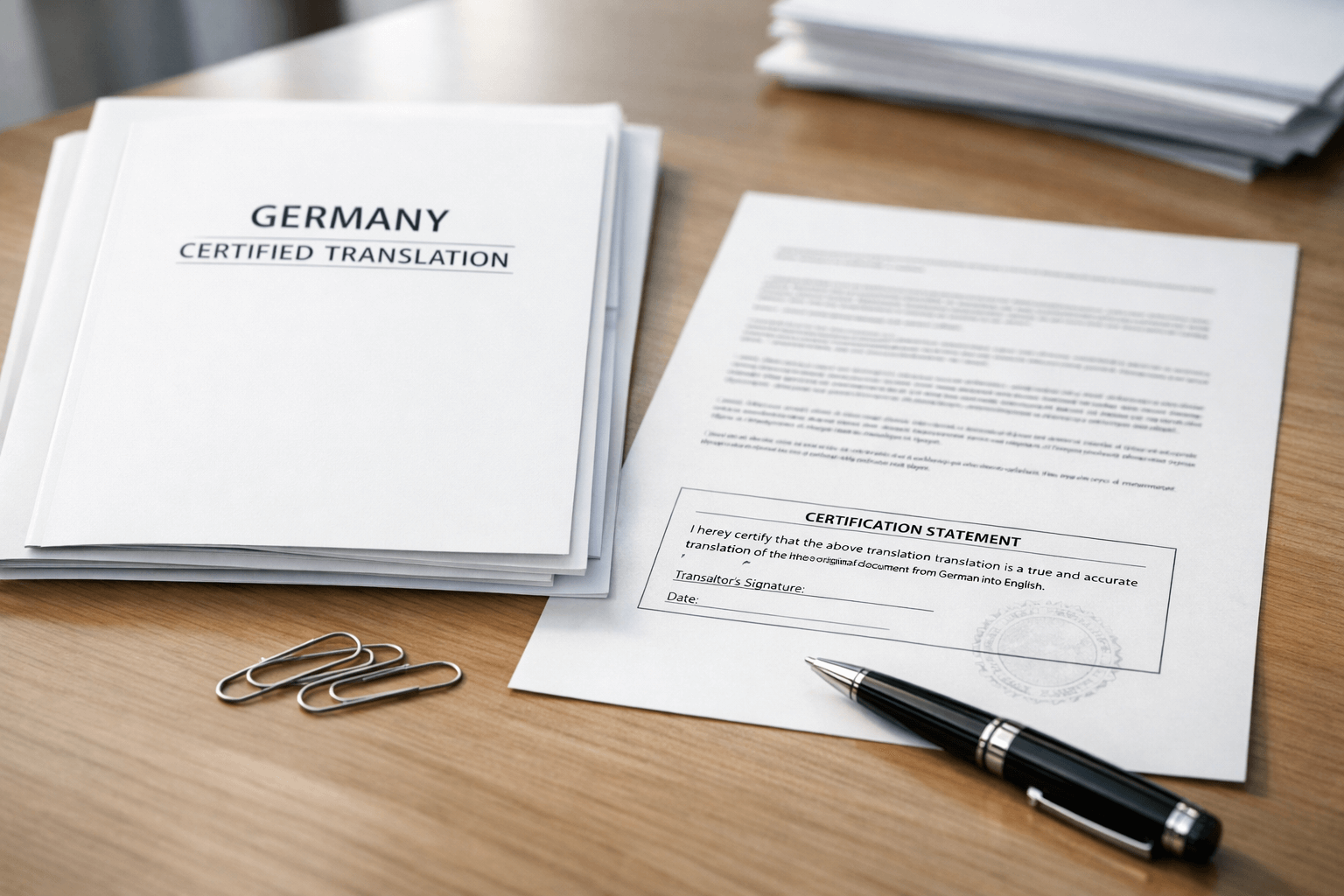
If you’re searching for certified translation Germany, you’re usually dealing with an official process: a registry office, immigration authority, court, university, notary, or employer that needs a translation they can rely on legally. In Germany, “certified” has a very specific meaning—often tied to sworn / authorised translators who can issue translations that are accepted as official documents.
This guide explains how certified translations work in Germany, what authorities typically expect, how to verify a translator, and how to avoid the most common rejection reasons—so your documents get accepted the first time.
What “certified translation” means in Germany
In everyday English, “certified translation” can mean a translation plus a signed statement of accuracy. In Germany, the concept is usually closer to a sworn / authorised translator’s certified statement, and the translation is commonly known as:
- beglaubigte Übersetzung (commonly used term)
- also seen as bescheinigte or bestätigte Übersetzung (more precise wording in some contexts)
The translator is typically a beeidigter / vereidigter / ermächtigter Übersetzer (the wording varies by federal state). What matters is that they are officially authorised to certify translations for formal use.
Practical takeaway: If the document is going to a German authority, your safest option is a translation issued by a translator authorised in Germany (or otherwise recognised by the receiving authority)—with the correct certification statement, signature, date, and (where required) stamp/seal.
Who can issue a certified translation for Germany?
A “regular” bilingual speaker—even a professional translator—may not be enough for official submission in Germany. In many cases, the receiving body expects a translation from a translator who is:
- sworn / publicly appointed / generally sworn / authorised (terms differ by state)
- listed in an official register or otherwise verifiable
- able to add the required certification statement and formal elements
Why the wording differs (and why it’s normal)
Germany is a federal system. Authorisation rules and formalities can differ by Bundesland, so the translator’s official title (and whether a stamp is mandatory) can vary. Authorities generally care about authorisation + verifiability + correct certification format, not a single universal label.
When you typically need a certified translation in Germany
You’ll most often need certified translation Germany services for:
Civil status and family matters
- Birth certificate, marriage certificate, divorce decree
- Name declarations, family book extracts
- Applications at the Standesamt (registry office)
Immigration and residency
- Residence permits, citizenship applications, family reunification
- Police certificates, court documents, financial evidence (where requested)
- Submissions to the Ausländerbehörde or German missions/consulates
Education and professional recognition
- Diplomas, transcripts, degree certificates
- Professional licences, registration documents
- Recognition applications (regulated professions)
Legal and court use
- Court submissions, judgments, affidavits, witness statements
- Litigation bundles and evidentiary documents
Business and corporate filings
- Commercial register extracts, articles of association
- Contracts and compliance documents (when formally required)
Best move before you translate: Ask the receiving institution what they accept (Germany-authorised translator, EU-authorised translator, digital vs hard copy, binding requirements). If they don’t specify clearly, assume they want a Germany-authorised sworn translator format.
What a German-certified translation should include (acceptance checklist)

A German-style certified translation commonly includes:
- A complete translation (not “summary” or partial unless clearly marked as partial and accepted)
- A certification statement confirming the translation is accurate and complete
- Place and date
- Translator’s signature
- Translator’s stamp/seal (required in many workflows; not universally mandatory everywhere, but widely expected)
- Clear reference to the source document (original, certified copy, scan, etc.)
- Handling of stamps, seals, handwritten notes (these should be described/translated, not ignored)
- Multi-page integrity (pages often numbered and bound/attached so they can’t be swapped without detection)
Rule of thumb: A certified translation should read like an “official mirror” of the original—including stamps, marginal notes, and visible annotations.
Will a UK-certified translation be accepted in Germany?
Sometimes—but it depends on the receiving authority.
Germany-based institutions often prefer (and sometimes effectively require) certified translations produced by an authorised/sworn translator recognised for German official use. Some offices may accept a certified translation produced abroad, especially if:
- it’s from a translator recognised in an EU/EEA context, or
- the translation can be verified to their satisfaction, or
- the German embassy/consulate provides or recognises a trusted list
But you should plan for the reality that the receiving authority decides. If your timeline is tight or rejection would be costly, choose a Germany-authorised sworn translator format from the start.
How to verify a sworn/authorised translator in Germany
Verification is one of the biggest reasons German authorities trust certified translations. A robust verification approach includes:
- Check the official translator/interpreter database (search by language + city + name)
- Confirm the translator is authorised for the required language direction
- Ensure the certification statement matches the expected official style (including date, place, and reference to the source document)
- Verify that the translator’s stamp (if used) contains identifying details consistent with their registration and language authorisation
If you’re not sure what to check: Send the receiving authority a sample (with personal data redacted) and ask if the format is acceptable before ordering a large bundle.
Certified translation vs notarisation vs apostille (Germany)
These are often confused, and confusion leads to delays:
Certified translation (Germany context)
A translation certified by an authorised/sworn translator—focused on accuracy and official acceptance.
Notarisation
A notary does not “certify the translation’s accuracy” in the same way. Notaries typically certify:
- identities/signatures, or
- copies as true copies
Sometimes notarisation is requested in cross-border procedures, but it’s not the default substitute for a German sworn translator’s certification.
Apostille / legalisation
An apostille (or legalisation) relates to the authenticity of the original document (the signature/seal on it), not the translation itself.
You may need apostille/legalisation before translating—especially if a German authority requires it for foreign documents.
Practical sequencing (common):
- Obtain the correct original/certified copy + apostille/legalisation (if required)
- Then translate everything including apostille text/seals as part of the certified translation bundle
Digital vs hard copy: what Germany usually expects
Acceptance varies, but many German offices still expect a physical certified translation with original signature/stamp, especially for registry office or formal legal submissions.
That said, some workflows allow:
- scanned certified translations for pre-checks, followed by
- delivery of the physical original for final submission
In certain formal frameworks, qualified electronic signatures can be used for electronic documents—however, acceptance still depends on the receiving office and their technical/legal process.
Best practice: If the receiving authority doesn’t explicitly confirm digital acceptance, plan for hard copy delivery.
Cost and turnaround: what affects the price of certified translation in Germany
Pricing for certified translations in Germany is influenced by:
- Document type & complexity (civil certificates vs court judgments vs contracts)
- Language pair (rarer languages often cost more)
- Legibility and formatting (stamps, handwritten notes, poor scans increase time)
- Certification requirements (binding, extra copies, courier delivery)
- Deadline (express and weekend delivery)
- Volume (bundles may be priced differently)
A useful pricing reality-check (Germany)
In Germany, translations are often priced by Normzeile (a standard line length in characters, typically including spaces) or by word—depending on the provider and document type. For court/justice contexts, statutory fee frameworks exist and are often used as a reference point in negotiations, even when private pricing is agreed separately.
To avoid surprises: Send clean scans up front, list the receiving authority, confirm whether partial translation is permitted, and request a fixed quote for the whole submission bundle.
The “accepted first time” workflow (recommended)

If you want to minimise the risk of rejection, follow this workflow:
- Identify the receiving institution
- Standesamt, Ausländerbehörde, court, university, employer, notary, etc.
- Confirm acceptance rules
- Do they require a Germany-authorised sworn translator?
- Do they accept EU-authorised sworn translators?
- Do they need hard copy, bound pages, or multiple originals?
- Prepare the source documents properly
- Full scan with edges visible
- All pages included (front/back, stamps, notes)
- If apostille/legalisation exists, include it
- Translate with correct certification format
- Complete translation + certification statement + date/place + signature (+ stamp if expected)
- Quality check against the original
- Names, dates, reference numbers must match exactly
- Transliteration should be consistent with passports/IDs when relevant
- Deliver in the right submission format
- PDF for preview if useful, plus hard copies for the final hand-in
If you’re handling a time-sensitive submission, the fastest way to start is to upload your document scans and request a fixed quote for the exact authority you’re dealing with.
Common reasons German authorities reject translations (and how to avoid them)

1) The translator isn’t recognisable as authorised/sworn
Fix: Use a verifiable authorised translator format and ensure the certification statement contains all required elements.
2) Partial translation without clear marking (or not allowed)
Fix: Translate the entire document set unless the authority explicitly accepts partial translation.
3) Stamps, seals, handwritten notes ignored
Fix: These must be translated or described as part of the certified translation.
4) Name spellings don’t match the passport
Fix: Use passport spelling consistently and avoid “helpful” changes.
5) Missing pages or unclear scans
Fix: Provide complete, high-resolution scans before translation begins.
6) Wrong order of legalisation steps
Fix: Confirm apostille/legalisation needs early—then translate the final, legalised document set.
Real-world examples (Germany acceptance scenarios)
Example A: Marriage registration at the Standesamt
You submit foreign birth certificates and divorce records. The Standesamt typically expects:
- full German translations
- issued by an authorised/sworn translator format
- with clear certification statement + date/place + signature (+ stamp commonly expected)
- often as a physical set
Example B: Residence permit application
You provide civil documents and supporting evidence. Requirements vary by city, but common expectations include:
- certified translations for key civil status documents
- consistent name spelling across documents
- legible scans and complete pages
Example C: University admission / ZAB-style evaluation preparation
Academic documents often need:
- accurate formatting (tables, grades, course titles)
- correct institutional names and references
- certified format if the university requests it
What you’ll receive (what to ask for when ordering)
When ordering a certified translation for Germany, ask for:
- A certified translation in Germany-accepted format (sworn/authorised translator)
- Clear identification and verifiable credentials
- A scan preview (optional but helpful)
- Hard copies delivered with the certification statement, signature, and stamp where expected
- Extra certified copies if you’re submitting to multiple offices
If you’re unsure which format you need, the quickest route is to share the receiving authority name and upload your documents—then you can be guided to the correct format before work begins.
Quick glossary: the German terms you’ll see

- beglaubigte Übersetzung – commonly used term for certified translation
- bescheinigte / bestätigte Übersetzung – alternative terms used in formal contexts
- beeidigter / vereidigter Übersetzer – sworn translator
- ermächtigter Übersetzer – authorised translator (term varies by state)
- öffentlich bestellt – publicly appointed (term varies by state)
- Standesamt – registry office (birth, marriage, name declarations)
- Ausländerbehörde – immigration office
- Apostille / Legalisation – authentication of original document for cross-border use
Ready to translate for Germany?
If your document is going to a German authority, don’t gamble on format. Start with an authority-accepted certified translation approach—especially for civil status, immigration, court, or academic submissions.
Upload your documents, tell us which German institution you’re submitting to, and we’ll confirm the correct certified translation format and delivery method before the project starts.
FAQ Section
1) What is a certified translation in Germany?
A certified translation in Germany typically means a complete translation issued with an official certification statement by a sworn/authorised translator, including date/place, signature, and often a stamp.
2) Who can do certified translation Germany authorities accept?
German authorities usually expect a translation from a sworn/authorised translator who can certify the translation in an official format and whose status can be verified through recognised registers or documentation.
3) Are UK-certified translations accepted in Germany?
Sometimes, but acceptance depends on the receiving authority. Many German offices prefer (or effectively require) a certified translation issued in a German sworn/authorised translator format.
4) Do I need notarisation for a certified translation in Germany?
Not usually for the translation itself. Notarisation typically certifies identity/signature or true copies. German official submissions more commonly rely on sworn/authorised translator certification.
5) Do I need an apostille before translating my document for Germany?
If the receiving authority requires apostille/legalisation on the original document, you should obtain it first—then translate the final legalised document set (including apostille text and stamps).
6) How can I verify a sworn translator in Germany?
Use the official translator/interpreter database and professional association directories, and check that the translator is authorised for the required language pair and provides the correct certification elements.