


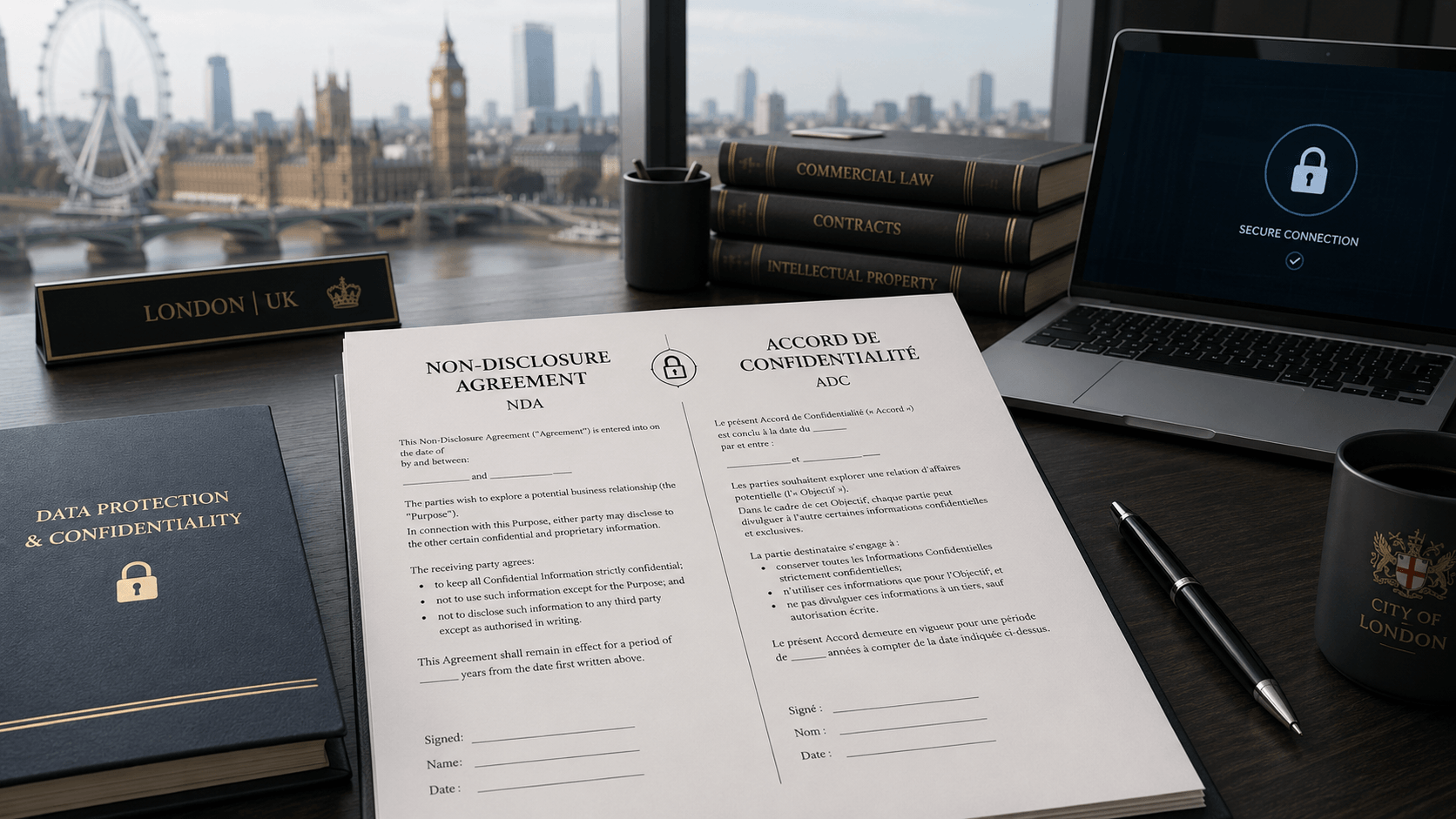
When you need nda translation uk support, you are not simply translating clauses word for word. You are protecting confidential information, preserving legal intent, and making sure every obligation still works when the agreement crosses languages, teams, and jurisdictions. A strong confidentiality agreement translation combines legal contract translation, secure handling, and fast turnaround without losing precision where it matters most: definitions, exceptions, time limits, remedies, and governing law.
If your NDA will be reviewed by overseas counsel, shared in due diligence, or signed by a counterparty abroad, the safest move is to start with the destination, the language pair, and the level of formality required. That is how you avoid rework, delays, and preventable risk.
Need a confidential review before you circulate the document? Send the NDA, language pair, and deadline, and we will confirm the safest route before work begins.
Quick answer: what is the best NDA translation service in the UK?
The best nda translation uk service is one that combines legal translation expertise, secure file handling, confidentiality protection, and the correct certification route for the destination. For most businesses, law firms, investors, HR teams, and commercial clients, the right provider should be able to translate the NDA accurately, preserve defined terms, protect sensitive information, and advise whether the final translation should be standard, certified, notarised, or sworn.
A reliable NDA translation provider in the UK should offer:
secure upload and controlled access to confidential documents
legal-linguistic translation by specialists familiar with contract wording
consistent treatment of defined terms, annexes, schedules, and signature blocks
review by a second qualified person where the document is high-risk
certified, notarised, or sworn translation options where required
fast turnaround for urgent commercial, legal, or due diligence deadlines
clear communication before work begins, especially where the document is for signature, filing, evidence, or overseas use
If your NDA contains commercial secrets, intellectual property, personal data, financial information, employment restrictions, or cross-border obligations, choose a service that treats the translation as a legal-risk document rather than a simple language task.
Why NDA translation is different from ordinary contract translation

A non-disclosure agreement may look short, but it carries a disproportionate amount of legal and commercial risk. In many deals, the NDA is the first legally binding document the parties sign. If the language is unclear, the relationship starts with uncertainty.
That is why nda translation uk work requires more than general bilingual ability. The translator has to preserve:
- the scope of confidential information
- the exact list of exclusions
- the permitted disclosure pathways
- the survival period of confidentiality obligations
- the remedies available after breach
- the governing law and jurisdiction wording
A translated NDA that sounds smooth but shifts the legal effect is still a failed translation.
In NDA translation, the most dangerous errors are often the ones that still sound correct.
One-way and mutual NDA translation: why the document type matters
NDA translation should also take account of whether the agreement is one-way or mutual. In a one-way NDA, only one party is usually disclosing confidential information, so the translation must make the receiving party’s restrictions very clear. In a mutual NDA, both parties may be disclosing and receiving information, so the translation must preserve the balance of obligations on both sides.
This matters because a small wording shift can accidentally make one party’s duties broader or narrower than intended. For example, the translation must clearly show who is the “Disclosing Party”, who is the “Receiving Party”, whether affiliates are included, and whether employees, contractors, advisers, investors, or subcontractors are allowed to access confidential information.
A strong confidentiality agreement translation should not only translate the words, but also keep the legal structure of the NDA intact.
The clauses that need the closest attention
Definitions of confidential information
A single definition can determine what is protected and what falls outside the agreement. If that definition becomes too broad, it may become harder to apply in practice. If it becomes too narrow, valuable information may lose protection.
Exceptions and carve-outs
Most NDAs exclude information that is already public, already known, independently developed, or lawfully received from another source. These carve-outs must stay aligned across languages, or the parties may walk away with different assumptions about what can be used or disclosed.
Duration and survival
Some obligations apply during discussions only. Others survive termination for a fixed period or as long as the information remains confidential. This wording must stay exact.
Remedies and enforcement
Terms dealing with breach, injunctive relief, indemnity, or dispute resolution cannot be softened by vague wording. A translated clause must carry the same practical weight as the source text.
Governing law and jurisdiction
Cross-border NDAs often need extra care here. A clause that works neatly in one legal culture may need careful functional wording in another language to avoid ambiguity at the point of enforcement.
The four risks that break NDAs across languages
Most weak confidentiality agreement translation work fails in one of four places.
1. Meaning drift
This happens when a term is translated literally but loses its legal function. Words such as “disclose,” “use,” “retain,” “reasonable steps,” or “need-to-know basis” may appear straightforward, yet small shifts in meaning can change how the clause operates.
2. System mismatch
An NDA may reference concepts that do not map cleanly from one legal environment to another. The translation has to preserve the source intent while staying intelligible to the target reader. That is especially important when one language version is for review and the other is for signature or filing.
3. Process weakness
Even a good legal contract translation can be undermined by poor workflow: the wrong source version, missing annexes, uncontrolled revisions, or inconsistent defined terms across email attachments, schedules, and appendices.
4. Security failure
NDA translation is not just about language risk. It is also about who can access the file, how it is transferred, where comments are stored, and whether the project leaves a clear audit trail. Secure handling is part of the service, not an optional extra.
What a secure NDA translation workflow should include

A proper UK service for confidential legal materials should be built around controlled handling from the start.
Restricted access
Only the people assigned to the project should have access to the source files, glossary, comments, and final delivery pack.
A legal linguist for the subject matter
NDAs often sit inside larger commercial contexts such as software licensing, manufacturing, investment, employment, life sciences, or M&A. The translator should understand the commercial setting, not just the words on the page.
Terminology alignment before delivery
If the NDA refers to product names, code names, affiliates, technical processes, defined parties, or previous agreements, those terms should be normalised before the final version goes out.
Second-person review
High-stakes legal text benefits from a second set of trained eyes. Review is not just proofreading. It is a legal-linguistic check for consistency, omissions, clause logic, and risk-sensitive wording.
Version control
A fast turnaround only works if everyone is working from the right draft. Final execution copies, mark-ups, tracked changes, and bilingual comments should stay organised throughout the project.
Delivery in the right format
Some clients need a clean bilingual review file. Others need a certified PDF, a hard copy, a notarised pack, or a route prepared for overseas use. The delivery format should be decided before translation starts.
If your NDA is heading to an external counterparty, investor, court, or overseas authority, upload the file with any instructions you have received. It is faster to match the route at the beginning than to rebuild the pack later.
Confidentiality, UK GDPR and secure file handling
NDA translation often involves highly sensitive business information, personal data, trade secrets, product plans, financial information, IP materials, employment terms, or investor communications. For that reason, security should be built into the translation process from the first file transfer to final delivery.
A secure NDA translation workflow should consider:
who is allowed to access the document
how the files are transferred and stored
whether the translator or reviewer needs to sign a separate NDA
how draft versions and comments are controlled
how final files are delivered
how long project files are retained after completion
whether the translation contains personal data or commercially sensitive information
For business clients, secure handling is not just an administrative preference. It is part of reducing legal, commercial, and data protection risk.
Standard, certified, notarised, or sworn: which route do you need?
This is one of the most important practical questions in nda translation uk work.
Standard professional translation
Usually suitable when the translated NDA is for internal understanding, negotiation support, compliance review, procurement review, or multilingual deal discussions.
Certified translation
Useful when the recipient needs the translation to be signed, traceable, or independently verifiable. This may be relevant where the translated NDA is being submitted, relied upon, or reviewed in a more formal setting.
Notarised translation
Needed when a notary must authenticate the signature or certification connected to the translation package.
Sworn translation
Relevant where the receiving country or authority specifically requires a sworn translator or court-recognised format.
The safest rule is simple: do not order the most formal route by default, and do not assume a basic translation will always be enough. Match the format to the destination.
What a UK certified NDA translation should include
Where a certified NDA translation is required, the final pack should normally include the translated NDA and a certificate of accuracy or signed certification statement. The exact format may vary depending on the receiving body, but a strong certified translation pack should usually include:
confirmation that the translation is true and accurate
the source and target languages
the document name or description
the translator’s or translation company’s details
the date of translation
a signature or authorised certification statement
contact details so the translation can be independently verified
any required stamp, reference number, or company certification details
If the NDA is being used outside the UK, the recipient may also ask for notarisation, apostille, legalisation, or a sworn translator route. These requirements should be confirmed before translation begins.
When an NDA translation may need legalisation or apostille
Some overseas authorities, courts, notaries, companies, or public bodies may ask for a translated NDA or related certification to be legalised. Legalisation is not the same as translation. It is a separate authentication step used when a document needs to be accepted abroad.
If your translated NDA is being used in another country, check whether the recipient needs:
a standard professional translation
a certified translation
a notarised translation
a sworn translation
apostille or legalisation
a hard copy with wet-ink signature
This should be checked before ordering the translation, especially where the NDA forms part of litigation, corporate filings, acquisition documents, immigration-related business evidence, overseas employment matters, or foreign court use.
Fast turnaround without cutting corners
Urgent confidentiality work is common. Deals move quickly, and counterparties rarely wait for perfect conditions. But speed should come from process, not shortcuts.
A reliable fast-turnaround workflow usually depends on:
- immediate file triage
- confirmation of language pair and destination
- early identification of signature version versus review version
- controlled terminology management
- expedited review and delivery planning
For urgent matters, the most helpful thing you can do is send the final source file, not screenshots stitched together from multiple drafts. Include annexes, schedules, and any previous bilingual wording you want retained.
Need this moved today? Upload the source file and note whether the translation is for review, signature, filing, or evidence. That one detail can save hours.
Common situations where NDA translation matters most
Cross-border procurement and supplier onboarding
A supplier may understand the commercial relationship but still need the confidentiality terms in their own language before internal approval. Clear translation prevents friction at the first legal checkpoint.
Investor and due diligence processes
When confidential data is shared before investment or acquisition, the NDA often governs access to financial, technical, and strategic materials. Translation has to be accurate before the data room opens wider.
Employment and HR matters
Confidentiality terms in employment contracts, settlement agreements, and executive exit documents need careful treatment. A weak translation can create later disputes over restrictions, disclosure rights, or post-termination obligations.
Technology, IP, and R&D collaborations
Where the real value sits in code, formulas, designs, product plans, or research results, confidentiality language must protect both the substance of the information and the process around access and use.
Manufacturing and white-label agreements
Commercial secrets often sit outside the headline contract itself: specifications, tolerances, samples, production methods, and supplier pricing. NDA language has to cover these practical realities clearly.
Law firms and litigation support
Law firms may need NDA translation where confidential agreements are used in evidence, disclosure, arbitration, settlement discussions, employment disputes, commercial claims, or cross-border proceedings. In these matters, the translation must be precise, complete, and easy to trace back to the original document.
Startups, investors, and data rooms
Startups and investors often exchange sensitive information before a funding round, partnership, acquisition, or technical review. If the NDA is translated for an overseas investor or buyer, defined terms, permitted use clauses, access restrictions, and survival periods must remain consistent before wider due diligence begins.
Three examples that show why the translation approach changes
Example 1: Mutual NDA for a UK software company and a French procurement team
The priority is not only literal accuracy. The translation also needs to preserve defined terms consistently across the NDA, annexes, and procurement communications so the buyer’s legal team reviews the same obligations the seller intends to impose.
Example 2: One-way NDA before disclosing product specifications to an overseas manufacturer
Here, the pressure points are usually scope, permitted use, subcontractor access, return or destruction of materials, and evidential clarity if misuse is suspected later.
Example 3: Confidentiality terms in an executive departure package
This kind of work may require very careful wording around disclosures required by law, professional advice exceptions, and post-termination obligations. Tone matters too. The translation must be clear without weakening the legal position.
How to choose the right NDA translation provider in the UK
Not every legal translation provider is the right fit for confidential contract work. Before you instruct anyone, check whether they can answer these questions clearly:
- Who will handle the file?
- What security measures apply to the project?
- Is this translation for understanding, signing, filing, or evidence?
- Do you need certified, notarised, or sworn format?
- Will a second reviewer check the final text?
- How will comments, revisions, and final delivery be controlled?
- Can they handle urgent work without splitting legal consistency across multiple unmanaged drafts?
A strong UK service should make the process feel clearer, not more complicated.
Best NDA translation services UK: comparison checklist
When comparing NDA translation services in the UK, do not look only at speed or price. NDAs are confidential legal documents, so the provider’s process matters as much as the final wording.
Use this checklist when comparing providers:
Legal translation experience
The provider should understand contracts, confidentiality clauses, defined terms, governing law, jurisdiction, remedies, and legal formatting.
Confidential handling
The provider should be able to explain how files are received, accessed, reviewed, stored, and delivered securely.
Certification options
The provider should be able to offer standard, certified, notarised, or sworn translation routes depending on the recipient’s requirements.
Human review
A high-risk NDA should not rely on machine translation as the final output. Human legal-linguistic review is important for defined terms, carve-outs, obligations, and clause logic.
Fast but controlled turnaround
Urgent NDA translation is possible, but the provider should still confirm the final version, language pair, intended use, and required delivery format before starting.
Clear quote process
The quote should confirm the language pair, turnaround time, certification route, delivery method, and whether VAT or hard-copy delivery charges apply.
Professional accountability
The provider should be able to give company details, contact details, and a clear route for verification if a certified translation is required.
Why choose UK Certified Translation for NDA translation UK?
UK Certified Translation provides confidential legal translation support for businesses, law firms, professionals, and private clients who need accurate NDA and confidentiality agreement translation. We can assist with standard professional translations, certified translation services, sworn translation routes, notarised translation options, and urgent legal document translation where required.
Our NDA translation support is suitable for:
commercial confidentiality agreements
mutual and one-way NDAs
employment confidentiality clauses
supplier and procurement NDAs
investor and due diligence documents
technology, IP, and R&D agreements
cross-border contract packs
documents requiring certified, sworn, or notarised handling
We focus on accuracy, confidentiality, secure handling, and clear delivery routes from the beginning of the project.
What to send for a faster and safer quote
To avoid delays, send:
- the final source NDA
- all schedules, annexes, and attachments
- the source and target languages
- the destination country
- whether the translation is for review, signature, filing, or evidence
- your deadline
- any reference wording you want mirrored from earlier bilingual documents
- any formatting or certification requirements already provided by the recipient
The clearer the brief, the cleaner the result.
How NDA translation pricing and turnaround are usually calculated
NDA translation pricing usually depends on the language pair, word count, complexity of the legal wording, formatting requirements, review level, certification route, and deadline. A short NDA may still require careful attention if it contains detailed definitions, technical annexes, complex IP wording, or cross-border enforcement clauses.
Turnaround can also vary depending on whether you need:
standard professional translation
certified PDF delivery
hard-copy certification
notarised translation
sworn translation
apostille or legalisation support
bilingual formatting or tracked-change review
For the fastest quote, send the final NDA file rather than screenshots or partial extracts. If the document is urgent, include the deadline and confirm whether the translated version is for internal review, signature, filing, or evidence.
A practical checklist before you approve any translated NDA
Before the translation is released externally, check that:
- defined terms are consistent throughout
- party names match the source exactly
- dates, numbers, and section references align
- exclusions and exceptions are complete
- annexes and attachments are included
- the correct signature or certification route has been prepared
- the final file is the agreed execution version
That final check is often where avoidable problems are caught.
Final thought
A good NDA translation does not simply read well. It protects leverage, reduces ambiguity, and helps every party understand exactly what is confidential, what is permitted, and what happens if the line is crossed.
If your agreement involves sensitive information, international counterparties, or formal submission requirements, treat the translation as part of the risk management, not an afterthought. Send the document, tell us where it will be used, and we will prepare the right route from the start.
FAQs
What is nda translation uk service for?
An nda translation uk service is used to translate non-disclosure agreements for cross-border business, legal review, negotiations, formal submission, or execution. The goal is to preserve legal meaning, confidentiality obligations, and usability across languages.
Do I need certified translation for a confidentiality agreement translation?
Not always. Many NDAs only need a professional legal contract translation for review or negotiation. If the recipient needs the translation to be signed, traceable, or formally presented, a certified route may be more appropriate.
Can machine translation be used for legal contract translation?
It may help with internal gist reading, but it is not a safe final route for a signed NDA or any high-stakes confidentiality agreement translation. Legal nuance, defined terms, and carve-outs need human control.
How do you keep NDA translation secure?
Secure handling should include restricted access, controlled file transfer, project-specific version control, careful review, and secure final delivery. Confidential translation is as much about workflow discipline as wording.
Can you provide fast turnaround for nda translation uk projects?
Yes, if the project starts with a clear brief, the correct source files, and the right delivery route. Fast turnaround works best when urgency is planned through workflow, not by skipping review.
When do I need notarised or sworn NDA translation?
You only need these routes when the receiving country, court, authority, or counterparty specifically requires them. The safest approach is to confirm the destination requirement before translation begins.
What makes a good NDA translation provider in the UK?
A good NDA translation provider should combine legal translation experience, secure document handling, confidentiality safeguards, accurate terminology management, and the correct certification route. They should also ask how the translated NDA will be used before confirming the best process.
Can the translator or translation company sign an NDA before starting?
Yes, where required, you can request confidentiality arrangements before sharing sensitive documents. This is especially useful for commercial negotiations, IP matters, investor discussions, litigation support, employment disputes, and due diligence projects.
Is NDA translation the same as general legal translation?
NDA translation is a type of legal translation, but it has its own risk points. The translator must pay particular attention to confidential information, permitted disclosure, use restrictions, carve-outs, survival periods, remedies, governing law, and jurisdiction.
Do mutual NDAs and one-way NDAs need different translation handling?
Yes. A one-way NDA usually protects information disclosed by one party, while a mutual NDA creates obligations for both parties. The translation must preserve this structure clearly so that each party understands its rights and restrictions.
Can you translate NDAs for overseas use?
Yes. NDAs can be translated for overseas counsel, foreign counterparties, courts, investors, suppliers, employers, employees, and public authorities. If the NDA will be used abroad, confirm whether the recipient requires certified, notarised, sworn, apostilled, or legalised documents.
How quickly can an NDA be translated?
Turnaround depends on the word count, language pair, complexity, certification route, and whether legal-linguistic review is required. Short NDAs can often be handled quickly, but urgent work should still include proper terminology checks and secure file control.
What should I send to get an NDA translation quote?
Send the final NDA, any schedules or annexes, the source and target languages, the destination country, the deadline, and whether the translation is for review, signature, filing, evidence, or overseas use. This helps the provider recommend the correct route from the start.