


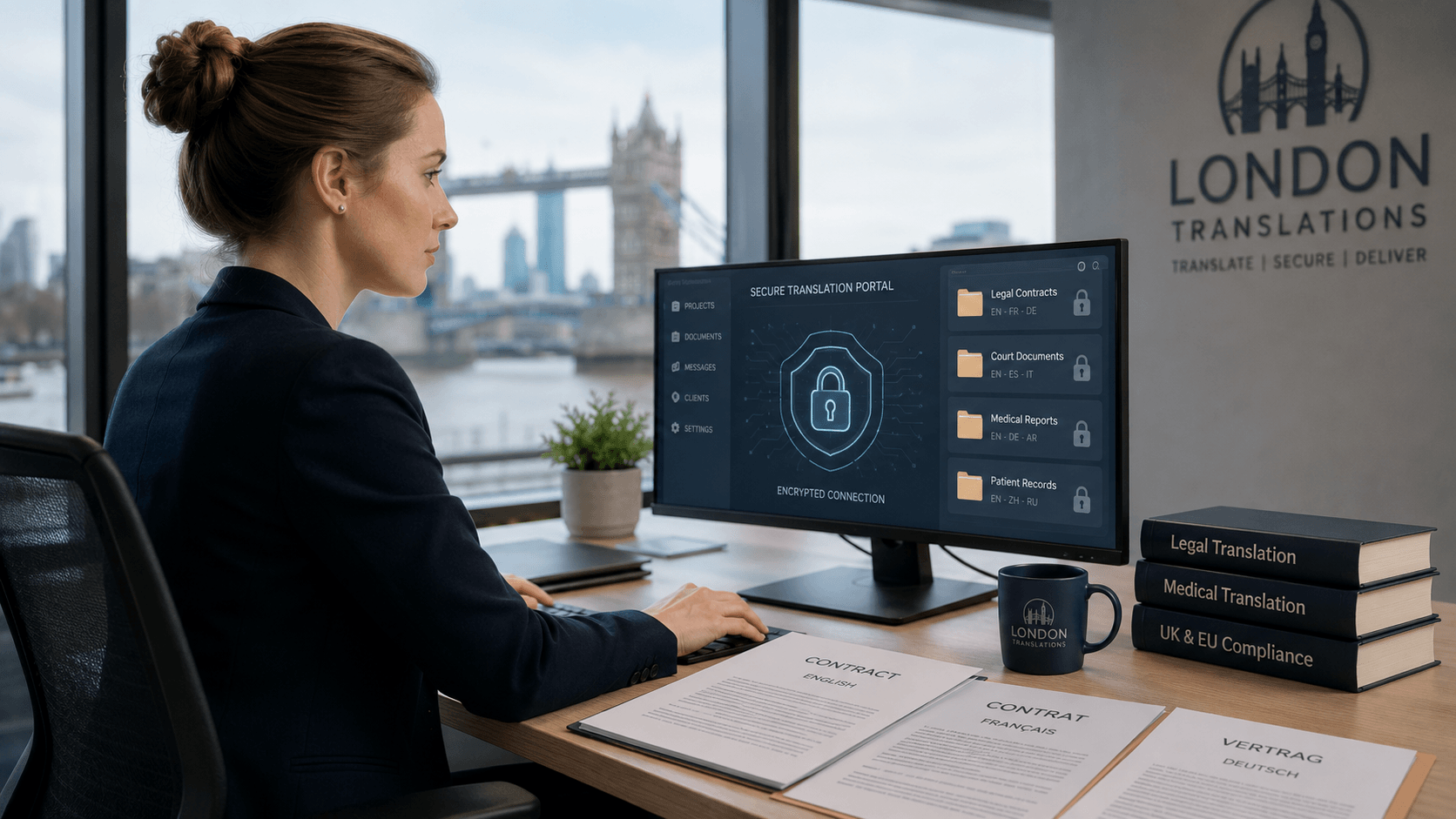
When people search for an iso 27001 translation agency uk, they are rarely looking for translation alone. They are looking for control. They need to know who can see the file, how it is transferred, where it is stored, how long it remains accessible, and whether the final translation will stand up to legal, regulatory, medical, or corporate scrutiny. That matters whether you are sending a patient record, a court bundle, an HR grievance file, a shareholder document, or a notarised certificate for overseas use.
A secure translation project is not just about language quality. It is about reducing exposure at every stage of the workflow. The right agency should make confidential translations feel predictable, documented, and low-friction from the moment you upload a file to the moment the final version is delivered.
What is ISO 27001 certification for translation services?
ISO 27001 certification for translation services means that a translation provider has implemented a structured Information Security Management System, often called an ISMS, to manage risks around confidential information. For translation buyers, this is especially relevant because translation agencies often handle sensitive legal, medical, financial, HR, immigration, corporate, and personal documents.
In practical terms, ISO 27001 is not a translation accuracy standard. It is an information security standard. It focuses on how an organisation identifies security risks, controls access to information, protects files, trains staff, manages suppliers, responds to incidents, and improves its security processes over time.
For a translation agency, ISO 27001 should support secure document intake, controlled access, confidentiality obligations, encrypted or protected file storage, safe delivery methods, clear retention rules, and documented procedures for dealing with information security issues. This is why buyers often look for ISO 27001 when translations involve court documents, medical records, personal data, contracts, due diligence files, tender documents, or regulated submissions.
Simple definition for buyers
An ISO 27001 translation agency is a language service provider that manages client documents through a formal information security framework. The aim is to reduce the risk of unauthorised access, accidental disclosure, poor file handling, uncontrolled sharing, and weak post-project retention.
What ISO 27001 does not mean
ISO 27001 does not automatically prove that every translation is linguistically accurate, accepted by every authority, or compliant with every legal requirement. It also does not mean that no security incident can ever happen. Instead, it shows that the provider has a structured system for identifying risks, applying controls, documenting responsibilities, and improving how information is protected.
Why security matters in translation more than most buyers realise
Sensitive documents move through more hands than many clients expect. A typical project can involve intake, project management, linguistic assignment, review, formatting, certification, and delivery. If that process is poorly controlled, risks multiply quickly.
The most common concerns include:
- unauthorised access to confidential files
- files being shared by unsecured email chains
- unclear retention and deletion periods
- too many people touching the document
- public tools being used without client approval
- missing audit trails when compliance teams ask questions later
That is why buyers increasingly look for strong information security translation workflows instead of choosing on price alone.
What ISO 27001 means in practice for translation buyers
ISO 27001 is best understood as a structured way of managing information security, not as a single technical feature. For a translation client, that matters because sensitive files are rarely protected by one control alone. Real protection comes from a joined-up approach that covers people, systems, access, processes, and accountability.
In practical terms, a strong secure translation workflow should cover:
Controlled intake
Files should enter the workflow through a managed route, not through scattered personal inboxes or ad hoc messaging threads.
Limited access
Only the people who need the file for the job should be able to open it. That usually means role-based access and clear internal permissions.
Secure file handling
The agency should be able to explain how files are transferred, where they are stored, how versions are controlled, and how final delivery works.
Confidentiality obligations
Linguists, reviewers, and project staff handling sensitive content should be bound by confidentiality requirements, not just trusted informally.
Clear retention and deletion rules
A professional provider should be able to tell you what happens after delivery. If you ask for deletion, the answer should be operationally clear.
Incident awareness
If something goes wrong, there should be a documented way to escalate, investigate, and respond.
If your files include legal, medical, HR, or compliance content, ask these questions before the first document is uploaded. It is much easier to build the right workflow at the start than to retrofit it halfway through a project.
Need a secure route for contracts, medical records, or official submissions? Upload your file with the language pair, deadline, and destination authority, and the handling route can be defined before work begins.
What an ISMS means inside a translation agency
An Information Security Management System is the set of policies, responsibilities, controls, and review processes used to protect information. In a translation agency, an ISMS should apply to the way client files are received, assessed, assigned, translated, reviewed, certified, delivered, retained, and deleted.
For buyers, the most important question is not only whether the provider mentions ISO 27001, but how the security system applies to the actual translation workflow. A strong provider should be able to explain:
how sensitive documents are classified
who can access files during a project
how freelance linguists, reviewers, and internal staff are controlled
whether cloud systems, portals, CAT tools, or file-sharing platforms are covered by security procedures
how corrections, revised versions, and final certified files are managed
how long files remain available after delivery
what happens if a client asks for deletion or restricted access
This matters because translation projects often involve more than one stage. A file may pass through project management, translation, proofreading, desktop publishing, certification, notarisation, or delivery. ISO 27001 is relevant because it encourages the provider to manage those stages as part of one controlled security system rather than as separate, informal tasks.
ISO 27001 vs ISO 17100 vs ISO 9001 for translation buyers
ISO standards can be confusing because several of them may appear on translation agency websites. They are not the same.
ISO 27001
ISO 27001 focuses on information security. For translation services, it is relevant to confidential documents, secure file handling, access control, supplier management, risk assessment, incident response, and data protection processes.
ISO 17100
ISO 17100 is specific to translation services. It focuses on translation processes, translator qualifications, revision, project management, and the resources required to deliver professional translation work. It is more closely linked to linguistic workflow and translation quality control.
ISO 9001
ISO 9001 focuses on quality management systems across many types of organisations. For a translation agency, it may support consistent processes, customer service, internal review, complaints handling, and continuous improvement.
Which one matters most?
For sensitive files, ISO 27001 is especially relevant because the core concern is information security. For translation quality, ISO 17100 is more directly relevant. For general service consistency, ISO 9001 may also help. The strongest providers often combine secure file handling with qualified linguists, documented project management, and the right certification route for the receiving authority.
How ISO 27001 supports GDPR-aware translation workflows in the UK
UK translation buyers often ask whether ISO 27001 means a provider is GDPR-compliant. The answer is that ISO 27001 can support GDPR-aware working, but it does not replace UK GDPR obligations. Data protection compliance depends on the specific role of the organisation, the type of personal data being processed, the lawful basis, contractual terms, retention rules, processor obligations, and security measures used in practice.
For translation work, this matters because many documents contain personal data or special category data. Examples include medical records, immigration files, employment documents, court evidence, family records, criminal record certificates, and safeguarding material.
A GDPR-aware secure translation workflow should consider:
what personal data is included in the file
whether special category data is present
who acts as controller or processor
whether a data processing agreement is needed
whether access is limited to the minimum required team
whether client files are transferred and stored securely
whether any third-party systems are used
how long files are retained after delivery
whether deletion can be requested after completion
ISO 27001 is helpful because it encourages structured risk management and documented controls. However, buyers should still ask practical questions about confidentiality, privacy, file retention, data processing terms, and the handling route for sensitive personal information.
The secure translation control matrix

Not every document needs the same level of protection. One of the biggest mistakes buyers make is treating all files as either “normal” or “highly confidential.” A more useful approach is to classify them by business risk.
Low-sensitivity files
Examples:
- birth certificates already intended for official submission
- academic transcripts
- standard civil status documents
- public-facing corporate brochures
Recommended controls:
- secure upload channel
- restricted access to assigned staff
- standard retention rules
- certified PDF delivery where appropriate
Medium-sensitivity files
Examples:
- employment contracts
- board minutes
- supplier agreements
- internal policies
- compliance correspondence
Recommended controls:
- encrypted storage
- named project team only
- explicit confidentiality controls
- tracked version management
- defined deletion timetable after completion
High-sensitivity files
Examples:
- medical records
- litigation bundles
- witness statements
- disciplinary case files
- internal investigation materials
- M&A or tender documents
- safeguarding records
Recommended controls:
- tightly limited access
- need-to-know assignment model
- secure delivery only
- no uncontrolled forwarding
- clear retention instructions
- documented handling restrictions from the client side
This risk-based model is where many generic providers fall short. They may promise confidential translations, but they do not always adapt the workflow to the sensitivity of the file. That gap is often invisible until procurement, legal, or IT asks how the project was actually handled.
What secure file handling should look like from start to finish

A translation agency handling sensitive files safely should be able to walk you through the full chain of custody in plain English.
1. File receipt
You send the document through an agreed channel with instructions about destination, deadline, and any special restrictions.
2. Project triage
The file is reviewed for sensitivity, language pair, certification needs, formatting issues, and the minimum number of people required to complete it.
3. Team assignment
The job is assigned to suitable linguists and reviewers with the right subject knowledge and only the access required for their role.
4. Translation and review
The translation is completed and checked in a controlled workflow, with terminology, formatting, and document integrity preserved.
5. Certification or authentication
If needed, the file is prepared for certified, notarised, or sworn use, depending on the submission route.
6. Delivery
The final translation is returned through an agreed secure method, with PDFs, hard copies, signatures, or notarial steps included where required.
7. Post-project handling
Files are retained, archived, or deleted in line with agreed policy and client instructions.
That sequence sounds simple. The difference between a secure provider and a risky one is whether each stage is actually controlled, documented, and limited to the right people.
How to check whether ISO 27001 actually covers your translation project
When a provider says it is ISO 27001 certified, buyers should check the scope. The scope explains which parts of the organisation, systems, locations, services, or processes are covered by the certification. This is important because a certificate may not automatically cover every department, every platform, every subcontractor, or every type of service offered by the business.
Before uploading sensitive files, ask:
Is ISO 27001 certification currently valid?
What is the scope of the certificate?
Does the scope include translation project management and client file handling?
Are cloud storage, file transfer systems, and project management tools included in the security process?
How are external linguists or subcontractors controlled?
Does the provider use a Statement of Applicability or equivalent control framework?
Can the agency explain which security controls apply to your project?
The best answer is not simply “we are certified.” The best answer explains how certification connects to the actual journey of your document.
The questions smart buyers ask before uploading sensitive files
This is the section most teams bookmark.
Before starting a project, ask:
- How should I send the file if it contains personal, legal, or medical information?
- Who will be able to access it inside your workflow?
- Do you use secure, encrypted storage for active projects?
- Can you limit access to a named team only?
- What confidentiality rules apply to your linguists and reviewers?
- Do you use any third-party tools on client content, and if so, under what controls?
- Can you work within a client portal or restricted environment if required?
- How do you handle certified, sworn, or notarised documents containing confidential data?
- How long do you retain files after delivery?
- Can I request deletion after completion?
- How do you deliver completed files safely?
- What happens if there is a security issue or urgent correction after delivery?
A strong provider will answer these questions clearly and without defensiveness. Vague answers are a warning sign.
AI, machine translation, and confidential client files
One of the most important modern questions for secure translation is whether client content is entered into public AI tools, machine translation systems, or online editing platforms. For low-risk public content, technology may be useful. For legal, medical, HR, financial, immigration, or commercially sensitive documents, buyers should ask exactly what tools are used and under what controls.
Before sending confidential documents, ask:
Will any AI or machine translation tools be used on my content?
Are public tools prohibited for confidential files unless I approve them?
Are translation memories, glossaries, or terminology databases controlled securely?
Can my files be excluded from tool training, reuse, or storage where applicable?
Are linguists instructed not to paste confidential content into uncontrolled platforms?
Can the project be handled manually or within a restricted client environment if required?
The issue is not whether technology is always good or bad. The issue is control. A secure translation provider should be able to explain when technology is used, when it is restricted, and how client confidentiality is protected.
Red flags that should make you pause
A lot of agencies talk about compliance. Fewer explain the actual file journey.
Be cautious if you hear phrases like:
- “Just email it over”
- “All our translators can access jobs as needed”
- “We keep files for convenience”
- “We use whatever tools are fastest”
- “We can’t really say who will work on it until later”
- “Everything is secure” without details
The problem is not only data exposure. It is also operational uncertainty. If a supplier cannot explain secure file handling clearly before the project begins, they are unlikely to improve once the file is in motion.
Confidential translations by document type
Different document categories create different security pressures. That is why a one-size-fits-all workflow usually underperforms.
Legal documents
Legal translation often involves contracts, court documents, witness evidence, pleadings, powers of attorney, compliance notices, and cross-border filings. These files frequently combine confidentiality risk with formatting precision and tight deadlines.
For legal work, buyers usually need:
- minimal-access handling
- terminology consistency
- exact reproduction of names, dates, clauses, and references
- clear certification route if the document is being filed or verified
Medical records
Medical translation can involve patient notes, discharge summaries, psychiatric reports, diagnostics, consent forms, and treatment histories. These files may include highly sensitive personal data and require especially careful handling.
For medical work, buyers usually need:
- specialist linguists with healthcare familiarity
- strong privacy controls
- careful treatment of abbreviations and handwritten content
- secure delivery to clinics, solicitors, insurers, or patients
HR and employment files
HR translations can include grievance reports, disciplinary records, contracts, policy acknowledgements, investigations, and employee correspondence. These are often overlooked from a security perspective, but they can be among the most sensitive corporate documents in circulation.
For HR work, buyers usually need:
- named handling team
- confidentiality-first workflow
- consistent terminology across policy and contractual language
- clear deletion and retention expectations
Corporate and compliance documents
Corporate translations may include board packs, shareholder communications, supplier due diligence, audits, ESG reporting, AML documentation, internal controls, and procurement files.
For these projects, what matters most is often not only translation quality but auditability. Finance, risk, and compliance teams want confidence that the file was handled responsibly from start to finish.
Secure translation is not the same as the right certification route
This is where many projects become more expensive than they need to be.
A document can be highly confidential and still only require a standard certified translation. Another document may not be especially sensitive but still require notarisation or a sworn route because of the receiving authority.
Here is the practical distinction:
Certified translation
Usually required for many official submissions, education, immigration, and general administrative use. The translation is accompanied by a signed statement confirming accuracy.
Notarised translation
Used when an extra authentication step is required from a notary public, often for overseas or legal use.
Sworn translation
Relevant in jurisdictions where sworn translators or court-appointed experts are required for legal validity.
The safest route is to confirm the destination before you order extras. Security and certification are different questions, and both matter.
If your file is going to a court, embassy, university, Home Office route, overseas authority, or regulated institution, send the destination details at quote stage so the correct format is prepared from the start.
What a strong UK agency should add beyond language accuracy
A serious provider should reduce friction, not increase it.
For UK buyers, the best agencies do more than translate. They help you avoid the mistakes that cause rejections, delays, or unnecessary exposure.
That usually means:
- reviewing the submission route before work starts
- confirming whether certified, notarised, or sworn service is required
- assigning a dedicated project coordinator
- using subject-matter specialists for legal, medical, or corporate content
- keeping communication clear and traceable
- delivering in the format the receiving body expects
At UK Certified Translation, this service model is already reflected in the way projects are managed: a dedicated Project Coordinator, sector-specific handling, GDPR-compliant processes, multi-stage review, and delivery prepared for official acceptance. The site also highlights secure handling for embassy submissions, court filings, corporate annual reports, and medical records, alongside certified, sworn, notarised, transcription, and interpreting services. (UK Certified Translations)
A recent client testimonial on the site captures the experience simply: “Uploaded my file in minutes and got the signed PDF back the next day. Solid service.” (UK Certified Translations)
When buyers should prioritise ISO 27001 in a translation supplier
ISO 27001 becomes especially important when the translation project involves confidentiality, legal exposure, personal data, or business-critical information. It is particularly relevant for:
law firms translating litigation bundles, contracts, witness statements, or evidence
healthcare providers translating patient records, reports, or consent documents
HR teams translating grievance files, disciplinary records, or employment contracts
corporate teams translating board papers, M&A files, tenders, or compliance reports
individuals translating immigration, court, or identity documents containing personal information
public sector, regulated, or procurement teams that need documented supplier assurance
For routine public marketing copy, ISO 27001 may be less central. For confidential or regulated documents, it can be a key part of supplier selection.
A practical secure-brief template you can use today
To get a faster and safer quote, send this information in the first message:
- source language
- target language
- document type
- receiving authority or end use
- deadline
- whether the file contains personal, medical, legal, or commercially sensitive information
- whether you need certified, notarised, or sworn output
- whether PDF is enough or hard copy is required
- any naming, formatting, or reference constraints
- any deletion or restricted-access requirements
That one brief reduces back-and-forth and helps the agency choose the right handling route from the start.
When an ISO 27001 translation agency UK buyers trust is the right fit
You do not need a high-control workflow for every text. But you almost certainly do when the file could create legal exposure, privacy risk, reputational damage, or regulatory problems if mishandled.
A stronger secure workflow is worth prioritising when:
- the file contains special category or personal data
- the project involves legal proceedings or evidence
- the document forms part of a compliance or audit trail
- the file contains commercially sensitive business information
- the translation will be used in an official or regulated process
- multiple internal stakeholders need confidence in how the document was handled
That is the real reason this topic matters. Buyers are not simply looking for “translation.” They are looking for low-risk execution.
Final word
Choosing a translation partner for sensitive documents is ultimately a trust decision. Accuracy matters. Speed matters. Price matters. But once a file contains medical details, legal strategy, personal data, or confidential business information, secure handling stops being a nice extra and becomes part of the service itself.
The best outcome is simple: the right people see the file, the workflow stays controlled, the final translation is accepted, and no one has to revisit the security question after the fact.
If you are preparing a confidential project now, send the file with the language pair, deadline, and destination requirement. The safest route is to define the handling method, certification level, and delivery format before the first word is translated.
FAQs
What is an iso 27001 translation agency uk buyers should look for?
An iso 27001 translation agency uk buyers should look for is a provider that can explain how sensitive files are controlled across intake, access, storage, translation, review, delivery, and deletion. The real value is not a badge alone, but a documented approach to confidential translations and secure file handling.
What is ISO 27001 certification for translation services?
ISO 27001 certification for translation services means that a translation provider uses a structured information security management system to protect confidential client information. It is relevant to how files are received, accessed, stored, shared, translated, reviewed, delivered, retained, and deleted.
Does ISO 27001 mean a translation agency is automatically fully compliant with every regulation?
No. ISO 27001 focuses on structured information security management. It is highly relevant for reducing risk, but buyers should still check how the agency handles privacy, retention, access control, contractual confidentiality, and sector-specific compliance requirements.
Is ISO 27001 the same as ISO 17100?
No. ISO 27001 focuses on information security management, while ISO 17100 focuses on translation service processes, translator competence, revision, and project workflow. For sensitive translation projects, both can be useful, but they answer different buyer concerns.
Does ISO 27001 prove the translation will be accepted by the Home Office, courts, embassies, or overseas authorities?
No. ISO 27001 relates to information security, not acceptance rules. Acceptance depends on the receiving authority, certification wording, signature, stamp, notarial requirements, sworn translation rules, formatting, and whether the translation follows the required submission route.
What is the safest way to send confidential documents for translation?
The safest way is to use an agreed secure upload or managed delivery method, share only the files needed for the job, state the sensitivity level upfront, and confirm who will access the material. Avoid uncontrolled forwarding and unclear email chains for high-risk documents.
Can a translation agency handle medical records and legal bundles securely?
Yes, but only if the workflow is designed for it. Ask how access is restricted, whether the team is selected by subject matter, how files are stored, how delivery works, and what happens after completion. Medical, legal, and HR files should never be treated like routine marketing copy.
Should confidential documents be translated using AI or machine translation?
Not without clear controls and client approval. Some technology can support translation workflows, but confidential files should not be pasted into uncontrolled public tools. Buyers should ask whether AI or machine translation will be used, whether data is stored or reused, and whether a manual or restricted workflow is available.
Do confidential translations also need certified, sworn, or notarised handling?
Sometimes. Security and certification are separate issues. A confidential document may still only need a standard certified translation, while another file may require notarisation or a sworn route because of the receiving authority. The destination always matters.
How can I check whether an ISO 27001 certificate applies to my translation project?
Ask for the scope of certification, whether it covers translation project management and client file handling, and whether the relevant systems, staff, suppliers, and file-sharing tools are included in the provider’s security procedures.
Is ISO 27001 mandatory for translation agencies in the UK?
No. ISO 27001 is not mandatory for all UK translation agencies. However, it can be valuable for buyers handling sensitive documents because it shows that the provider has a structured approach to information security management.
What should I send when requesting a quote for a secure translation project?
Send the source file, language pair, deadline, intended use, receiving authority, and any restrictions on access, storage, delivery, or deletion. The more specific the brief, the easier it is to build the right secure workflow from the start.