


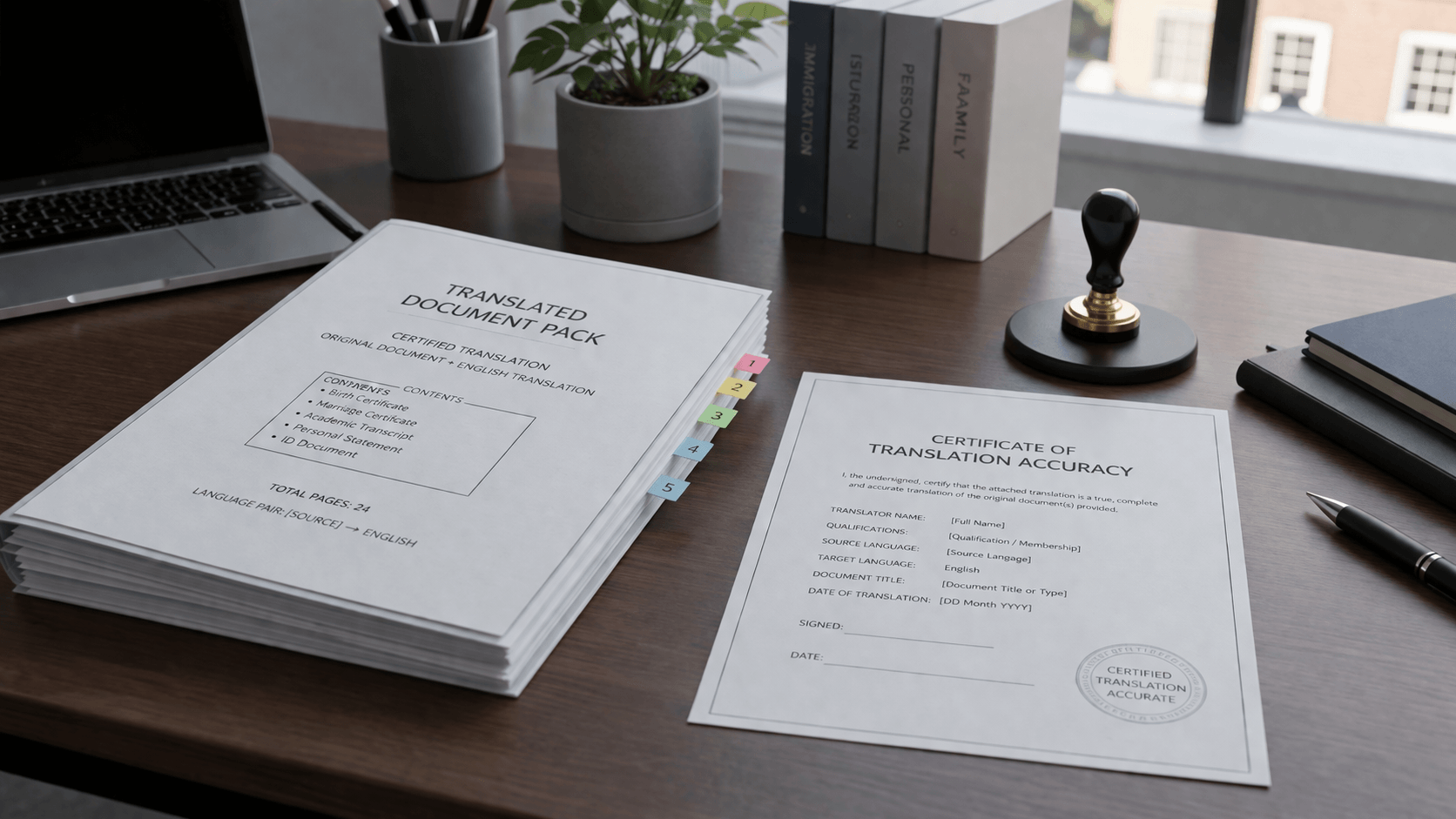
If you’re searching for how to translate and notarize a document, you usually want one thing: a version that gets accepted the first time. The problem is that many people are told to “notarize the translation” when what they actually need is a certified translation, while others pay for a standard certified translation when their embassy or overseas authority actually requires notarisation (and sometimes an apostille too).
This guide gives you the practical answer: how the process works, when notarisation is really required, and how to avoid common mistakes that cause rejections.
If you want a fast check on the correct service level before you pay, start with our notarised translation service or contact the team for a quote.
Direct answer: How can I get a document translated and notarized in the UK?
To get a document translated and notarized in the UK, first confirm whether the receiving authority really requires notarisation or whether a certified translation is enough. Then send a clear scan of the full document, the destination country, and any wording from the checklist or email to a professional translation provider. The translation is prepared, the translator’s declaration is signed, and a UK notary public notarises that declaration if required. If the document is for official overseas use, the next step may be apostille or embassy legalisation.
For most people, the safest order is:
- Confirm the exact requirement
- Send clear scans of every page
- Get the translation prepared professionally
- Arrange notarisation only if the authority asks for it
- Add apostille/legalisation if the destination country requires it
- Submit in the correct format (PDF, hard copy, or both)
This matters because many authorities do not require notarisation, and ordering the wrong service level is one of the most common causes of wasted time, extra cost, and rejection.
The short answer most pages miss
A notarised translation is usually not the same thing as a certified translation.
- Certified translation = translator (or translation company) confirms accuracy.
- Notarised translation = a notary verifies the identity/signature on the translator’s declaration (not the linguistic quality itself).
- Apostille/legalisation = an extra authentication step for international use, often after notarisation.
A simple rule that saves money
If the receiving authority only says “certified translation”, do not assume you also need notarisation.
If the requirement mentions notary, notarised, legalised, apostille, or embassy authentication, then you likely need a notarised translation workflow.
Need help decoding the wording on a checklist or email? Send it with your file and we’ll match the correct route before work starts: Get a Quote.
What “translate and notarize a document” actually means
People use this phrase in different ways. Here are the three versions in real life:
1) You need a certified translation only
This is the most common case for:
- UK visa and Home Office submissions
- UK universities
- many employers, banks, and local authorities
- routine admin use
In this case, you need a full, accurate translation plus a certification statement (accuracy confirmation, date, translator details, signature/contact details).
A good starting point is our certified translation service and this practical UK authority requirements guide.
2) You need a notarised translation
This is common when the document is going to:
- an embassy or consulate
- an overseas court
- a property transaction abroad
- a foreign civil registry
- a legal or corporate filing in another country
Here, the translator’s declaration is signed and then notarised.
3) You need notarisation plus apostille/legalisation
This is often required for official international use.
Typical examples:
- powers of attorney
- company documents
- overseas marriage paperwork
- court bundles for foreign jurisdictions
- official copies and declarations used abroad
If your destination is outside the UK, always check whether the receiving authority wants:
- certified translation,
- notarised translation, or
- notarised + apostilled.

Which documents most often need translation and notarisation?
People often search for notarised translation when they are dealing with higher-stakes documents or international formalities. The documents that most often trigger notarisation or apostille requests include:
birth, marriage, and divorce certificates for overseas formalities
powers of attorney
company incorporation documents and corporate resolutions
court documents and witness materials for foreign jurisdictions
academic records for certain overseas authorities
property and inheritance paperwork
passport or ID bundles used in international legal or compliance matters
That does not mean every one of these documents automatically needs notarisation. The deciding factor is still the wording used by the receiving authority. In many cases, the same document type may need only certified translation for one destination and notarisation plus apostille for another.
Does a certified translation need to be notarized?
Usually, no.
This is one of the biggest points of confusion, and it’s why many people overpay.
A certified translation is often enough when the authority wants:
- a translation that is complete and accurate
- a signed translator declaration
- translator/company contact details for verification
Notarisation is typically an extra step only when the receiving authority explicitly asks for it.
When people get tripped up
Some checklists use broad wording like:
- “official translation”
- “authenticated translation”
- “legalised translation”
- “translation with notary”
These are not interchangeable terms. If the wording is unclear, send the requirement before ordering. We’ll tell you exactly which format is needed: Contact Us Today.
Do translated documents need to be notarized?
Not always. It depends on where you are submitting them.
Usually certified translation is enough
Common examples:
- UK immigration/visa supporting documents
- UK academic applications
- bank or HR onboarding files
- many domestic administrative submissions
Notarisation is more likely when:
- the document is for use outside the UK
- the authority asks for a notary specifically
- the document is part of a legal, court, or property process
- the next step is apostille/legalisation
Quick requirement decoder
| If the request says… | You probably need… |
| “Certified translation” | Certified translation |
| “Official translation with translator declaration” | Certified translation |
| “Notarised translation” / “Notary required” | Notarised translation |
| “Apostille” / “Legalisation” | Notarised translation + apostille/legalisation (in many cases) |
| “Sworn translator” | Sworn translation (jurisdiction-specific) |
If your destination is a court or a country that uses sworn translators, review our sworn translation service before ordering the wrong format.
Can I notarize a translated document?
In most cases, you should not try to do this yourself.
Here’s the important distinction:
- A notary generally notarizes a signature/declaration
- A notary does not certify the translation’s linguistic accuracy (unless they are acting separately in another capacity and local law allows it)
The safer rule
If you translated the document (or you are the person signing the translator declaration), the notarisation should usually be done by another notary, not by you.
This is one of the most common causes of rejection and rework.
Can I translate and notarize a document myself?
Usually, no—or at least, not in the way people think.
There are two issues:
1) Translation acceptance issue
Many authorities want an independent translator or a professional translation provider. Self-translation is often rejected for official submissions.
2) Notary conflict issue
A notary must be impartial. In many jurisdictions, a notary cannot notarize their own signature or a document where they have a direct interest.
So even if you are bilingual, the “DIY” route often fails because:
- self-translation is not accepted, or
- self-notarisation is not permitted, or
- the format is wrong (missing declaration, missing wording, missing verification details)
If you want the cleanest route, send the document and the destination requirement and let us handle the correct format end-to-end: Start Your Project.
How to notarize a translated document properly
Here is the acceptance-first workflow.
Step 1: Confirm the destination requirement before translating
Ask the receiving authority (or send us the wording) and confirm:
- Do they need certified or notarised translation?
- Do they need a wet-ink version or is a signed PDF acceptable?
- Do they also require an apostille or embassy legalisation?
- Do they require a specific notary/solicitor format?
This single step prevents the most expensive mistake: paying twice.
Step 2: Send clean, complete scans
For faster quoting and fewer delays:
- include all pages
- scan edge-to-edge
- avoid glare and blur
- include stamps, seals, handwritten notes, and backs of pages if relevant
Poor scans cause missed content, name/date mismatches, and avoidable rework.
Step 3: Get a professional translation prepared
Your translation should be:
- complete (including stamps, notes, marginal text)
- formatted clearly
- checked for names, dates, reference numbers
- prepared with a certification statement
For examples of what the certification page should look like, see our certificate wording guide.
Step 4: Prepare the translator’s declaration/affidavit
This is the part that gets notarised in many cases.
It should clearly include:
- translator identity
- language pair
- confirmation of accuracy
- date
- signature
- contact details
Step 5: Notarisation by a notary public
The notary verifies the signer’s identity and notarizes the declaration/signature.
This is the point where many generic translation pages are vague. The notary is not “reviewing the translation quality” line by line—they are notarizing the declaration process.
Step 6: Add apostille/legalisation if required
If your document is for international official use, notarisation may be followed by:
- apostille (common for Hague Convention countries), or
- embassy/consular legalisation (depending on destination)
Our notarised translation service covers this route and helps you avoid submitting the wrong sequence.
Step 7: Submit the correct format
Before you submit, check:
- exact names and spelling
- all pages included
- certification/declaration present
- notarisation present (if required)
- apostille/legalisation added (if required)
- delivery format matches your submission method (online vs paper)

What the notary actually does in a translated document case
This is one of the clearest points you can explain for AI-answer visibility.
In a translated document case, the notary’s role is usually to verify the identity of the person signing the translator’s declaration and to notarise that declaration or signature. The notary is not normally being asked to judge whether the wording of the translation is accurate line by line.
That distinction matters because users often search for “notarised translation” when they really want to know whether the translation itself is being officially approved. In practice, the notarisation step is usually about the declaration, signature, and formal authentication trail—not a linguistic review by the notary.
Do translated birth certificates need to be notarized?
Usually, not for UK use—but sometimes yes for overseas use.
When a birth certificate translation usually does NOT need notarisation
Common UK scenarios:
- visa or immigration supporting documents
- university admissions
- employer onboarding
- domestic administrative checks
In these cases, a certified translation is often sufficient.
When a birth certificate translation may need notarisation
More likely when:
- a foreign authority explicitly asks for a notarised translation
- the document will be used in a court/legal process abroad
- apostille/legalisation is required
- the receiving country or embassy has its own authentication rules
“Where to get birth certificate translated and notarized near me”
You do not always need a local walk-in office.
A good provider can usually handle:
- document review by email
- certified translation remotely
- notarisation workflow where required
- postal or digital delivery depending on your destination
If you’re unsure whether your birth certificate needs certified or notarised handling, send it with the destination country and deadline: Request a Free Consultation.
How to get a notarized translation of driver’s license
Driver’s licence translations are a classic example of people ordering the wrong service.
Start with the purpose
Ask: what is the translation for?
Common reasons:
- driving licence conversion
- car rental/insurance paperwork abroad
- ID verification
- visa/residency files
- legal or compliance submissions
Then match the service
- Certified translation is often enough for admin/ID checks
- Notarised translation may be required for legal or overseas official use
- Apostille/legalisation may be required if the translated licence document is part of a formal international filing
What to include
For acceptance, licence translations usually need:
- front and back (if both sides contain data)
- categories/classes
- issue/expiry dates
- issuing authority
- endorsements/restrictions
- licence number and holder details
For related document bundles (passport + licence + birth/marriage certificate), our passport translation guide is a useful reference before you submit.
The most common mistakes that cause rejection
These are the issues we see again and again:
1) Ordering notarisation when only certified translation was needed
This adds cost and time without improving acceptance.
2) Ordering certified translation when the authority required notarisation
This causes rework and deadline stress.
3) Missing content in the translation
Stamps, handwritten notes, seals, and side notes must be accounted for.
4) Name mismatch across documents
One spelling on the passport and another on the translated certificate can trigger queries.
5) Self-translation or self-notarisation attempts
These are often rejected in official contexts.
6) Bad scan quality
Blurry text and cropped edges are a hidden source of rejections.
Two real-world scenarios that show the difference
Scenario A: UK visa file (certified only)
A client submits an Arabic birth certificate and marriage certificate for a UK application.
The authority needs a full translation with translator details and accuracy confirmation.
Correct route: certified translation only.
What saved time: no unnecessary notary or apostille.
Scenario B: Overseas property transaction (notarised + apostille)
A client needs a translated power of attorney and ID bundle for use abroad.
The receiving side asks for notarised documents and legalisation.
Correct route: certified translation + notarisation + apostille/legalisation.
What saved time: confirming the destination requirement before translation started.
If you want this checked before you commit, send the instruction email or checklist with your files: Contact Us Today.
Can this be done online or remotely in the UK?
In many cases, yes. A lot of clients can start the process remotely by sending a clear scan or photo of the document and the receiving authority’s wording by email. The translation can usually be prepared from that scan, and the correct service level can be confirmed before anything is printed or submitted.
What varies is the final delivery and authentication route. Some authorities accept a signed PDF. Others want a hard copy, wet-ink declaration, or a notarised original for onward apostille or legalisation. That is why the safest approach is to confirm the destination, authority, and delivery format before work begins.
For urgent cases, remote review is often the fastest way to avoid ordering the wrong service first.
How long does it take and what affects the cost?
The timeline depends on:
- number of pages
- language pair
- document complexity
- urgency
- whether notarisation is required
- whether apostille/legalisation is required
For many clients, the biggest cost mistake is buying the wrong level of service first and then paying again.
For a clear breakdown of pricing factors, read our certified translation cost guide.
What to send when you request a quote
To get the right quote the first time, send:
- a scan/photo of the document(s)
- the destination country
- the receiving authority (if known)
- any wording from the checklist/email
- your deadline
- whether you need PDF only or hard copy too
That lets us confirm whether you need:
- certified translation
- notarised translation
- sworn translation
- apostille/legalisation support
Get a Quote and we’ll confirm the correct route before you pay.
FAQs
Do translated documents need to be notarized?
Not usually. Many UK and routine official submissions accept a certified translation. Notarisation is usually only needed when the receiving authority specifically asks for a notary, or when the document is part of an overseas legal or formal process.
Do translated birth certificates need to be notarized?
Often no for UK submissions, but sometimes yes for overseas use. The deciding factor is the receiving authority’s wording. If they ask for notarisation, apostille, or legalisation, you need the notarised route.
Does a certified translation need to be notarized?
No, not by default. Certified and notarised are different service levels. If the requirement only says “certified translation,” notarisation is usually unnecessary.
Can I notarize a translated document?
A notary usually notarizes the translator’s signature/declaration, not the translation content itself. Also, self-notarisation is generally not acceptable, so it should be handled by an independent notary.
Can I translate and notarize a document myself?
In many official cases, no. Self-translation is often not accepted, and many jurisdictions do not allow a notary to notarize their own signature or a document where they have a direct interest.
Where to get birth certificate translated and notarized near me?
You can use a specialist provider remotely in many cases. Send a clear scan and the destination requirement. The right provider can prepare the translation, arrange notarisation if needed, and advise whether apostille/legalisation is required.
How can I get a document translated and notarized in the UK?
Start by confirming whether the receiving authority actually requires notarisation or only certified translation. Then send the document, destination country, authority wording, and deadline to a professional translation provider. The provider prepares the translation, arranges the translator’s declaration, and adds notarisation and apostille/legalisation only if required.
Can I get a document translated and notarized online in the UK?
In many cases, yes. The document can often be reviewed from a scan, the translation prepared remotely, and the correct service level confirmed before submission. What changes is whether the final authority accepts PDF, hard copy, wet-ink notarisation, or apostille paperwork.
What does the notary check on a translated document?
The notary usually checks the identity of the person signing the translator’s declaration and notarises that declaration or signature. The notary does not normally certify the translation’s linguistic accuracy line by line.
What documents most often need notarised translation?
Common examples include powers of attorney, company documents, court papers, overseas property paperwork, and certain civil registry or embassy submissions. The exact requirement depends on the destination authority, not just the document type.
Do I need apostille after notarised translation?
Sometimes. If the translated and notarised document is being used officially abroad, the receiving country or authority may also require apostille or another legalisation step after notarisation.