



Freelance translation jobs are everywhere—but the best ones are rarely won by the fastest bidder. If you’re looking for freelance translation opportunities, internet translation jobs, or remote translation jobs, the real advantage comes from how clearly you position yourself, how well you screen projects, and how easy you make it for clients to trust you.
This guide shows you where to find work, how to build a profile that gets replies, and how to stand out in a crowded market without underpricing yourself.
Need certified document translation support right now?
If you’re here as a business, law firm, university applicant, or individual with official documents, you can Get a Quote and Upload Your File through UK Certified Translation for a fast, compliant document review and turnaround.
What counts as freelance translation jobs
Not all “translation work” is the same. Grouping opportunities correctly helps you avoid wasting time on the wrong channels.
1) Specialist translation jobs
These are projects where language skills alone are not enough. The client also expects subject knowledge.
Examples:
- Legal contracts and court bundles
- Medical reports and consent forms
- Academic transcripts and diplomas
- Financial statements
- Technical manuals
- Marketing copy and transcreation
These usually pay better when you can show:
- A clear niche
- Relevant samples
- A reliable process
- Good terminology control
2) Volume marketplace jobs
These are common on freelancer platforms and job boards. They can help you build momentum, but they vary heavily in quality.
Typical examples:
- Product descriptions
- App content
- Website pages
- Short business emails
- E-commerce listings
These can be useful early on if you:
- Choose projects strategically
- Protect your rates
- Build repeat clients quickly
3) Agency vendor work
Many translators build their careers by working with agencies first. Agency work can provide:
- Steady volume
- Project management support
- Access to larger clients
- Experience in QA workflows
It is often the best route when you are building your first 12–24 months of consistent work.
4) Direct client work
This is where your margin is usually strongest—but it takes longer to build.
Direct clients often come from:
- Referrals
- Your website
- Professional directories
- Repeat buyers who trust your process
Where to look for freelance translation jobs
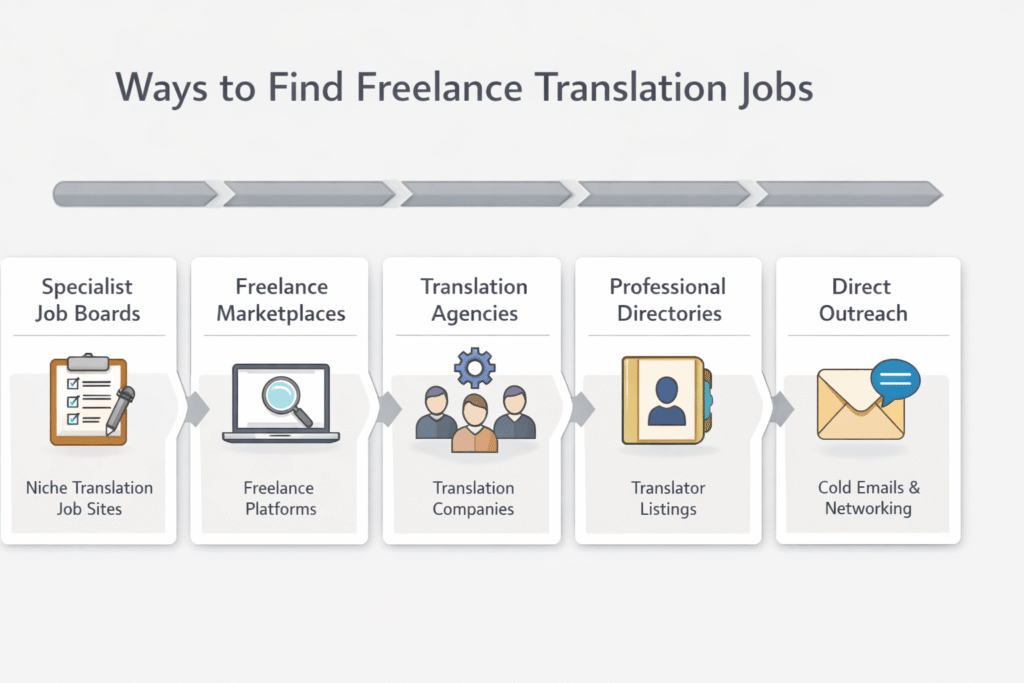
The best strategy is not “pick one platform.” It’s building a balanced pipeline.
The 5-channel model that works
Use all five channels at the same time, but give each a different purpose.
Channel 1: Specialist translation job boards
Use these for higher-intent, language-specific opportunities.
What they’re good for:
- Language-pair matching
- Agency sourcing
- Industry-specific postings
- Recurring client relationships
How to stand out here:
- Respond exactly as requested
- Mention the subject field first (not your life story)
- Include relevant samples immediately
- State your turnaround and rate structure clearly
Channel 2: Freelance marketplaces
These are useful for testing offers, building social proof, and filling schedule gaps.
What they’re good for:
- Fast project flow
- International buyers
- Testing niches (legal vs marketing vs technical)
- Building a stronger portfolio
How to stand out here:
- Create separate profiles for separate niches (if the platform allows it)
- Lead with outcomes (“contract-ready legal translation”, “website-ready bilingual copy”)
- Use portfolio pieces with before/after formatting
- Avoid generic proposals
Channel 3: Agency outreach
This is the most overlooked source of stable work.
What to do:
- Make a list of agencies by niche and language pair
- Check their vendor pages or careers pages
- Send a short, tailored introduction
- Follow up once (politely)
- Track replies in a simple spreadsheet
Best practice:
- One niche per email
- One clear CTA (“I can send a short legal sample if helpful”)
- One-page CV + portfolio link
- No mass-template wording
Channel 4: Professional directories and associations
These help you build credibility and improve your discoverability.
Why they matter:
- Clients use them to verify translators
- Agencies check profiles before onboarding
- Your profile can rank in search
- Membership adds trust signals
Your profile should include:
- Language pair(s)
- Specialisms
- Location/time zone
- Qualifications
- CAT tools (if relevant)
- Document types you handle
- Turnaround expectations
- Contact method
Channel 5: Direct outreach and referrals
This is where long-term clients often come from.
Start with industries that regularly need translation:
- Immigration advisers
- Solicitors
- Universities and admissions consultants
- Accountancy firms
- Medical clinics
- HR teams
- Recruitment firms
- Export/import businesses
A simple outreach message works better than a sales pitch:
- Who you help
- What documents/content you handle
- What makes your process low-risk
- How to send a sample project
How to stand out from other translators
Most translators blend in because their profile says the same thing as everyone else: “accurate, fast, professional.”
Clients don’t buy adjectives. They buy confidence.
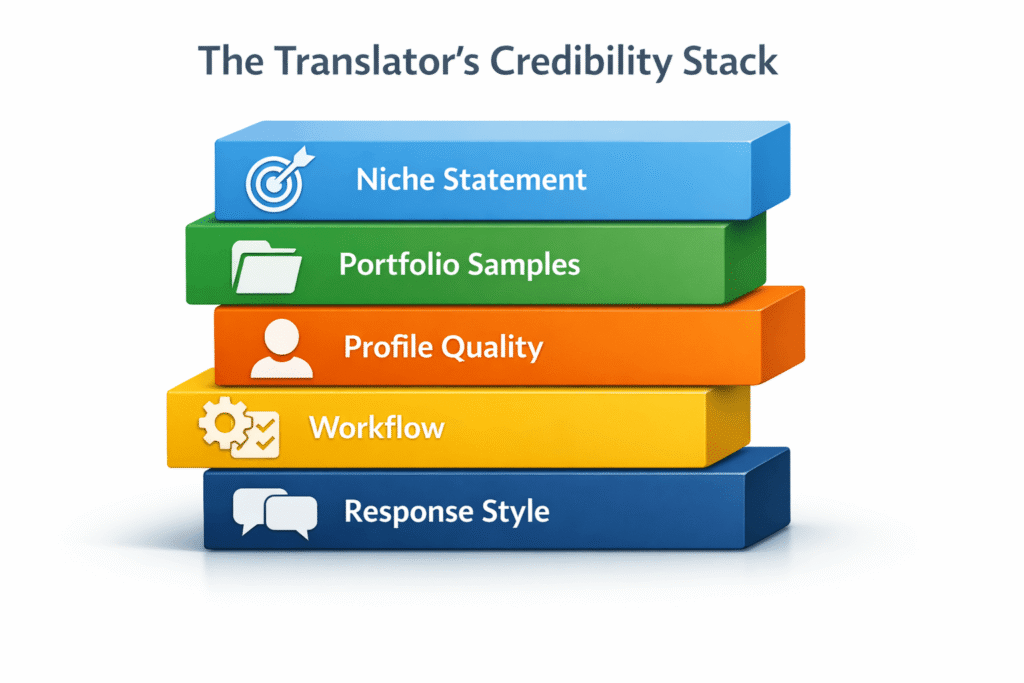
Build a credibility stack
Instead of trying to sound impressive, show proof in layers.
Your credibility stack should include
1) A clear niche statement
Bad:
- “I provide translation services in multiple fields.”
Better:
- “I translate legal and immigration documents from Arabic to English for UK submissions.”
2) A focused portfolio
Use 4–6 sample categories, not 40 random files.
Good portfolio mix:
- 1 legal sample
- 1 academic sample
- 1 business/corporate sample
- 1 formatting-heavy document sample
- 1 terminology-heavy sample
- 1 short turnaround sample (with notes)
3) A profile that answers buyer questions fast
Your profile should answer these within 10 seconds:
- Can this person handle my document type?
- Do they understand my deadline?
- Do they look professional?
- Can I trust them with sensitive files?
4) A simple workflow clients can understand
Clients trust translators who look organised.
Add a short process box:
- File review
- Fixed quote
- Translation + review
- Final delivery (PDF/Word)
- Revisions (if needed)
That one box can increase replies more than a long bio.
5) A professional response style
Your first reply is a sample of your work quality.
A strong first reply includes:
- Confirmation you read the brief
- What you need to start
- Your availability
- A realistic turnaround
- Your pricing model
- One relevant proof point
A better way to apply for translation jobs
If you send the same proposal everywhere, you’ll get ignored.
Use this 3-part proposal format instead.
The 3-part proposal format
Part 1: Match the brief
Show the client you read the post.
Example:
- “I can help with your English-to-Arabic legal document translation and preserve the original formatting for submission.”
Part 2: Show relevant proof
Add one targeted proof point.
Examples:
- “I regularly handle contracts, statements, and supporting documents.”
- “I can deliver a clean bilingual layout if needed.”
- “I work with a review checklist to reduce back-and-forth.”
Part 3: Make the next step easy
Give a simple action.
Examples:
- “If you share the file, I can confirm turnaround and provide a fixed quote.”
- “I can review the document today and tell you whether certification is needed.”
- “Send the sample page and I’ll confirm terminology approach before we proceed.”
How to price freelance translation jobs without undercutting yourself
The fastest way to lose good clients is unclear pricing.
Use a pricing model clients can understand
Choose a structure that matches the work type:
Per word
Best for:
- Text-heavy documents
- Repetitive content
- Website content
- Manuals
Per page
Best for:
- Certificates
- IDs
- Standard official documents
- Similar-length forms
Per hour
Best for:
- Editing/revision
- Research-heavy projects
- Consultation
- Urgent file cleanup
Per project (fixed quote)
Best for:
- Mixed files
- Complex formatting
- Multi-document submissions
- High-stakes work
Add a rate floor rule
Before you quote, define your minimum acceptable price based on:
- Subject complexity
- Deadline
- File quality (scan/photo quality matters)
- Formatting workload
- Confidentiality requirements
- Revisions scope
This protects you from “small job” requests that become half-day projects.
How to spot bad freelance translation opportunities early
Not every job post is worth your time. Some are low-quality. Some are risky.
Red flags to watch for
Job post red flags
- No source language or target language listed
- “Need this in 1 hour” for a long document
- No sample, no context, no deadline clarity
- “Budget to be discussed” with no scope
- Vague phrases like “simple translation” for legal/medical files
Client red flags
- Refuses to share file but wants a final quote
- Pushes for immediate start without terms
- Avoids platform or formal email channels too early
- Uses personal messaging only
- Asks for free test work beyond a short sample
Payment red flags
- No payment terms
- “We pay after client approval” (with no timeline)
- Requests identity or banking details too early
- Asks you to pay a fee to start work
If something feels off, pause. Professional clients respect process.
A weekly routine that creates consistent freelance translation jobs
Talent matters, but consistency wins more work.
The 60-minute pipeline routine (repeat 5 days a week)
15 minutes: job board scan
- Check specialist boards and platforms
- Save only roles that match your niche
- Ignore everything outside your scope
15 minutes: targeted applications
- Send 2–3 tailored proposals
- Use the 3-part format
- Track sent date and follow-up date
10 minutes: profile improvement
Rotate one small upgrade daily:
- Rewrite headline
- Add one sample
- Add one testimonial
- Improve service description
- Clarify turnaround terms
10 minutes: direct outreach
- Message one agency or one direct client lead
- Keep it short and relevant
10 minutes: relationship follow-up
- Check in with previous clients
- Ask if they need support this month
- Remind them what you specialise in
This routine is simple, but it compounds.
How to stand out specifically in certified document translation work
Many translators want better-paying, lower-chaos work. Certified document translation can be one of the most reliable niches if you understand process and compliance expectations.
Clients in this niche care about:
- Accuracy
- Formatting
- Certification wording
- Fast turnaround
- Clear communication
- File security
That means your edge is not just language skill—it’s process clarity.
A niche positioning example (you can adapt)
“I handle official document translations with a structured workflow: file check, fixed quote, translation, review, and delivery-ready formatting. I work with clear turnaround options and document-type experience (academic, legal, personal records).”
That wording is stronger than “I am a professional translator.”
Conversion-ready trust points you can use naturally
Use these near your contact or quote CTA (website, profile, or proposal footer):
- Fixed quotes before work starts
- Clear delivery format (PDF/Word/hard copy if needed)
- Document-type specialisation
- Revision policy for minor corrections
- Secure file handling
- Clear contact details and response times
CTA block for document clients
If you need official document support rather than a freelancer marketplace bid, Start Your Project with UK Certified Translation. You can Upload Your File and get a clear quote, delivery timeline, and the right certification route for your destination.
CTA block for agencies and firms
If your team needs overflow language support for certified, sworn, or notarised documents, Contact Us Today to discuss ongoing workflow support and turnaround requirements.
CTA block for higher-stakes submissions
For immigration, legal, academic, or embassy-related document packs, Request a Free Consultation and confirm the correct translation route before you submit anything.
Common mistakes that stop translators getting replies
- Applying for everything instead of choosing a niche
- Sending long bios instead of specific proof
- Hiding rates until the third message
- Using generic subject lines
- Not following application instructions
- No portfolio samples
- No process explanation
- Accepting rush jobs without a rate premium
- Ignoring formatting requirements
- Failing to follow up
Fixing just 2–3 of these can dramatically improve response rates.
Final word
Freelance translation jobs are not scarce—but good opportunities go to translators who look easy to trust and easy to hire.
Start with a focused niche, build a simple credibility stack, and use a repeatable outreach routine. If you do that consistently, you’ll stop chasing random jobs and start building a real pipeline.
And if your work includes official documents, learning the certified translation workflow is one of the fastest ways to stand out in a crowded market.
FAQs
Where can I find freelance translation jobs online?
You can find freelance translation jobs on specialist translation job boards, freelancer marketplaces, agency vendor portals, professional directories, and through direct outreach to businesses that regularly need multilingual support.
What are the best freelance translation opportunities for beginners?
The best freelance translation opportunities for beginners are usually agency work, smaller marketplace projects, and niche-specific jobs where you can show subject knowledge and a clean process. Start with manageable projects and build a focused portfolio.
Are internet translation jobs legitimate?
Many internet translation jobs are legitimate, but quality varies. Check for clear language pairs, realistic deadlines, transparent payment terms, and a professional communication process before accepting work.
How do I win more remote translation jobs?
To win more remote translation jobs, specialise in a niche, tailor each proposal, show relevant samples, explain your workflow, and make it easy for the client to send files and approve a quote quickly.
Should I charge per word or per project for freelance translation jobs?
It depends on the job. Per-word pricing works well for text-heavy files, while per-project pricing is often better for complex, formatting-heavy, or multi-document assignments.
Do I need qualifications to get freelance translation jobs?
Qualifications help, but clients also look for experience, niche focus, and reliability. A strong portfolio, a clear process, and consistent results can be just as important as formal training.