


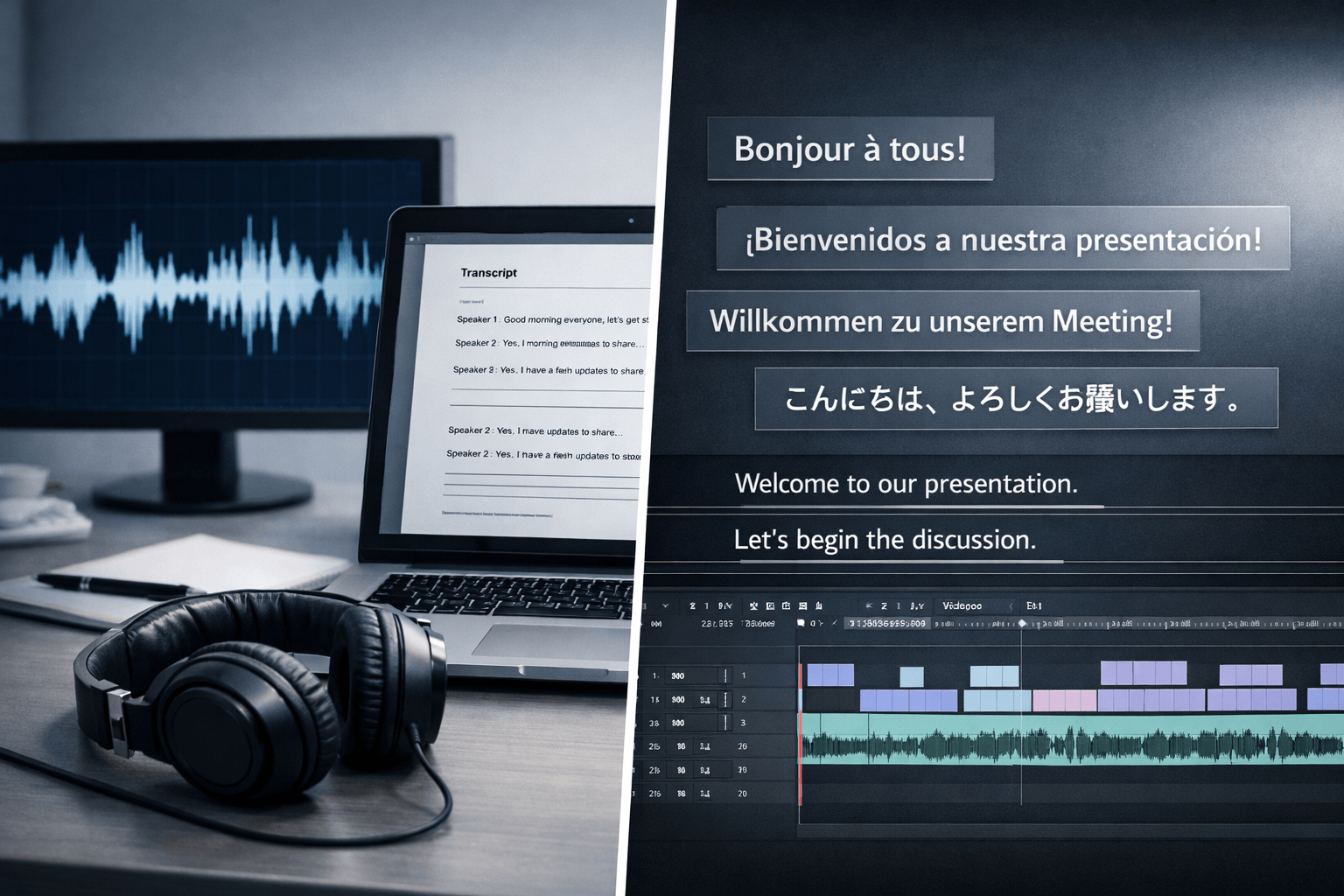
If you’re working with interviews, meetings, podcasts, legal recordings, or multilingual video, you’ve probably asked the same question: do I need transcribing and translating, or just one of them?
The short answer is simple:
- Transcription turns speech into text (usually in the same language)
- Translation turns meaning from one language into another
- Many projects need both—in a specific order
This matters because choosing the wrong workflow can create delays, accuracy issues, and avoidable costs.
If you already have audio or video and need a transcript, translation, or a complete multilingual document pack, upload your file and get a quote. A specialist team can review the recording quality, language pair, and delivery format before work starts.
What is the difference between transcribing and translating services?
Transcribing services convert spoken audio or video into written text in the same language. Translating services convert written text from one language into another while preserving meaning, tone, and context.
In simple terms:
Transcription changes format
Translation changes language
If your starting point is audio or video and your final deliverable needs to be in another language, you will usually need both services in sequence.
A simple way to think about it:
If you need spoken English turned into written English, you need transcription.
If you need written English turned into written Spanish, you need translation.
If you need spoken Arabic turned into written English, you usually need transcription first and translation second.
This is why people often search for transcribing and translating services together. They are connected, but they are not the same service.
The quickest way to understand the difference
Transcription changes format (speech to text). Translation changes language (one language to another).
When a project starts with audio/video in one language and must end as text in another language, you usually need both.
A simple example
- Source file: Arabic audio interview
- Transcription output: Arabic written transcript
- Translation output: English translation of that transcript
That is a transcribing and translating workflow.
Transcription vs translation at a glance

| Task | What goes in | What comes out | Language change? | Typical use |
| Transcription | Audio or video | Written text | No (usually same language) | Interviews, meetings, legal recordings, podcasts |
| Translation | Written text (or subtitle text) | Written text in another language | Yes | Documents, websites, certificates, reports |
| Transcribing + translating | Audio/video in one language | Transcript + translated text/subtitles | Yes | Research, legal, media, training, multilingual evidence packs |
Transcription, translation, subtitles, captions, and interpreting: what’s the difference?
These services are related, but they solve different problems.
Transcription
Transcription turns spoken content into written text, usually in the same language as the original recording.
Translation
Translation turns written text into another language while preserving meaning and context.
Subtitles
Subtitles are timed on-screen text for video. They may be in the same language as the speaker or translated into another language.
Captions
Captions are also timed on-screen text, but they are usually designed with accessibility in mind and may include speaker changes and important non-speech sounds.
Interpreting
Interpreting is live spoken-language conversion in real time. It is different from transcription and translation because the output is usually spoken rather than written.
If you are dealing with a live meeting, hearing, or event, you may need interpreting. If you are dealing with a recorded file, you may need transcription, translation, or both.
What transcription includes
Transcribing services can be delivered in different styles:
- Verbatim transcription (every word, pauses, fillers, overlaps)
- Clean/edited transcription (lightly cleaned for readability)
- Time-stamped transcription (timestamps for editing, review, subtitles)
- Speaker-labelled transcription (Speaker 1, Speaker 2, named speakers)
What translation includes
Translation is not just word replacement. A strong translation preserves:
- Meaning
- Tone
- Terminology
- Context
- Intended audience
For official use, the translation may also need:
- Certification
- Notarisation
- Sworn translation format (depending on country/authority)
When you only need transcription
You may only need audio transcription services if the audience speaks the same language as the recording and your main goal is to make spoken content searchable, readable, or easier to process.
Common transcription-only use cases
1) Meetings and internal business records
Use transcription when you need a written record of:
- Board meetings
- HR interviews
- Team calls
- Training sessions
2) Podcasts and webinars
Transcripts help with:
- Content repurposing (blogs, newsletters, clips)
- Accessibility
- Editorial review
- Episode summaries
3) Research interviews and focus groups
Researchers often need transcripts for:
- Coding and thematic analysis
- Quote extraction
- Audit trails
- Team collaboration
4) Legal and compliance records
Legal teams often require:
- Verbatim wording
- Speaker identification
- Clear timestamps
- Strict confidentiality handling
If your file is in English and the end user also needs English, transcribing services alone may be enough.
When you only need translation
You only need translation when your source is already text and does not require speech-to-text processing.
Common translation-only use cases
- Birth certificates
- Marriage certificates
- Academic documents
- Contracts
- Medical reports
- Website copy
- Product documentation
In these cases, you can send the text or scanned document directly for translation.
If the final destination is an authority, court, university, or embassy, ask upfront whether the translation must be:
- Certified
- Notarised
- Sworn
- Apostilled (in some cases)
When you need both transcription and translation
This is where many people get stuck—and where project planning matters most.
If your source is audio/video and your final deliverable must be understood in a different language, you usually need both services.
The most common “need both” scenarios
1) Legal audio that must be submitted in another language
Examples:
- Recorded statements
- Interviews
- Hearings
- Evidence clips
Workflow:
- Verbatim transcript in the source language
- Translation into the target language
- Certification (if required for submission)
This creates a clear, reviewable chain from recording to final translated text.
2) Immigration or official case files with voice recordings
If an authority, lawyer, or caseworker needs to review audio that is not in the working language, a transcript + translation is often the most reliable approach.
This is especially useful when:
- Multiple speakers are involved
- Dialects or accents make review difficult
- You need a readable record for the file
3) Research interviews in multilingual studies
For academic and market research projects, teams often need:
- Source-language transcript for auditability
- Target-language translation for analysis/reporting
- Anonymisation of names or identifiers
4) Podcasts, webinars, and training videos for international audiences
A strong media workflow often includes:
- Transcript (for editing and accessibility)
- Translation (for subtitles, captions, or multilingual transcripts)
- Timecodes (for editors and subtitle syncing)
5) Customer support and QA call reviews across regions
Global teams often transcribe and translate calls to:
- Audit service quality
- Train teams
- Investigate incidents
- Share insights across markets
The best workflow for transcribing and translating audio

The biggest mistake is trying to jump straight from unclear audio into translation without a stable source transcript.
A better workflow
Step 1: Confirm the purpose
Before work starts, define the outcome:
- Internal reference?
- Legal evidence?
- Published subtitles?
- Official submission?
This determines whether you need:
- Verbatim or clean transcription
- Timestamps
- Speaker labels
- Certification
Step 2: Create the source-language transcript
Build a clear master transcript first.
This is your quality anchor. It allows:
- Better terminology consistency
- Easier review
- Faster corrections
- Cleaner translation downstream
Can you translate audio without transcribing it first?
Sometimes, yes—but it depends on the project.
For short media tasks, summaries, or straightforward subtitle work, some providers may work directly from audio. But for legal, academic, compliance, research, or official-use projects, a source-language transcript is usually the safer foundation.
That is because a transcript creates a fixed record of what was said before translation begins. It improves review, reduces disputes over wording, and makes corrections easier to manage.
If accuracy, traceability, or certification matters, transcription usually comes first.
Step 3: Review names, dates, numbers, and jargon
This is where many costly errors happen.
Always verify:
- Names
- IDs/reference numbers
- Dates
- Amounts
- Technical terms
- Place names
Step 4: Translate from the approved transcript
Once the transcript is approved, translation becomes faster and more accurate because the source text is fixed.
Step 5: Format the final deliverable
Depending on the project, you may need:
- Bilingual transcript
- Monolingual translation
- Subtitle file text
- Certified translation statement
- Time-stamped review copy
Step 6: Add certification or notarisation if needed
If the translated output is for official use, apply the required certification path at the end—not mid-process.
What can go wrong if the workflow is unclear
Here are the most common issues in transcribing and translating projects:
Poor audio quality causes downstream errors
If audio is noisy, overlapping, or low-volume:
- Words are missed
- Names are guessed
- Translators lose context
Fix: Flag audio quality early and request the best original file available.
No transcript style is agreed
If nobody confirms verbatim vs clean:
- The client expects legal detail
- The provider delivers edited readability
- Rework begins
Fix: Agree the transcript style before the first minute is typed.
Translation starts before transcript approval
If the transcript changes after translation starts:
- Terminology becomes inconsistent
- Costs increase
- Timelines slip
Fix: Approve the transcript first for sensitive projects.
The final use case is not disclosed
If the provider is not told the output is for a court, embassy, or regulator, the formatting and certification may be wrong.
Fix: Tell the provider exactly where the final document will be used.
A practical checklist before you request a quote
To get an accurate quote (and avoid back-and-forth), send these details in your first message:
Recording details
- File format (MP3, WAV, MP4, MOV, etc.)
- Total duration
- Number of speakers
- Audio quality (clear / mixed / difficult)
- Accent or dialect notes
Language details
- Source language
- Target language(s)
- Any specialist terminology (legal, medical, technical)
Output details
- Verbatim or clean transcript
- Timestamps required? (yes/no)
- Speaker labels required? (yes/no)
- Translation only, or bilingual transcript?
- Subtitle-ready text needed?
Delivery and compliance
- Deadline
- Confidentiality/NDA requirements
- Official submission? (certified/notarised/sworn)
- Editable file format needed? (Word, PDF, subtitle format)
If you want a fast, accurate quote, upload your file and include these details. It saves time and usually improves turnaround.
Accessibility, privacy, and compliance
Transcribing and translating projects often sit at the intersection of accessibility, privacy, and official-document requirements.
Accessibility
For media and education content, transcripts and captions are not “nice to have” extras—they’re often essential for access and usability.
A good workflow separates:
- Transcript (readable text record)
- Captions/subtitles (timed on-screen text)
- Translation (language conversion of transcript or subtitle text)
Privacy and confidentiality
If recordings contain personal or sensitive information, your provider should have a documented process for:
- Secure file transfer
- Access controls
- Data minimisation
- Confidentiality agreements (where needed)
- Clear retention/deletion handling
Official document use
If your translated transcript will be submitted to:
- A court
- A university
- An immigration authority
- A regulator
- An embassy
…confirm the required format before work starts. In some cases you’ll need a standard translation; in others you’ll need certified, notarised, or country-specific sworn formats.
Turnaround and pricing: what actually affects the cost
There is no single price for transcribing and translating, because two services are being combined.
What affects transcription pricing
- Audio length
- Audio quality
- Number of speakers
- Verbatim vs clean style
- Timestamps
- Specialist terminology
- Urgent turnaround
What affects translation pricing
- Word count of the final transcript
- Language pair
- Technical/legal complexity
- Certification needs
- Formatting requirements
- Deadline
A useful planning tip
For multilingual audio projects, the transcript is often the “cost-control layer.”
Why? Because once the transcript is approved:
- The translation scope is clearer
- Revisions are easier to track
- Timelines become more predictable
Real-world examples of when both services are needed
Example 1: Research interview pack for an international team
A UK research team runs interviews in Arabic and needs English analysis notes.
Best approach
- Arabic verbatim transcript
- English translation of transcript
- Speaker labels
- Light anonymisation for participant privacy
Why this works
The research team can audit the original wording while analysts work from the English version.
Example 2: Podcast repurposing for global reach
A podcast producer records in English and wants to expand into other markets.
Best approach
- English clean transcript
- Time-stamped transcript for editing
- Translation for subtitles and summaries
- Optional multilingual show notes
Why this works
One source transcript can power editing, accessibility, and multilingual publishing.
Example 3: Legal recording for cross-border review
A solicitor needs a non-English recorded interview reviewed by an English-speaking legal team.
Best approach
- Source-language verbatim transcript
- English translation
- Clear timestamps and speaker labels
- Certification if the translated text will be filed formally
Why this works
The legal team can trace every translated section back to the source recording.
What clients value in transcribing services
Readers often care about speed, but they usually stay for clarity and trust.
A strong service experience typically includes:
- Clear quoting
- Secure handling
- Fast communication
- Accurate outputs
- The right transcript style from day one
You can reinforce trust on this page with a short testimonial strip, such as:
- “Exactly what our research team needed.”
- “Their legal transcription was flawless and securely handled.”
- “Great service for our podcast episodes—time-stamps made editing easy.”
Then place a clear next step directly below it: Start your project by uploading your audio or video file.
How to choose the right provider for transcribing and translating
Not every provider that offers transcription also handles translation properly—and not every translation provider is built for difficult audio.
Use this checklist:
1) Can they do both services in one workflow?
You want one team (or one managed process) to reduce handoff errors.
2) Do they offer the transcript style you need?
Ask for:
- Verbatim
- Clean
- Time-stamped
- Speaker-labelled
3) Can they handle specialist subject matter?
Legal, medical, academic, and technical projects need domain familiarity.
4) Do they support official translation requirements?
If your project may need certification or notarisation, confirm this early.
5) Is confidentiality built into the process?
Ask about:
- Secure file transfer
- NDAs
- Access controls
- Retention/deletion policy
6) Do they explain their revision process?
A good provider should clearly explain:
- What counts as a correction
- How transcript approval works
- How translation revisions are handled
7) Can they advise on output format?
You may need:
- Word document
- Bilingual layout
- Subtitle-ready text
- Certified translation format
If the provider asks these questions before quoting, that’s a good sign.
Final takeaway
If your project starts as audio/video and ends as readable content in another language, the safest route is usually:
- Transcribe
- Review
- Translate
- Certify (if required)
That sequence protects accuracy, speeds up review, and reduces rework.
If you’re not sure what you need yet, send the file anyway. A specialist can quickly tell you whether you need transcribing services, audio transcription services, translation, or the full combined workflow.
Upload your file to get a quote, or contact UK Certified Translation for a fast review of your recording and required deliverables.
FAQs
What does transcribing and translating mean?
Transcribing and translating means converting spoken audio/video into text first (transcription), then converting that text into another language (translation). It is commonly used for interviews, webinars, legal recordings, and multilingual media projects.
Do I always need transcription before translation?
Not always. If your source is already a written document, you only need translation. But if your source is audio or video and the final output must be in another language, transcription usually comes first.
Are transcribing services and subtitles the same thing?
No. Transcribing services produce a text transcript, while subtitles are timed on-screen text for video. Subtitles may be created from a transcript, but they require timing and formatting for playback.
Can audio transcription services also provide certified translations?
Yes, some providers can handle both. For official use, the process is usually: source-language transcript, translated text, then certification (and sometimes notarisation) depending on the authority or country.
How do I know if I need a verbatim transcript or a clean transcript?
Choose verbatim for legal, evidential, or detailed research needs. Choose clean for readability, publishing, internal summaries, or general business use. If unsure, explain the end use when requesting a quote.
How can I make transcribing and translating projects more accurate?
Share the best-quality file, confirm the language pair, define the transcript style, provide names/terminology, and explain where the final document will be used. This helps the team choose the right workflow from the start.
Is transcription the same as translation?
No. Transcription converts speech into written text in the same language, while translation converts written text into another language. If you have audio in one language and need text in another language, you will usually need both.
Can you translate audio directly without transcribing it first?
Sometimes, but not always. For subtitles, summaries, or simple media content, direct audio-to-translation may be possible. For legal, official, research, or quality-sensitive work, transcription usually comes first so there is a stable source text to review and approve.
What is the difference between a transcript, subtitles, and captions?
A transcript is a full written record of spoken content. Subtitles are timed text shown on video, often focused on dialogue and sometimes translated. Captions are also timed text, but they may include speaker labels and important sound cues for accessibility.
What is the difference between translation and interpreting?
Translation usually deals with written text. Interpreting usually deals with spoken language in real time. If you need support during a live conversation, meeting, or hearing, you may need interpreting rather than transcription or document translation.
Which service do I need for a video in one language and subtitles in another?
In most cases, you need a transcript, a translation, and subtitle timing or formatting. The strongest workflow is usually transcript first, translation second, and subtitle preparation third.