


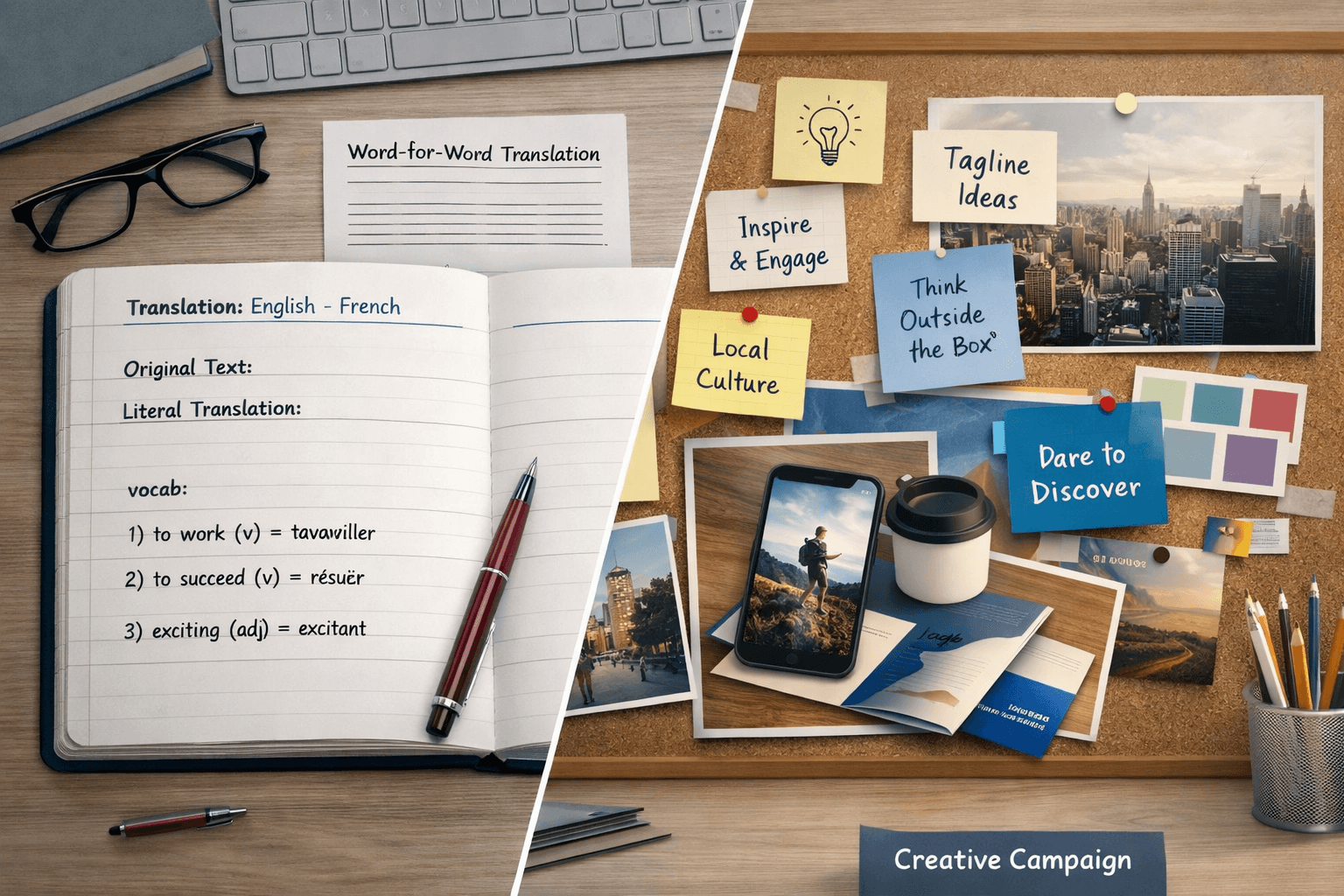
If you’re searching for transcreation meaning, you’re usually trying to answer one practical question: Do I need normal translation, or do I need something more creative?
The short answer: if your content needs to persuade, sell, inspire, or protect brand tone across cultures, transcreation often beats standard translation.
In this guide, you’ll learn what transcreation actually is, how it differs from translation and localization, when to use it, what a good transcreation brief looks like, how transcreation services are usually priced, and how to choose a reliable transcreation agency.
What is transcreation?
Transcreation is the process of adapting content from one language to another so the meaning, tone, intent, and emotional effect still work for the target audience.
Unlike literal translation, transcreation may change wording, structure, references, and calls to action so the message feels natural, persuasive, and culturally right in the new market.
In simple terms: translation transfers meaning, while transcreation recreates impact.
What transcreation means in plain English
Transcreation is a blend of translation + creative adaptation.
Instead of converting words as closely as possible, transcreation recreates the message so it lands with the same emotional impact in a different language and culture.
Another way to say it: transcreation is often creative translation for high-impact content.
A simple definition you can use internally
Use this working definition with your team:
Transcreation is the creative adaptation of content from one language to another, preserving intent, tone, and impact rather than wording alone.
That “impact over wording” part is the key difference.
Transcreation meaning in one sentence
Transcreation means rewriting a message for another language and culture so people respond to it the way the original audience did.
Translation vs transcreation vs localization

These terms get mixed up all the time, so here’s the practical difference.
Translation
Use translation when accuracy and completeness are the priority.
Typical examples:
- contracts
- certificates
- manuals
- policies
- medical reports
- academic transcripts
The goal is to transfer meaning clearly and faithfully.
Transcreation
Use transcreation when response and persuasion are the priority.
Typical examples:
- slogans
- ad campaigns
- landing page headlines
- email subject lines
- social media ads
- brand messaging
- app store copy
- product launch campaigns
The goal is to trigger the right reaction, not preserve every word.
Localization
Localization is broader. It can include translation and transcreation, but also adapts:
- dates and time formats
- currencies
- visuals
- colors
- layouts
- legal references
- UX/UI details
- cultural references
Think of localization as the full market adaptation process, and transcreation as the creative messaging part inside it.
What transcreation can change beyond words
Transcreation can involve more than text. Depending on the campaign, it may require adapting:
headlines and taglines
idioms and wordplay
humor and emotional triggers
images and visual references
CTA wording
video scripts and voiceover lines
product names or descriptors (where legally and commercially appropriate)
This matters because a message can be linguistically correct and still feel culturally off.
When transcreation beats translation
Here’s the rule of thumb:
Use transcreation when the content must make someone feel something
If the text is supposed to:
- build trust fast
- sound premium
- create urgency
- sound playful or witty
- protect brand personality
- drive clicks or conversions
…you’re usually in transcreation territory.
Use translation when the content must be exact
If the text is supposed to:
- document facts
- prove compliance
- preserve legal meaning
- explain procedures
- avoid ambiguity
…use professional translation, not transcreation.
Why literal translation often fails in marketing
A literal translation can be accurate at sentence level but weak at campaign level.
That happens when:
the rhythm sounds unnatural
the emotional trigger disappears
the call to action feels too soft or too aggressive
a cultural reference does not travel
wordplay or humor stops working
For brand and performance content, the real test is not “Are the words equivalent?” but “Will the audience respond in the intended way?”
The 5-question transcreation test

Use this quick test before you brief a linguist or agency.
If you answer “yes” to 3 or more, you likely need transcreation services.
- Is this content marketing, advertising, or brand-led?
- Would a literal version sound awkward or weak?
- Does tone matter as much as meaning?
- Is the content trying to persuade or sell?
- Will cultural references, humor, or idioms affect performance?
Need a quick answer on whether your content needs translation or transcreation?
Send your source copy and target market, and we’ll recommend the right workflow before you spend on the wrong service.
Clear project scoping before work starts
Human linguists and reviewers
Secure document handling
Support for both creative and official-language workflows
Who usually needs transcreation services?
Transcreation is commonly used by:
brands launching in new markets
ecommerce teams
SaaS companies
app publishers
luxury and premium brands
travel and hospitality brands
agencies running multilingual campaigns
It is especially useful when brand tone, local resonance, and conversion performance matter as much as linguistic accuracy.
Fast examples
Use translation
- Terms and conditions
- HR policy documents
- Immigration paperwork
- Product safety instructions
Use transcreation
- Taglines
- Meta ad copy
- Campaign headlines
- Product launch emails
- Premium brand homepage copy
What transcreation looks like in the real world
A lot of teams assume transcreation means “translate, then tweak a few words.”
That usually underdelivers.
Good transcreation often produces copy that looks very different from the source text while keeping the same commercial goal.
Example: campaign headline adaptation
Source message goal: confidence + momentum + action
Original line: “Make your next move count.”
A literal translation may preserve the words but lose the tone.
A transcreated version might instead become:
- a more direct action-led line in one market
- a trust-led line in another market
- a benefit-led line in a third market
All three can be “correct” if they preserve the intended reaction.
Why this matters
In creative campaigns, “technically correct” copy can still perform badly.
That’s why transcreation is used for:
- global ad campaigns
- multilingual brand launches
- performance marketing copy
- ecommerce messaging
- app onboarding content
- video and voiceover scripts
What a transcreation brief should include
A weak brief is the fastest way to get weak transcreation.
If you’re hiring a freelancer or transcreation agency, the brief matters as much as the source text.
What a transcreation brief is
A transcreation brief is a short document that explains the goal, audience, tone, channel, constraints, and success criteria so the linguist can recreate the message effectively rather than translate it literally.
Transcreation brief checklist
Include these in every brief:
1) Business goal
What should this content achieve?
- click-throughs
- sign-ups
- demo bookings
- purchases
- app installs
- brand awareness
2) Target audience
Be specific:
- country/region
- customer type
- age range (if relevant)
- what they care about
- what they avoid
- level of formality expected
3) Tone of voice
Describe the tone you want:
- premium
- friendly
- authoritative
- witty
- calm
- bold
- technical-but-clear
4) Brand boundaries
What must stay consistent?
- brand promise
- product names
- legal wording
- banned phrases
- approved claims
- key differentiators
5) Channel and format
Where will the copy be used?
- Google Ads
- Meta ads
- landing page
- app store
- packaging
- billboard
- video subtitles/voiceover
Channel changes the writing.
6) Character limits
This is essential for:
- ads
- CTAs
- banners
- app UI
- SMS
- push notifications
7) Visual context
Share the design if possible:
- layout
- image choices
- CTA button text
- surrounding UI
- color emphasis
Words don’t live alone in creative work.
8) Success criteria
What counts as “good”?
- tone match
- options provided
- legal-safe copy
- back translation
- stakeholder sign-off
- performance test readiness
How transcreation services are usually delivered
Most high-quality transcreation services follow a process that looks more like copywriting than standard translation.
A practical transcreation workflow
1) Content triage
First, decide what needs:
- translation
- transcreation
- full localization
Not everything should be transcreated (that wastes budget).
2) Briefing and asset handoff
Share:
- source copy
- brand guidelines
- audience notes
- visual mockups
- campaign goals
- deadlines
3) Transcreation draft(s)
A transcreator may produce:
- one polished version, or
- multiple options (especially for slogans/headlines)
For campaign work, multiple options are often better.
4) Back translation (optional but helpful)
Back translation means converting the transcreated line back into the source language so stakeholders can understand the intent.
This is especially useful when:
- the team doesn’t speak the target language
- the line is highly creative
- approvals are sensitive
- legal/compliance review is involved
5) Review and revision rounds
Expect feedback on:
- tone
- clarity
- risk
- brand fit
- CTA strength
Good transcreation is collaborative.
6) Final QA in context
Final checks should happen in the actual asset:
- ad creative
- landing page
- app screen
- packaging
- subtitle frame
A line can be perfect in a document and wrong in the layout.
Who does transcreation and what skills are involved?
Transcreation is usually done by specialist linguists or multilingual copywriters who understand both the source and target cultures.
The strongest transcreators combine:
translation skill
copywriting ability
market awareness
brand sensitivity
research skills
the confidence to propose alternatives rather than mirror the source too closely
That is one reason transcreation should not be treated as commodity translation.
How transcreation pricing works
One reason people search “transcreation meaning” is they’re trying to understand why quotes look different.
Why transcreation costs more than translation
Transcreation usually takes more time because it involves:
- creative decision-making
- multiple wording options
- cultural adaptation
- stakeholder feedback rounds
- back translations
- visual/context review
Common pricing models for transcreation services
You’ll usually see one (or a mix) of these:
- Per hour (common for ongoing creative work)
- Per project (common for campaigns)
- Per asset (e.g., per slogan set, per ad batch, per landing page)
- Retainer (for teams launching multilingual campaigns regularly)
Per-word pricing can still appear, but it’s often a poor fit for creative work.
Budgeting tip that saves money
Don’t transcreate everything.
Use a simple split:
- Transcreation: ads, headlines, product messaging, campaign pages
- Translation: FAQs, help docs, policy content, legal text
That hybrid approach usually gives better results and better ROI.
If you are comparing budgets across service types, it also helps to separate transcreation pricing from certified translation cost in the UK, because the workflow, buying criteria, and output are different.
Transcreation agency checklist: how to choose the right partner
A good transcreation agency is not just a translation vendor with a new label.
Here’s what to check before you start.
10 things to check before hiring a transcreation agency
1) Do they ask for a creative brief?
If they only ask for the source file and deadline, that’s a warning sign.
2) Do they discuss audience and intent?
They should ask who the copy is for and what the CTA is.
3) Do they offer multiple options for key lines?
For slogans and headlines, one option is rarely enough.
4) Can they explain their review process?
Look for a clear workflow:
- draft
- review
- revisions
- final QA
5) Do they handle back translation when needed?
Useful for approvals and stakeholder confidence.
6) Can they work with brand guidelines?
This is essential for consistency across markets.
7) Do they flag legal/risk-sensitive wording?
Creative copy still needs compliance awareness.
8) Can they review copy in layout?
Especially important for ads, UI, and landing pages.
9) Do they separate translation and transcreation workstreams?
This keeps budgets controlled and outputs fit-for-purpose.
10) Do they sound like copywriters, not just translators?
For transcreation, writing quality matters as much as language ability.
If your wider project also includes official paperwork, it helps to understand how to choose a certified translation agency and to review certified translation reviews before appointing a supplier for acceptance-sensitive work.
Planning a multilingual campaign? Start your project with a brief review first.
A strong brief and the right workflow will save time, reduce rewrites, and protect your brand tone in every market.
A common mistake: using transcreation for official documents
This is where many people get confused.
Transcreation is excellent for marketing and brand content.
It is not the right approach for official paperwork.
For:
- visas
- passports
- court documents
- certificates
- academic records
- legal submissions
…you usually need a certified translation (and sometimes notarised or sworn formats), not creative adaptation.
If a receiving authority needs a document accepted, accuracy and formal certification come first.
For official paperwork, the correct service is usually certified translation services, and in some jurisdictions you may need sworn translation services or notarised translation depending on the authority. If you are preparing a passport certified translation, WES certified translation, or other acceptance-sensitive submission, accuracy and formal compliance come before creative adaptation. If the recipient needs confirmation of format, it also helps to understand what a certified translation certificate includes.
The best way to use both (without overpaying)
The strongest multilingual teams do not choose between translation and transcreation.
They combine them.
A smart split for growing brands
Use transcreation for:
- campaign headlines
- paid ads
- homepages
- product messaging
- email subject lines
- launch copy
Use translation for:
- support content
- policy pages
- legal copy
- technical content
- onboarding instructions
- compliance documents
This gives you:
- stronger brand performance
- better conversion potential
- lower risk
- better budget control
A practical transcreation framework your team can reuse
Here’s a simple internal framework you can apply before every multilingual launch.
The Impact–Accuracy Matrix
High Impact + Low Accuracy Risk → Transcreation
Examples:
- slogans
- social ads
- brand videos
- campaign emails
High Impact + High Accuracy Risk → Hybrid review
Examples:
- regulated marketing copy
- healthcare campaigns
- financial promotions
(Transcreation + legal/compliance review)
Low Impact + High Accuracy Risk → Translation
Examples:
- terms
- contracts
- policies
- certificates
Low Impact + Low Accuracy Risk → Standard translation or localization
Examples:
- general UI labels
- support pages
- internal documentation
This framework stops “one-size-fits-all” decisions and makes your content workflow much easier to manage.
Ready to launch multilingual campaigns that actually sound local?
If your team is expanding into a new market and you’re unsure whether a page needs translation, localization, or full transcreation, send the source copy and target market details and get a clear recommendation before production starts.
For creative campaigns, a strong brief and the right transcreation workflow can save weeks of rework and protect your brand voice from day one.
If you’re also handling official documents alongside marketing launches, keep those workflows separate so each job gets the right treatment first time.
If you need broader translation and language services or interpreting services alongside campaign adaptation, keep those as separate workstreams with shared terminology, audience notes, and brand guidance.
Ready to move from “translated” to “market-ready”?
Contact UK Certified Translation to review your content, target markets, and launch timeline—and get a practical recommendation for translation, localization, or transcreation. If you’re ready to discuss a live brief, contact our team.
FAQ
What is transcreation meaning in marketing?
Transcreation meaning in marketing is the creative adaptation of messaging into another language so it keeps the same intent, tone, and emotional impact. It is often used for ads, slogans, landing pages, and brand campaigns.
Is transcreation the same as creative translation?
They are very close. “Creative translation” is often used as a simpler way to describe transcreation. In practice, transcreation usually involves a clearer brief, more creative freedom, and more collaboration than standard translation.
When should I use transcreation services instead of translation?
Use transcreation services when your content needs to persuade, convert, or protect brand tone across cultures—especially for marketing campaigns, headlines, ads, and product messaging. Use translation for legal, technical, or official content where accuracy is the priority.
How are transcreation services priced?
Transcreation services are commonly priced per hour, per project, or per asset because the work includes creative development, revisions, and context review. It is often priced differently from standard per-word translation.
What should I send a transcreation agency before starting?
Send a source file, target audience details, brand tone guidance, channel context (ads, email, landing page, etc.), character limits, visuals if available, and the action you want the audience to take.
Can a transcreation agency also handle certified translations?
Some agencies can handle both, but the workflows are different. Transcreation is for creative marketing content, while certified translation is for official and acceptance-sensitive documents.
What is the difference between translation and transcreation?
Translation focuses on transferring meaning accurately. Transcreation focuses on recreating the intended response, tone, and commercial impact. If accuracy is the priority, use translation. If persuasion and brand tone are the priority, use transcreation.
Is transcreation part of localization?
Yes. Transcreation is often one part of localization. Localization covers the wider adaptation of a product or campaign for a specific market, including language, visuals, formats, legal references, and UX details. Transcreation focuses specifically on the creative messaging inside that wider process.
Does transcreation only change words?
No. Transcreation can also affect headlines, slogans, CTAs, imagery, cultural references, video scripts, voiceovers, and layout-sensitive copy. The goal is to make the message feel natural and effective in the target market, not just linguistically correct.
Who writes transcreated copy?
Usually a specialist linguist, bilingual copywriter, or transcreation agency with both language expertise and marketing judgement. Strong transcreators understand culture, brand voice, audience psychology, and channel constraints—not just vocabulary.
What is a transcreation brief?
A transcreation brief is a document that explains the business goal, target audience, tone of voice, brand rules, channel, character limits, and success criteria for the content. It gives the transcreator the context needed to produce copy that works in market.
Can transcreation be used for official documents?
No—not when the document must be accepted by a university, court, visa authority, or other institution. In those cases, you usually need certified translation, and in some countries sworn translation or notarised translation, depending on the receiving body’s rules.
How long does transcreation take?
Timelines vary by asset type, number of options required, review rounds, and whether back translation is needed. A short slogan set may move quickly, while a multilingual campaign with approvals and in-context QA usually takes longer than standard translation.