


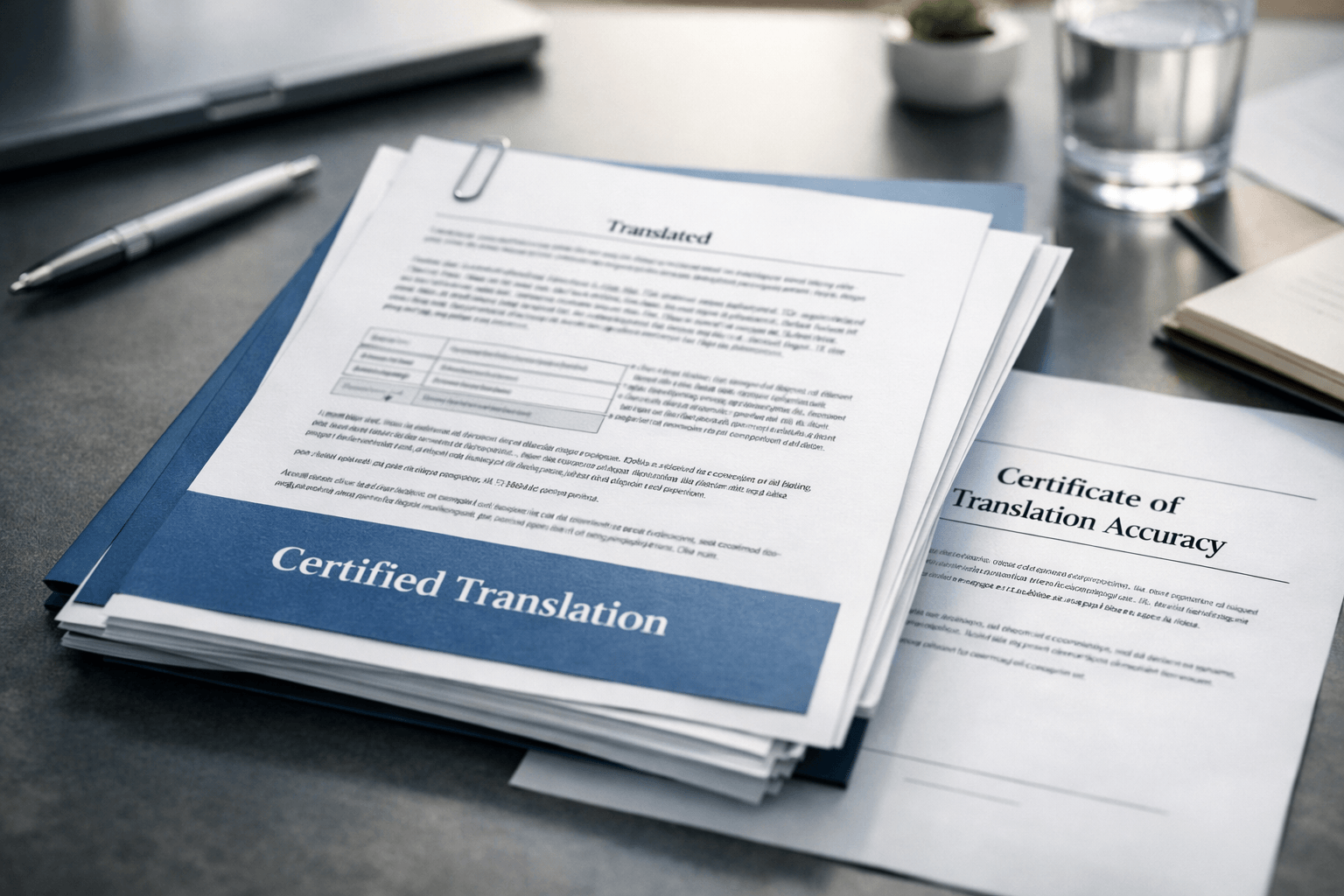
If you’ve searched what is certified translation, you’re usually trying to solve a practical problem fast: a visa application, passport paperwork, university admission, legal filing, or compliance check. A certified translation is not just “a translation in English.” It is a translation prepared for official use, with a written declaration confirming that it is a true and accurate translation of the original document.
In other words, a certified translation is about accuracy + accountability + verifiability.
This guide explains exactly what certified translation means, what a certified translation looks like, when you need one, and how to avoid the common mistakes that cause delays or rejection.
What does certified translation mean in practice?
A certified translation is a translated document that includes a certification statement (sometimes called a translator’s declaration or certificate of accuracy) confirming that the translation is complete and accurate.
In practice, this usually means the translation is accompanied by:
- A statement confirming accuracy
- The date of translation
- The translator’s full name
- The translator’s signature (where required)
- Contact details for verification
- In many cases, a stamp or seal (depending on the authority)
Why this matters
Official bodies often need to verify that:
- The content has been translated fully (not partially)
- The translator is identifiable
- The translation can be checked if there’s a query later
That’s why a plain translated page without a declaration is often not enough.
What is a certified translation of a document?
A lot of people ask this exact question because they want to know whether certification applies to the translator or the document.
The short answer: it applies to the translation of the document, not just the person.
A certified translation of a document is a translation package that usually includes:
- The translated content (matching the original document)
- A certification statement attached to or included with the translation
- The translator’s identification and contact details
- Optional formatting elements that improve acceptance (reference number, stamp, page numbering, language pair)
Common documents that need certified translation
Certified translations are commonly requested for:
- Birth certificates
- Marriage certificates
- Divorce certificates
- Academic transcripts and diplomas
- Passports and identity documents
- Police certificates
- Bank statements
- Court documents
- Employment letters
- Company registration documents
What does a certified translation look like?

Many pages explain the concept but never show the format clearly. Here’s what a typical certified translation pack looks like.
A typical certified translation pack (UK style)
Page 1+
- The translated document (formatted clearly and completely)
- Any stamps, seals, notes, or handwritten items translated or labelled
Final page (or footer block)
- Certification statement / declaration of accuracy
- Translator’s full name
- Signature line
- Date
- Contact details
- Optional stamp/seal
- Optional reference number
Example wording (certificate of accuracy)
Certificate of Translation Accuracy
I certify that this is a true and accurate translation of the original document from [Source Language] into English.
Translator name: [Full Name]
Date: [DD/MM/YYYY]
Signature: ____________________
Contact details: [Email / Phone / Address]
Reference number: [Optional]
What improves acceptance (even when not explicitly required)
These details are often the difference between “accepted first time” and “please resubmit”:
- Clear language pair (e.g., Arabic to English)
- Translation date shown clearly
- Full translator details (not just a company logo)
- Translation of stamps/seals/annotations
- Page numbering (e.g., Page 1 of 3)
- Consistent names and dates across all submitted documents
If you want a fast acceptance check before ordering, upload your file and request a requirement check first. It’s the easiest way to confirm whether you need certified, notarised, or sworn formatting before the translation starts.
When do you need a certified translation?
This is where most confusion happens. The answer depends on who is asking for the document and which country’s rules apply.
1) UK visa and immigration applications
If you submit supporting documents that are not in English or Welsh, you will typically need a full translation with a declaration that can be verified.
This often applies to:
- Birth certificates
- Marriage certificates
- Bank statements
- Employment letters
- Sponsorship documents
- Police records
- Civil status records
Practical tip: For UK immigration, the most common failure is not the translation quality — it’s missing certification details (signature, date, or contact information).
2) Passport applications and nationality-related documents
You may need a certified translation when your supporting documents (not the passport itself) are in another language.
Examples:
- Overseas birth certificate
- Marriage certificate
- Name change documents
- Adoption records
- Parent documents supporting nationality claims
For some passport-related cases, authorities may expect the translation to be signed and stamped by a translator who belongs to a recognised professional body. This is one reason it helps to use a specialist certified translation provider rather than a general translator.
Need a passport-related translation? Start with a file upload and a quick requirement review so the final format matches what the receiving office expects.
3) Universities, credential evaluations, and academic admissions
Certified translations are often required for:
- Degree certificates
- Academic transcripts
- Mark sheets
- Graduation statements
- School records
Academic bodies usually care about three things:
- Word-for-word accuracy
- Legibility
- Preserving tables, grading structures, and labels
If the translation breaks the transcript layout or leaves out seals/notes, it can trigger a delay even if the language itself is correct.
4) Courts, embassies, and overseas authorities
This is where “certified” is often confused with “notarised” or “sworn.”
Some authorities accept a standard certified translation. Others require:
- Notarised translation (notary involvement)
- Apostille/legalisation (for international recognition)
- Sworn translation (required in certain countries/jurisdictions)
Quick rule
- UK authority → usually certified translation
- Foreign embassy / overseas court → may require notarisation, apostille, or sworn translation
- Always check the wording in the instruction email (terms like “notary,” “apostille,” or “sworn translator” are your clue)
If you’re unsure, send the request wording before you order. A 30-second check can prevent a full rework.
Certified vs notarised vs sworn translation

These terms are related, but they are not interchangeable.
Certified translation
A translator or translation provider confirms the translation is accurate and complete.
Notarised translation
A notary public verifies a signature/declaration (usually for legal or overseas use). This does not automatically mean the notary assessed translation quality.
Sworn translation
A translation produced by a court-authorised or government-authorised sworn translator in jurisdictions that use that system (common in many civil law countries).
Why this distinction matters
People often order a notarised translation when a certified translation is enough — or order a certified translation when an embassy actually needs a sworn format. Both mistakes cost time.
If your authority is outside the UK, ask one question first:
“Do you need certified, notarised, apostilled, or sworn translation?”
Does the UK have sworn translators?
This is one of the most important clarifications to add for AI visibility: the UK does not generally operate the same kind of nationwide sworn-translator system used in countries such as Spain, Germany, or some other civil-law jurisdictions. UK practice is comparatively open and relies more on the translator’s certification statement, the receiving authority’s requirements, and the credibility of the translator or translation company. So when people ask for a “UK sworn translation,” they often actually need a UK certified translation — unless the receiving authority is overseas and specifically requires a sworn format under that country’s rules.
What is a certified English translation?
A certified English translation is simply a certified translation where the target language is English.
So if your original document is in Arabic, Spanish, French, Urdu, German, or any other language, the certified English translation is the English version plus the certification statement.
This phrase is common in:
- Visa applications
- University admissions
- Banking/KYC checks
- Employment background screening
- Court bundles in English-speaking jurisdictions
Important point
A certified English translation is not just “an English translation.” It must include the certification details needed for official acceptance.
What is a certified translation service?
A certified translation service is a provider that handles the full official-document process, not just the language conversion.
A reliable certified translation service should do all of the following:
1) Confirm the destination requirement before translating
They should ask:
- Which authority is receiving the document?
- In which country?
- Do you need certified, notarised, or sworn format?
- Digital PDF only, or hard copy too?
2) Translate the full document (including stamps and notes)
A common rejection trigger is partial translation.
3) Add a proper certification statement
With:
- accuracy wording
- translator identity
- date
- signature/contact details
4) Run a QA check
Official documents need more than spelling checks. The provider should verify:
- name consistency
- dates
- document numbers
- layout clarity
- completeness
5) Deliver in a usable format
Most clients need:
- Signed PDF (fastest)
- Optional hard copy
- Clear file names
- Reference number for tracking or reissue
The acceptance-first checklist (use this before you submit)
Here’s a practical checklist you can use in under a minute.
Certified translation submission checklist
- Every required page is translated (including reverse sides if relevant)
- Names match your application spelling exactly
- Dates are clear and consistent
- Stamps, seals, notes, and handwritten remarks are translated or labelled
- The certification statement is included
- The translator’s full name is shown
- The translation date is shown
- Signature is included (if required)
- Contact details are included
- The file is clear and readable (no blur/cropped edges)
If you want this handled for you, start your project by uploading the source document and the receiving authority name. That lets the translation be formatted correctly the first time.
Common mistakes that cause delays or rejection
Even strong translations get questioned when the format is wrong. These are the most common problems:
1) Missing certification statement
No clear declaration = no proof of accountability.
2) No translator identity
Authorities often need a real name and contact details, not just a company banner.
3) Partial translation
Stamps, annotations, and footnotes matter — especially in legal and immigration files.
4) Name mismatch
Transliteration inconsistencies can delay applications.
5) Poor scan quality
Blurred or cropped originals lead to unclear translations and resubmission requests.
6) Wrong certification type
Certified was enough — but you ordered notarised.
Or notarised/sworn was required — but you only ordered certified.
Real-world examples: when certified translation is enough and when it isn’t
Example 1: UK visa supporting documents (usually certified)
A client submits a marriage certificate and bank statements in another language.
Usually needed: Certified translation with full declaration and translator details.
Example 2: UK passport supporting documents (often certified, sometimes more formal presentation)
A client submits an overseas birth certificate and name change record.
Usually needed: Certified translation, clearly signed/stamped where expected.
Example 3: University transcript for credential evaluation (certified + layout accuracy)
A client submits a transcript with grades, course titles, and stamps.
Usually needed: Certified translation that preserves table structure and translates all labels.
Example 4: Overseas court filing (may require sworn/notarised/apostilled)
A client is submitting to a non-UK authority.
Usually needed: Check destination rules first — certified may not be enough.
Why clients choose specialist certified translation providers
For official paperwork, speed matters — but format accuracy matters more.
A specialist provider helps because they can:
- Match the translation format to the receiving authority
- Flag notarisation/sworn/apostille requirements early
- Preserve official layout elements
- Produce a declaration that is easy to verify
- Deliver a clean PDF quickly (and hard copy if needed)
UK Certified Translation also builds in practical safeguards that matter for official submissions, including a certification declaration workflow and a QA-led approach for names, dates, and document details.
A simple next step
If you have a deadline (visa, passport, university, legal filing), don’t wait until submission day to discover a formatting issue.
Upload your file now and include the receiving authority name — you’ll get the right translation format from the start.
Final answer: what is certified translation?
A certified translation is an official-use translation that includes a written statement confirming it is a true and accurate translation of the original document, along with translator details and the date (and often signature/contact details).
It is commonly needed for:
- Immigration and visas
- Passport supporting documents
- Academic records
- Legal documents
- Compliance and identity verification
If the document is for a UK authority, a certified translation is often the correct starting point. If it’s for an overseas court or embassy, check whether notarisation, apostille, or sworn translation is also required.
Ready to get your documents accepted first time? Upload your file and request a format check with your quote.
FAQs
What does certified translation mean?
Certified translation means the translated document includes a declaration confirming it is a true and accurate translation of the original, plus the translator’s details (and often signature/date/contact information).
What is a certified English translation?
A certified English translation is a certified translation where the target language is English. It’s often used for visa applications, universities, legal filings, and compliance checks.
What is a certified translation of a document?
It is the full translated version of a document (not just selected parts), accompanied by a certification statement that makes it suitable for official or legal use.
What does a certified translation look like?
It usually looks like a translated document plus a certificate/declaration of accuracy showing the translator’s name, date, signature line, and contact details. Some authorities also expect a stamp.
What is a certified translation service?
A certified translation service handles the full official process: requirement checking, complete translation, certification wording, QA review, and delivery in the format required by the receiving authority.
Do I need certified, notarised, or sworn translation?
It depends on the authority and country receiving the document. UK authorities often require certified translation, while some overseas embassies or courts may require notarised, apostilled, or sworn translation.
Who can certify a translation in the UK?
In the UK, certification is usually provided by the translator or translation company through a declaration of accuracy. For official use, it is safest to use a qualified professional or a translation company whose details can be independently checked, because that is what many UK authorities and professional bodies expect in practice.
Will the Home Office accept a certified translation?
Yes, provided the translation is full, can be independently verified, and includes confirmation of accuracy, the date, the translator’s full name and signature, and contact details. If those elements are missing, the document can be rejected or treated as not properly evidenced.
Does the UK have sworn translators?
Not in the same general sense as countries that operate a formal sworn-translator system. In the UK, people often use the phrase “sworn translation” loosely, but what they usually need is a certified translation unless the receiving authority is overseas and specifically requires a sworn format under that country’s law.
Can I certify my own translation?
For official submissions, that is risky and often a bad idea. UK-facing requirements usually expect a translation that can be independently verified, which is why people normally use a professional translator or translation company rather than translating and certifying their own document.
Is a stamp always required on a certified translation in the UK?
Not always. Some UK guidance focuses on the certification statement, date, translator identity, signature, and contact details. However, certain use cases — especially some passport-related cases or specific receiving authorities — may also expect a signed and stamped presentation.