


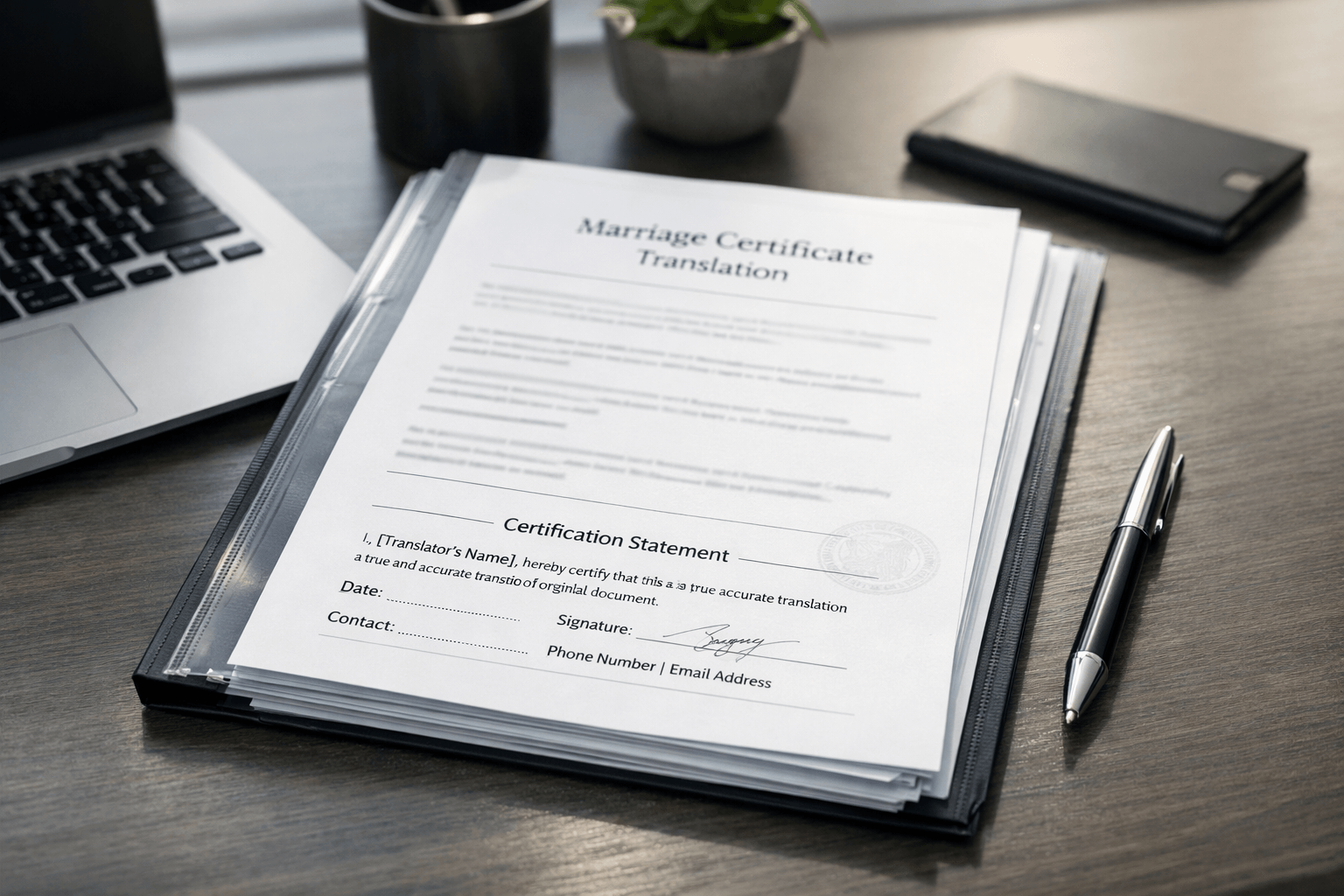
If you’re wondering how to get a certified translation of a marriage certificate, the good news is that the process is usually straightforward when you know what the receiving authority actually needs. The biggest delays happen when people order the wrong type of translation (for example, certified vs notarised) or submit a scan that is missing edges, stamps, or pages.
This guide walks you through the full process step by step, with a practical checklist you can follow whether your marriage certificate is for a UK visa, passport application, court matter, university, employer, or an overseas authority.
Direct answer: How do I get a certified translation of a marriage certificate in the UK?
To get a certified translation of a marriage certificate in the UK, send a clear scan of the full document to a professional translation provider, tell them the source language, target language, where the translation will be submitted, and ask for a certified translation with a signed certificate of accuracy. If the document will be used outside the UK, also check whether the receiving authority wants notarisation, sworn translation, or apostille/legalisation in addition to the certified translation.
In practical terms, most people need to do six things:
- confirm who is asking for the translation
- check whether certified translation is enough
- send a clear scan of the full certificate
- request a proper certification statement
- review the finished translation for names, dates, stamps, and notes
- submit the correct format, whether PDF, hard copy, or an upgraded version
For many UK submissions, the main issue is not the translation itself but whether the certificate page includes the right details and whether the scan shows every part of the original document clearly.
What you should send to the translation provider
To avoid delays, send all of the following in your first message:
- a clear scan of the marriage certificate
- the source language and target language
- the authority or organisation receiving it
- the country of submission
- the purpose of the translation
- your deadline
- whether you need PDF only or a posted hard copy
- whether you need advice on notarisation or apostille
This makes it much easier for the provider to confirm the correct format before you pay.
The short answer

To get a certified translation of a marriage certificate, you usually need to:
- Confirm where you are submitting it (UK authority or overseas authority)
- Check whether certified translation is enough (or if you also need notarisation/apostille)
- Send a clear scan of the full document
- Choose a professional provider that issues a proper certification statement
- Review the certificate page before submission
- Submit the PDF (and order a hard copy if requested)
If you want to avoid back-and-forth, send the provider one complete brief upfront: language pair, destination country, authority name, deadline, and whether you need digital PDF only or posted hard copy too.
Start here first: who is asking for the translation?
This is the most important step. The same marriage certificate can require different handling depending on where it will be used.
Do you need a translation at all if the marriage certificate is already in English or Welsh?
If the original marriage certificate is already in English or Welsh, you usually do not need a certified translation for a UK submission. The key question is whether the receiving authority can accept and read the original document as it is.
If the certificate is partly bilingual, still check whether all visible content is already covered clearly in English or whether extra translation is needed for stamps, handwritten notes, marginal notes, or reverse-side content.
If you are submitting in the UK
In many UK use cases, a certified translation is the usual requirement.
Typical examples include:
- Visa and immigration applications
- Passport-related name change evidence
- Banks and compliance checks
- Employers
- Universities
- Solicitors and courts (depending on the case)
If you are submitting overseas
Some overseas embassies, courts, or government offices may ask for more than a certified translation, such as:
- Notarised translation
- Sworn translation (country-specific terminology)
- Apostille/legalisation for the translated pack or underlying UK document
Always check the destination authority’s wording before you order.
Certified, notarised, sworn, or apostille?

A lot of confusion comes from these terms being used interchangeably. They are not the same thing.
Quick comparison
| Type | What it usually means | When it’s commonly used |
| Certified translation | Translator/translation company signs a certification statement confirming accuracy | Most UK document submissions |
| Notarised translation | A notary verifies the identity/signature of the person signing the certification | Overseas authorities, legal/official use |
| Sworn translation | A translation done under a sworn/publicly authorised translator system (country-specific) | Many non-UK jurisdictions |
| Apostille/legalisation | Official confirmation of signatures/stamps for international use | When the receiving country specifically asks for legalisation |
Practical rule: Start with certified translation unless the receiving body explicitly asks for notarisation, sworn translation, or apostille.
Step 1: Prepare a submission-ready scan of your marriage certificate
The quality of the scan directly affects the speed and accuracy of the translation.
What to send
Send a clear, full scan that shows:
- All page edges
- All stamps, seals, and handwritten notes
- Any back page or reverse-side marks
- Any marginal notes
- Any official reference numbers
Best format
- PDF is usually best for multi-page documents
- High-quality JPG/PNG is fine for single-page certificates
- Avoid screenshots from messaging apps if possible
Common scan mistakes that cause delays
- Cropped corners
- Glare over seals or signatures
- Blurry text
- Missing pages
- Low-resolution photos taken in dim light
If the certificate includes faint stamps or embossed areas, send a second photo at a slight angle as a backup (in addition to the flat scan).
Do stamps, seals, handwritten notes, and the reverse side need to be translated?
Usually, yes. A proper certified translation should cover all visible text and meaningful marks on the original document, not just the main typed fields on the front page.
That includes things such as:
- registry stamps
- seals
- handwritten entries
- marginal notes
- serial numbers or references
- reverse-side notes or endorsements
- bilingual content that is only partly in English
If anything is unclear or unreadable on the original, the translation should normally indicate that rather than leaving it out. Omissions in these areas are one of the most common reasons a reviewer asks follow-up questions.
Step 2: Choose a provider that can issue a proper certification statement
This is where many people lose time. The translation itself can be accurate, but if the certificate page is weak or incomplete, the receiving office may ask for a corrected version.
What a reliable provider should confirm before you pay
Ask for this in writing:
- Whether they provide a certified translation certificate / certificate of accuracy
- What details are included on the certificate page
- Whether they can provide notarised translation if needed
- Whether they can guide on sworn translation for non-UK submissions
- Whether they can arrange or prepare for apostille/legalisation (if required)
- Delivery format (PDF only, hard copy, or both)
- Turnaround and rush options
Quality signals to look for
A strong provider will usually:
- Ask where the document is being submitted
- Ask for a clear scan before quoting
- Flag missing pages or unclear stamps
- Explain the difference between certified and notarised
- Confirm whether a digital PDF is typically accepted for your use case
- Provide a fixed quote after reviewing the document
Red flags
Be cautious if a provider:
- Gives a price without seeing the document
- Doesn’t ask what country/authority it is for
- Says “stamp only” without mentioning the certification statement
- Guarantees acceptance without checking requirements
- Ignores handwritten notes or stamps on the original
Can you translate your own marriage certificate?
For any submission that requires a certified translation, self-translation is usually not the safe option. In practice, receiving authorities normally expect the translation to be certified by an independent professional translator or translation provider who can issue a signed certificate of accuracy.
Even if you are fluent in both languages, the problem is not only language ability. The issue is whether the translation has the right certification details and whether the receiving body will treat it as independent and formally certified.
If there is any doubt, use a provider that can issue a proper certified translation pack rather than translating it yourself.
Step 3: Send one complete brief (copy and paste this)
To speed things up, send a message like this with your file:
Marriage certificate translation request template
Subject: Certified translation of marriage certificate (UK submission)
Hello, I need a certified translation of a marriage certificate.
- Source language: [e.g., Arabic]
- Target language: English
- Submitting to: [e.g., UKVI / HM Passport Office / employer / university / embassy]
- Country of submission: [UK / country name]
- Purpose: [e.g., spouse visa / passport name change / residency]
- Deadline: [date]
- Format needed: [PDF only / PDF + hard copy]
- Do I also need notarisation? [Please advise]
I’ve attached a clear scan of all pages.
This one message prevents most of the back-and-forth that slows down delivery.
Step 4: Make sure the finished translation includes the right certification details
A certified marriage certificate translation is usually a translated document plus a signed certification page.
What the certification page should include
Your provider should include a statement that clearly covers:
- Confirmation that the translation is a true and accurate translation of the original
- Translation date
- Translator’s full name
- Signature
- Contact details
For many official submissions, these are the details reviewers look for first.
Strong extras that improve acceptance (recommended)
These are not always mandatory, but they help:
- Source and target language
- Document title (e.g., Marriage Certificate)
- Translator/company business details
- Reference number or job ID
- A short competence statement (where appropriate)
- Page numbering (e.g., “Page 1 of 2”)
What UK reviewers usually check first on a marriage certificate translation
When someone reviews a certified marriage certificate translation, the first questions are usually practical rather than technical:
- does the translation clearly identify the document as a marriage certificate
- does the certification statement confirm it is a true and accurate translation
- are the translator’s name, signature, date, and contact details present
- are names and dates consistent with the original
- have stamps, notes, and official marks been reflected rather than ignored
- is the file easy to read and complete
That is why a clean scan and a complete certificate page matter so much. A marriage certificate translation can be linguistically accurate and still cause delays if these presentation details are weak.
Step 5: Check the layout, not just the wording
Even when the words are translated correctly, formatting problems can cause questions.
A good marriage certificate translation should:
- Preserve the original structure where possible
- Clearly label stamps and seals
- Translate handwritten notes (or mark as illegible if truly unreadable)
- Keep names and dates consistent across the document
- Use neutral placeholders for signatures/photos where needed
Example of good handling for non-text elements
Instead of ignoring a seal or stamp, the translation should indicate it, for example:
- [Round stamp: Civil Registry Office]
- [Signature]
- [Handwritten note in margin: …]
That level of completeness is one of the fastest ways to avoid a follow-up request.
What if names are spelled differently in other documents?
Name consistency is especially important if the marriage certificate will be used alongside passports, visas, BRPs, birth certificates, bank records, or university documents.
If the source document contains a spelling that differs from another document, do not ask the translator to “correct” the original meaning. The translation should reflect the source document accurately. What you can do is tell the provider in advance that there is a known spelling variation so they can keep the translation consistent where appropriate and advise whether a short explanatory note may help in the broader submission pack.
This is particularly important for:
- maiden name and married name issues
- transliteration differences from Arabic, Cyrillic, Chinese, or other non-Latin scripts
- hyphenated surnames
- middle names that appear in one document but not another
Step 6: Confirm the delivery format before finalising
Before the project is completed, confirm exactly what you’ll receive.
Usually requested
- Certified PDF (email delivery)
- Optional hard copy by post
Sometimes requested
- Wet-ink signed certificate page
- Bound/stapled pack
- Notarised version
- Apostille-ready pack
If you are unsure, tell the provider to issue the certified PDF first and advise whether a hard copy or upgrade is likely to be needed.
Is a PDF certified translation enough, or do you need a hard copy?
In many cases, a certified PDF is the starting point because it is faster to issue and easier to submit online. However, some authorities, solicitors, courts, universities, or overseas bodies may still ask for a hard copy, wet-ink signature, or notarised pack.
The safest approach is to ask two questions before ordering:
- will a certified PDF be accepted for this submission
- do I need a posted hard copy or any upgraded format
That small check can save time and prevent duplicate ordering.
Step 7: Use the 60-second acceptance check before you submit
Before uploading or posting your documents, review this checklist:
60-second marriage certificate translation check
- The translation covers all visible text (including stamps/notes)
- The names match the original document exactly
- The dates are consistent and clearly formatted
- The certification statement says it is a true and accurate translation
- The certificate page includes date, name, signature, contact details
- The file is clear and easy to read on desktop and mobile
- You have the correct format (PDF / hard copy / notarised if needed)
This simple check catches most avoidable submission problems.
UK examples: when a marriage certificate translation is commonly needed
1) Visa or immigration application
If you’re providing a marriage certificate in support of a UK visa or immigration application and the document is not in English or Welsh, a certified translation is typically required.
2) Passport name change or passport evidence
If you are using a marriage certificate as supporting evidence in a passport-related application and the document is not in English or Welsh, a certified translation may be needed.
3) Overseas residency, embassy, or court use
If your marriage certificate was issued in the UK and needs to be used abroad, you may need:
- Certified translation
- Notarisation
- Apostille/legalisation
The exact order depends on the receiving country and authority.
Common mistakes that cause avoidable delays
A marriage certificate translation is more likely to be delayed, questioned, or reissued when one of these problems happens:
- the scan is cropped or unclear
- the provider is not told where the translation will be submitted
- the wrong service level is ordered first
- the translation leaves out stamps, notes, or reverse-side content
- the certificate of accuracy is incomplete
- names or dates are inconsistent across the pack
- a hard copy was required but only a PDF was ordered
Most of these problems can be avoided by sending a complete brief and checking the certificate page before submission.
How much does it cost to translate a marriage certificate?
There isn’t one universal price, because quotes depend on:
- Language pair
- Urgency
- Document quality
- Formatting complexity
- Whether you need hard copy postage
- Whether you need notarisation or apostille
What affects the quote most
For marriage certificates, providers often price in a way that reflects:
- Short official document format (often quicker to scope)
- Special scripts or uncommon language pairs
- Urgent turnaround
- Add-ons (notary, legalisation, courier)
The fastest way to get an accurate figure is to send a clear scan and request a fixed quote.
How long does it take?
Turnaround depends on the provider, language pair, and whether any upgrades are needed (notarisation/legalisation usually adds time).
For straightforward marriage certificate jobs, the process is often fast once the provider has a clear scan and complete brief.
If you have a deadline, include it in your first message. A good provider will tell you immediately whether same-day, next-day, or standard turnaround is realistic.
How to get a certified translation of marriage certificate without delays
If you want the smoothest route, use this order:
- Check the receiving authority’s wording
- Send a clean full scan
- Tell the provider the destination country and purpose
- Ask whether certified is enough or if notarisation/apostille is required
- Review the certificate page before submission
- Submit the correct format (PDF or hard copy)
That is the simplest way to get a certified translation of marriage certificate accepted the first time.
Ready to start your marriage certificate translation?
If your deadline is close, the quickest approach is to send your scan now and request a fixed quote with the submission purpose included.
At UK Certified Translation, clients usually move faster when they send:
- the document
- the destination authority
- the country of submission
- the deadline
- whether they need PDF only or a posted hard copy
That allows the team to confirm the right level (certified, notarised, or sworn) before work starts, which helps avoid paying twice for the wrong format.
“Their certified translation was flawless and accepted immediately by the Home Office.” — Rachel Bennett, Immigration Consultant
“Fast, reliable and fully compliant. Exactly what our university needed.” — Dr. Stephen Clarke, Admissions Officer
If you’re ready, upload your file and request your quote now so the requirement check and translation can start in one step.
FAQ Section
1) How do I get a certified translation of a marriage certificate in the UK?
Send a clear scan of your marriage certificate to a professional translation provider, state the language pair and where you’re submitting it (for example UKVI, passport, or an embassy), and ask for a certified translation with a signed certificate of accuracy. If the destination is overseas, also ask whether notarisation or apostille is required.
2) What should a certified translation of a marriage certificate include?
A certified translation of a marriage certificate should include the full translated text plus a certification statement confirming it is a true and accurate translation, along with the translator’s full name, signature, date, and contact details.
3) Do I need notarisation or just a certified translation of marriage certificate?
It depends on the receiving authority. For many UK submissions, a certified translation is usually enough. Some overseas authorities ask for notarised or sworn translations, and some also require apostille/legalisation.
4) Can I get a certified translation of marriage certificate online?
Yes. In most cases, you can get a certified translation of marriage certificate online by sending a clear scan and receiving a certified PDF by email. Some authorities may also request a hard copy, so it’s worth checking before ordering.
5) How long does a certified marriage certificate translation take?
It depends on the provider, the language pair, and whether you need urgent delivery or add-ons such as notarisation. Straightforward marriage certificate translations are usually quicker than multi-page legal or academic documents once the scan is clear.
6) How much does it cost to get a certified translation of a marriage certificate?
The price varies by language pair, urgency, document quality, and any extras (hard copy, notarisation, apostille). The most accurate way to get pricing is to send the document and request a fixed quote after review.
7) Do I need a certified translation if my marriage certificate is already in English?
If your original marriage certificate is already in English, you usually do not need a certified translation for a UK submission. If it is bilingual, check whether all visible content is already covered clearly in English, including stamps, handwritten notes, and reverse-side information.
8) Can I translate my own marriage certificate?
For any submission that requires a certified translation, self-translation is usually not the safest route. Most authorities expect the translation to be certified by an independent professional translator or provider who can issue a signed certificate of accuracy.
9) Do stamps, seals, and handwritten notes need to be translated?
Yes, in most cases the translation should reflect all visible and relevant content on the original marriage certificate, including stamps, seals, handwritten notes, marginal notes, and reverse-side text where present.
10) Is a PDF certified translation enough for a marriage certificate?
Often, a certified PDF is enough for many online or straightforward submissions, but some authorities still ask for a hard copy, wet-ink signature, notarised pack, or apostille-ready set. It is best to confirm the required format before ordering.
11) What should I send to get a fixed quote for a marriage certificate translation?
Send a clear scan of the full marriage certificate, the source and target language, the authority receiving it, the country of submission, the purpose, your deadline, and whether you need PDF only or a hard copy. That gives the provider enough information to confirm the correct service level and quote accurately.
12) What if the names on my marriage certificate are spelled differently from other documents?
The translation should reflect the original marriage certificate accurately, but it helps to warn the provider in advance if there are known spelling or transliteration differences. This is common with non-Latin scripts, maiden names, married names, and hyphenated surnames.