


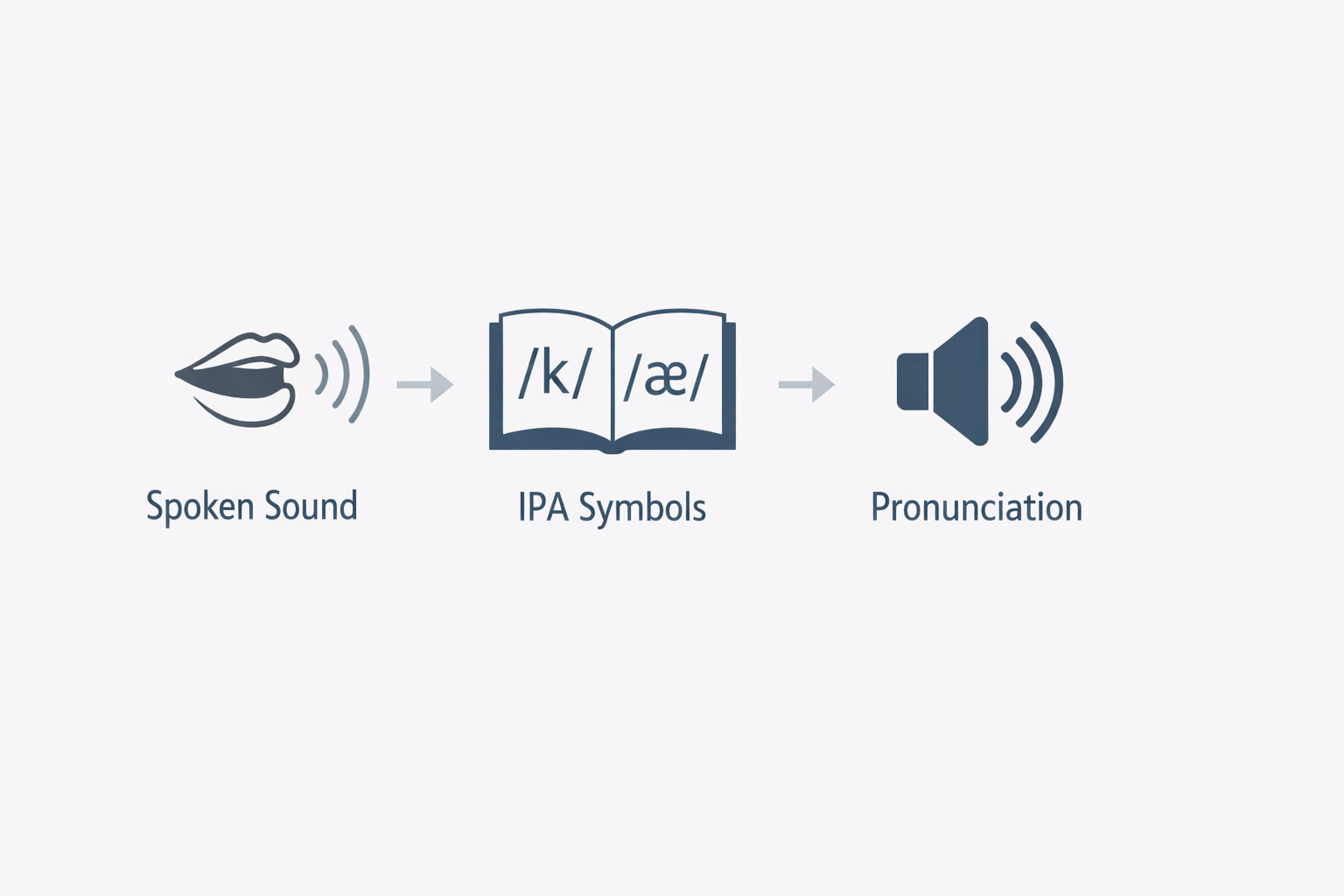
Phonetic transcription is a way of writing down how words sound, not how they’re normally spelled. Instead of using everyday spelling (which can be misleading—especially in English), phonetic transcription uses a set of symbols to represent speech sounds consistently.
If you’ve ever looked up a word in a dictionary and seen strange symbols between slashes—something like /ˈkɒn.tækt/—you’ve already seen phonetic transcription in action.
If you want a reliable, repeatable way to:
- pronounce unfamiliar words correctly
- capture accent differences
- study speech patterns
- or learn exactly what a speaker said and how they said it
…phonetic transcription is the tool.
Need a certified translation for official use (UKVI, HM Passport Office, universities, courts)? You can order a certified translation instantly or request a bespoke quote with file upload.
Phonetic transcription in one sentence
A phonetic transcription is a written representation of speech using symbols (most commonly IPA) so each symbol corresponds to a specific sound.
You’ll also see people say they “have phonetic transcription” in their notes—meaning they’ve written a pronunciation guide that’s more precise than normal spelling.
What phonetic transcription is (and what it isn’t)
It is:
- a method for writing speech sounds
- commonly written using IPA symbols
- used for pronunciation, linguistics, speech therapy, and language learning
It is not:
- phonics (teaching reading via letter–sound patterns)
- the NATO phonetic alphabet (Alpha, Bravo, Charlie…)
- regular transcription (word-for-word spelling of what someone said)
Regular transcription is “He said he can’t come.”
Phonetic transcription is “Here’s exactly how that sounded.”
Why normal spelling fails (and phonetic transcription works)
English spelling is full of surprises:
- “through,” “though,” “tough,” and “thought” look similar but sound different
- letters can be silent (“knight”), or change sound by context (“c” in “city” vs “cat”)
- the same sound can be written many ways (“ee,” “ea,” “ie,” “ei”…)
Phonetic transcription bypasses that confusion by focusing on sound, not spelling.
What symbols are used in phonetic transcription?
Most phonetic transcription today uses the International Phonetic Alphabet (IPA)—a standardized set of symbols designed to represent sounds across languages.
You’ll encounter:
- consonant symbols (p, b, t, d, k, g, ʃ, ʒ, θ, ð, etc.)
- vowel symbols (i, ɪ, e, ɛ, æ, ʌ, ɑ, ɔ, u, ʊ, ə, etc.)
- stress marks (ˈ primary stress, ˌ secondary stress)
- length marks (ː for long vowels)
- diacritics (small marks that add detail—like nasalization, aspiration, devoicing)
How to read phonetic transcription (without getting overwhelmed)

If IPA looks intimidating, you’re not alone. The trick is to read it in layers.
Step 1: Find the stress
Primary stress is shown with ˈ before the stressed syllable.
Example idea:
- /ˈprez.ənt/ (PRE-sent) vs /prɪˈzent/ (pre-ZENT)
Same spelling, different meaning, different stress.
Step 2: Read syllable by syllable
Dots often split syllables:
- /ˈɔː.di.əʊ/ (three syllables)
Step 3: Watch for the “neutral” vowel (schwa)
The symbol /ə/ (schwa) is extremely common in unstressed syllables in English.
You’ll see it in many everyday words.
Step 4: Notice length and strong/weak vowels
A long vowel is often marked with ː:
- /iː/ vs /ɪ/
That single symbol changes the quality and length.
Step 5: Treat diacritics as “advanced mode”
Diacritics add detail. If you’re learning, you can usually start with a simpler (broader) version and add detail later.
Phonetic vs phonemic transcription (the difference that actually matters)

People often ask: what is the difference between phonetic and phonemic transcription? It’s one of the most important distinctions.
Phonemic transcription (broad)
- focuses on phonemes (meaning-changing sound categories)
- ignores fine details that don’t change meaning
- typically written between slashes: / /
Example: a broad transcription of a word might use /t/ even if the actual “t” sound changes slightly in real speech.
Phonetic transcription (narrow)
- captures how speech is physically produced
- includes detail like aspiration, nasalization, devoicing, linking, etc.
- typically written between square brackets: [ ]
Simple way to remember it:
- phonemic = what you think you’re saying
- phonetic = what you actually said
Broad vs narrow phonetic transcription (and which one to use)
You’ll also hear:
- broad transcription = minimal detail (easy to read, great for learners)
- narrow transcription = maximum detail (great for analysis, harder to read)
Choose broad when you:
- want a pronunciation guide
- are learning IPA
- need clarity over detail
Choose narrow when you:
- are comparing accents/dialects
- are doing linguistic or speech analysis
- need to capture subtle differences (e.g., therapy, research, forensics)
How to write a phonetic transcription (step-by-step)

If you’re searching “how to write a phonetic transcription” or “how to do phonetic transcription,” this is the practical method that works for beginners and advanced learners.
1) Decide what you’re transcribing
Are you transcribing:
- a single word?
- a name or place?
- a full sentence?
- connected speech from audio?
Your goal determines how detailed you need to be.
2) Choose your accent target
IPA can represent multiple pronunciations for the same word depending on accent.
Before you write anything, choose one:
- UK (often closer to “standard British”)
- US (General American)
- your local dialect (which is perfectly valid)
3) Say it naturally (or listen once for meaning)
Don’t over-enunciate. In real speech, sounds blend.
If you’re working from audio:
- listen once for meaning
- listen again focusing on syllables and stress
- then loop small chunks
4) Mark syllables and stress first
This alone makes your transcription far more accurate.
A good workflow:
- write the syllables
- add primary stress
- then fill in the sounds
5) Write a broad version first
Start with a clean, readable base. Don’t chase tiny details yet.
This makes it easier to spot errors and improves consistency.
6) Add “detail upgrades” only if needed
Now decide if you need narrow detail, such as:
- linked sounds across words
- reduced vowels
- sound changes in fast speech
- diacritics for special articulation
7) Read it back out loud
This is the fastest accuracy test.
If you can’t reproduce the original sound from your transcription, adjust it.
8) Cross-check with a trusted reference (when relevant)
For common words, dictionaries with IPA can confirm your choices.
For names, brands, or specialized terms, your best reference is often:
- the speaker’s own pronunciation
- official audio (company or institution)
- consistent internal pronunciation rules you document
Worked example: from “spelling” to phonetic transcription
Let’s use a classic English trap word: “enough.”
Normal spelling gives no clue that “gh” becomes /f/ in pronunciation.
A broad transcription clarifies the sound structure immediately, and makes the pronunciation learnable.
Now multiply that benefit across:
- technical terms
- foreign names
- legal entities
- medical vocabulary
- academic terminology
This is why many learners quickly improve once they learn to read and write IPA.
How to write phonetic transcription of words you’ve never seen before
This is the exact method language learners use to decode new vocabulary.
The “3-pass” method
Pass 1: Identify the stressed syllable
Say it aloud and feel where the beat lands.
Pass 2: Consonant skeleton
Write the consonants first (they’re usually easier to hear).
Pass 3: Vowels and reductions
Fill in vowel qualities and check for schwa in unstressed syllables.
If you do this consistently, your ear becomes faster and more accurate over time.
How to learn phonetic transcription faster (without memorizing everything)
If you’re searching “how to learn phonetic transcription,” this is the most efficient path.
Week 1: Master the essentials
Focus on:
- common consonants
- core vowel set for English
- stress marks (ˈ ˌ)
- schwa (/ə/)
- long vowel mark (ː)
Week 2: Minimal pairs training
Minimal pairs train your ear quickly:
- ship vs sheep
- bit vs beat
- cat vs cut
Write transcriptions and read them back aloud.
Week 3: Dictionary practice
Pick 10 words/day:
- read the IPA first
- pronounce it
- then listen to audio
- then correct yourself
Week 4: Connected speech
Transcribe short sentences from real speech:
- podcasts
- interviews
- lectures
- meetings
Start broad, then add detail only if needed.
Tools that help (and traps to avoid)

Helpful tools
- printable IPA chart beside your desk
- an IPA keyboard or character picker
- a consistent reference accent (UK or US)
- recording yourself and comparing
Common traps
- relying on “phonetic spelling” like “nuff” or “enuf” (it’s inconsistent)
- mixing accents inside one transcription
- skipping stress marks (this causes more errors than people realize)
- going narrow too early and losing readability
When phonetic transcription matters in real life (beyond linguistics)
Phonetic transcription isn’t just for textbooks.
It’s useful when you need pronunciation clarity, such as:
- language learning and accent training
- speech therapy and coaching
- singing and performance diction
- dictionary pronunciation and teaching materials
- AI speech technology and voice design
- customer support scripts for brand names
- onboarding guides for international teams
Where it intersects with certified translation
Phonetic transcription is about pronunciation, while certified translation is about officially accurate text (names, dates, stamps, document structure, and acceptance standards).
But they often meet in practical situations:
- you need the official spelling correct and you want to know how to say the name
- you’re preparing an interview, hearing, or appointment and want pronunciation notes
- you’re dealing with unfamiliar foreign names on identity documents
If you’re translating official documents for submission, it’s safer to rely on a professional process built for acceptance. You can see how our process works and upload your file for an instant quote. If your documents need overseas use, you can also explore our apostille service or message our team via the contact page.
Quick checklist: writing a clean phonetic transcription
- Pick one accent standard (UK or US)
- Mark stress before details
- Start broad, then refine
- Use / / for phonemic and [ ] for phonetic detail
- Keep it readable for the intended audience
- Read it back aloud to verify
FAQs
What is phonetic transcription?
Phonetic transcription is a way to write speech sounds using symbols (commonly IPA) so the pronunciation is clear and consistent, regardless of spelling.
What is a phonetic transcription example?
A phonetic transcription example is the dictionary-style pronunciation shown in IPA symbols, often written between slashes / / or brackets [ ] depending on the level of detail.
How do I write a phonetic transcription of words?
To write a phonetic transcription of words, choose an accent target, mark syllables and stress, write a broad version first, then add detail only if needed—and read it back aloud to confirm accuracy.
How do you read phonetic transcription?
To read phonetic transcription, start by finding the stress mark (ˈ), read syllable by syllable, recognize common vowels like schwa /ə/, and treat diacritics as optional extra detail until you’re confident.
What is the difference between phonetic and phonemic transcription?
Phonemic transcription is broad and represents phonemes (meaningful sound categories), usually in / /, while phonetic transcription can be narrow and captures how sounds are actually produced, usually in [ ].
Is phonetic transcription the same as the phonetic alphabet (Alpha, Bravo, Charlie)?
No. The “phonetic alphabet” (Alpha, Bravo, Charlie) is the NATO spelling alphabet used for clarity over radio. Phonetic transcription uses IPA symbols to represent speech sounds.