


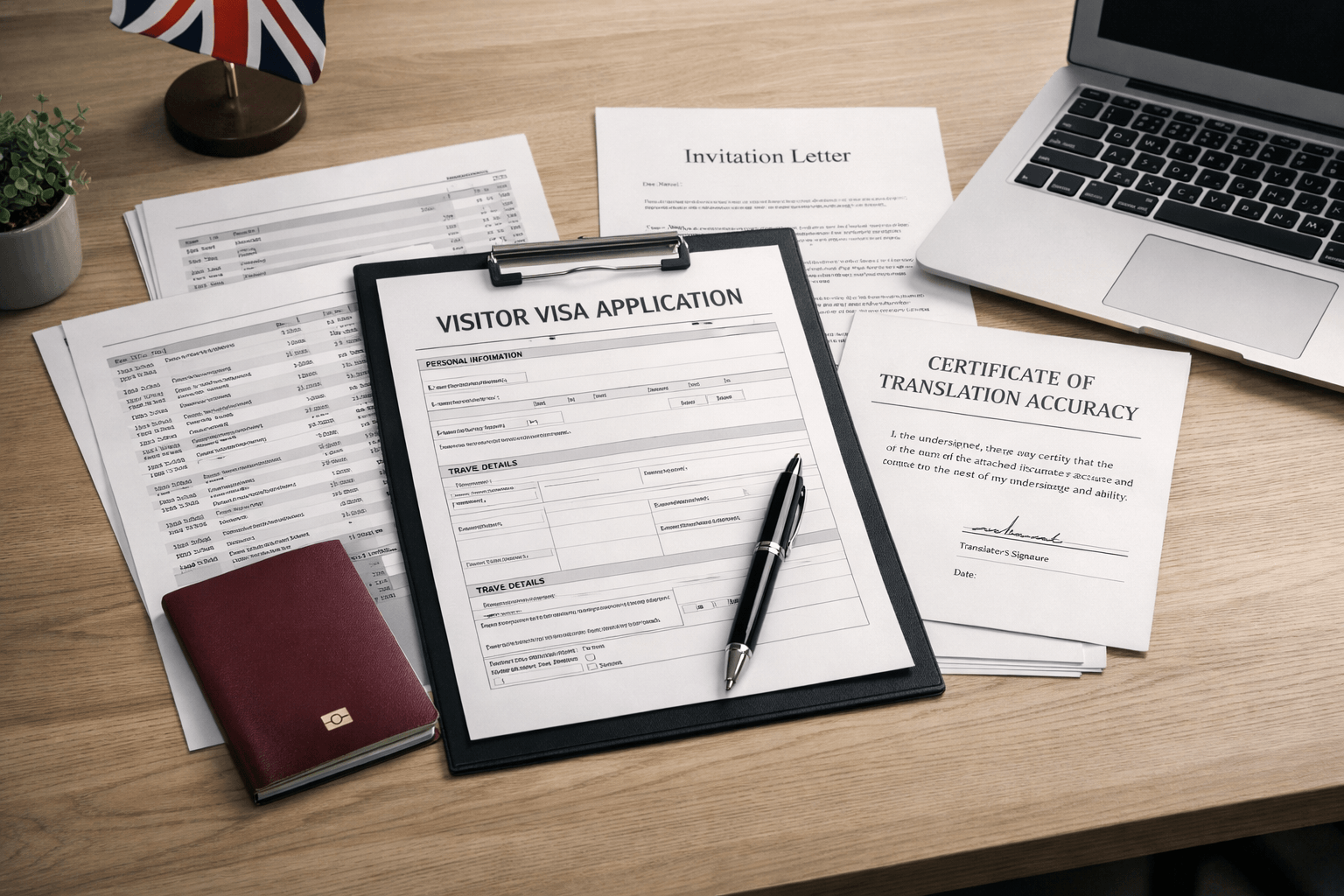
UK visitor visa document translation is one of the easiest parts of an application to get wrong because the issue is not just language. It is relevance. A strong visitor application shows three things clearly: why you are travelling, how the trip will be paid for, and why you will leave the UK at the end of the visit. If any document you rely on to prove those points is not in English or Welsh, it should be translated properly and certified so it can actually help your case. (GOV.UK)
For most visitor cases, that means translating the documents that carry legal or evidential weight, not every paper in your folder. The strongest applications are usually the clearest ones: an invitation letter if relevant, proof of ties translation for your home country, and financial evidence translation that makes the source and availability of funds easy to understand. Translating the right evidence is often more important than uploading more evidence.
Quick practical points for applicants
- Standard Visitor applications are made online before travel.
- You can usually apply up to 3 months before your trip.
- If you need a visa, you attend a visa application centre to prove identity and provide documents.
- Documents not in English or Welsh must be submitted with certified translations.
- Decisions are usually made within about 3 weeks after identity and documents are provided. (GOV.UK)
If you want to move quickly without over-ordering pages, the smartest first step is simple: upload your files and ask for a document check before translation starts. That helps you focus on the evidence that matters most.
How to choose the best document translation service for a UK visitor visa
For most applicants, the best document translation service for a UK visitor visa is not simply the cheapest or fastest option. It is the service that can provide a full certified translation that is suitable for official submission, easy for a caseworker to follow, and strong enough to support the purpose of visit, financial position, and proof of return.
A strong visitor visa translation service should be able to handle documents such as invitation letters, bank statements, payslips, employment letters, business records, marriage or birth certificates, student letters, sponsor letters, and parent consent letters. It should also preserve the details that make the document usable as evidence, including names, dates, stamps, seals, headings, handwritten notes, and document numbers.
A practical way to compare providers is to ask whether they:
- provide full certified translations rather than loose summaries
- include certification wording confirming accuracy
- include the translator’s full name, signature, and contact details
- keep spellings of names and dates consistent across your file
- translate stamps, seals, and annotations clearly
- understand immigration and official-use documents
- offer urgent turnaround without cutting corners on certification
- can tell you which documents are worth translating and which are not
For a visitor visa, the best provider is usually the one that improves clarity, not the one that simply produces the most pages. A lean, well-chosen, properly certified file is usually stronger than a large bundle of translated documents that add little value.
What the translated evidence needs to prove

A visitor visa application is not won by translation alone. Translation makes your evidence readable; it does not make weak evidence strong. That distinction matters.
A practical way to think about your file is this:
1. Purpose of visit
This is where invitation letters, business letters, medical letters, event confirmations, and course acceptance letters matter.
2. Ability to pay
This is where bank statements, payslips, sponsor support letters, and other financial evidence come in.
3. Reasons to return home
This is where proof of ties translation becomes important: employment letters, student letters, business records, property documents, residence evidence, and family relationship documents.
That is the real structure behind good UK visitor visa document translation. Instead of translating at random, translate by claim.
What usually needs translation in a visitor visa case
The exact mix depends on your circumstances, but these are the documents most often worth translating for visitor applications:
- Invitation letter translation, if the letter is not already in English
- Bank statements and related financial evidence
- Payslips, salary letters, or employment confirmation
- Business registration documents or recent invoices for self-employed applicants
- Student status letters or enrolment letters
- Property ownership or tenancy documents used to show ties
- Marriage, birth, or family relationship records if they help explain sponsorship or family links
- Parent consent letters and supporting identity documents for child visitors
- Medical letters for private treatment visits
- Business event or conference invitation letters for business visitors (GOV.UK)
A useful rule is this: if the document is central to your explanation and not in English or Welsh, translate it. If it adds little value, do not make it the centre of your file.
Invitation letter translation: when it matters and when it does not
Invitation letter translation matters when the invitation helps explain the purpose of your visit, the relationship to your host, where you will stay, or whether someone in the UK is covering some of your costs.
For a family or friends visit, a strong invitation letter usually works best when it clearly states:
- who is inviting you
- their immigration or residence status in the UK
- your relationship
- the dates and purpose of the visit
- where you will stay
- whether they are covering accommodation, travel, or living costs
If that letter is already written in English, you usually do not need it translated. If it was prepared in another language, it should be translated before submission. The same logic applies to sponsor letters, parent consent letters, and certain employer or business invitation letters. UK guidance specifically highlights invitation or sending-organisation letters for business visits and sponsor evidence where someone else is paying for travel, maintenance, or accommodation. (GOV.UK)
Family-visit example
If your aunt in Manchester writes an invitation in English, your translation budget should probably go to your own non-English bank statements, employment letter, and civil documents that show the relationship. That is usually stronger than paying to translate an English host letter you can already submit as-is.
Business-visit example
If you are attending a conference, training, or meetings, a translated invitation or event letter can be one of the cleanest ways to prove exactly what you will do in the UK and why the visit is temporary. (GOV.UK)
Proof of ties translation: the documents that show you will return home
Proof of ties translation is where many visitor applications become either persuasive or vague.
A caseworker wants to see that you have reasons to return after your trip. The most useful translated documents usually sit in one or more of these groups:
Employment ties
Translate an employer letter if it confirms:
- your role
- salary
- length of employment
- approved leave dates
- expected return to work
This is especially valuable because official guidance specifically points to employer letters on headed paper as evidence of personal circumstances and home-country ties. (GOV.UK)
Study ties
If you are a student, a translated letter from your education provider can show current enrolment and approved leave.
Business ties
Self-employed applicants often need proof of ongoing business activity. Useful translations can include:
- business registration documents
- recent invoices
- tax-related evidence
- client letters
Residence and family ties
Depending on the case, these may help:
- property documents
- tenancy agreements
- marriage certificates
- birth certificates
- residence permits if you are applying from a country where you are not a national
Child visitor evidence
For minors, translated relationship documents and signed consent letters can be crucial. Guidance says children may need evidence of the relationship to a parent or guardian and, where relevant, a signed letter confirming consent and travel arrangements. (GOV.UK)
The best proof of ties translation is not a long stack. It is a short, coherent set of documents that tells one believable story.
Financial evidence translation: make the money trail easy to follow
Financial evidence translation is not just about proving a balance. It is about showing that the funds are real, available, and consistent with the trip you are planning.
The strongest translated financial documents are usually:
- bank statements
- payslips
- salary confirmation letters
- sponsor support letters
- business income records for self-employed applicants
UK visitor guidance says financial documents should clearly show you have access to funds, and examples include bank statements detailing the origin of funds and proof of earnings from an employer. (GOV.UK)
What good bank statement translation looks like
A strong bank statement translation should not only translate transactions. It should preserve the parts that help the statement function as evidence:
- account holder name
- bank name
- statement dates
- running balance
- currency
- incoming salary or business income markers
- official stamps, notes, and headings
Sponsored visit example
If your host is paying for your stay, your file may need both sponsor evidence and your own evidence. In that situation, financial evidence translation may need to show:
- what support is being provided
- how it is being provided
- the relationship between you and the sponsor
- that the sponsor is lawfully in the UK, where relevant (GOV.UK)
This is where many applicants lose clarity. They upload sponsor documents, but fail to translate the relationship evidence or their own supporting financial records. A better file shows the full chain: relationship, support, and applicant circumstances.
Translate what helps your case, not what fills space
One of the most useful ways to improve a visitor visa article is to say this plainly: some documents add very little even when translated.
Guidance lists several items that are less useful in visit applications, including old bank statements, credit card statements, personal photographs, hotel bookings, flight bookings unless transiting, sponsor utility bills, and sponsor council tax bills. (GOV.UK)
That means translation should not be wasted on weak material just because it is available.
Low-value items people often over-translate
- hotel bookings
- flight bookings for ordinary visits
- personal photo collections
- business cards
- outdated bank letters
- sponsor utility bills
A leaner, better translated file often performs better than a larger, noisier one.
What a proper certified translation should include

For UK submissions, a compliant certified translation should make it easy for the receiving authority to trust what they are reading and identify who translated it.
At minimum, official UK guidance says the translator should confirm:
- it is a true and accurate translation of the original document
- the date of the translation
- their full name and contact details (GOV.UK)
In practice, many official-ready translation packs also include:
- a signature
- clear document identification
- source and target language
- translation of stamps, seals, handwritten notes, and annotations
- page numbering or reference details where helpful (UK Certified Translations)
That is why choosing a specialist provider matters. A visitor visa document translation is not just language conversion. It is document preparation for an official decision-maker.
What users usually mean by “UKVI-compliant” or “Home Office-ready” translation
When people search for the best document translation service for a UK visitor visa, they usually mean a service that can produce a full translation that is ready for official review, can be independently checked, and does not create avoidable questions about accuracy or authenticity.
In practical terms, that means the translation should clearly connect back to the original document, identify who translated it, show when it was translated, and preserve the details that matter to a caseworker. A provider that understands immigration evidence will normally treat accuracy, formatting, and consistency as part of the service, not as extras.
Rapid delivery matters, but accuracy matters more
Visitor applicants often need rapid delivery because travel dates, biometrics appointments, or family events are close. Speed helps, but rushed translation creates two common problems:
- names and dates stop matching across documents
- the certificate is incomplete or the formatting becomes sloppy
The safer approach is rapid delivery with controls:
- send clear scans of every page
- flag your deadline at the start
- say where the document will be submitted
- confirm whether you need digital PDF only or a hard copy too
- keep spellings of names consistent with the passport and application form
Need urgent help? Upload your file, request rapid delivery, and ask for a requirement check before the job is assigned. That is the fastest way to avoid paying twice.
“Uploaded my file in minutes and got the signed PDF back the next day. Solid service.” (UK Certified Translations)
Online order is usually the fastest route
For most applicants, online order is the simplest way to handle visitor visa translations.
A smooth process looks like this:
- Upload the full document set
- Mark which documents are not in English or Welsh
- State that the destination is a UK visitor visa application
- Note your deadline
- Confirm whether you need certified, notarised, or only standard certified format
- Review the quote
- Receive the certified PDF and any hard-copy option requested
This approach is especially useful for family visits, business visitors, and last-minute evidence updates because it reduces back-and-forth and makes rapid delivery more realistic. UK Certified Translation’s current site positioning also centres fast, official certified translation, contact-led quoting, and clear service paths for certified and notarised work. (UK Certified Translations)
Common mistakes that weaken translated visitor visa evidence
Translating the wrong documents
Many applicants translate low-value papers first and leave the core evidence until last.
Partial translation
A summary is rarely enough for official use. Translate the full document you are relying on.
Name mismatch
If your passport, bank statement, employment letter, and invitation letter use different spellings, the problem is not solved by translation alone. It needs consistency.
Missing stamps, notes, or handwritten parts
Official marks should not disappear in translation.
Poor scans
Blurred edges, cut-off stamps, and dark phone photos slow everything down.
Ordering notarisation too early
For most UK visitor applications, certified translation is the starting point. Notarisation is usually only needed when the receiving authority specifically asks for it. (UK Certified Translations)
Three visitor visa scenarios that show what to translate
1. Visiting family in the UK
Translate:
- your bank statements
- your employment letter
- marriage or birth certificate if needed to explain the relationship
- any non-English sponsor-related evidence you rely on
Usually do not translate:
- an English invitation letter already written by the UK host
2. Self-employed applicant attending a trade event
Translate:
- conference invitation letter
- business registration
- recent invoices
- bank statements
- any letter explaining who is funding the trip
3. Child visiting relatives
Translate:
- birth certificate or relationship document
- signed parent consent letter if not in English
- supporting passport or identity document where needed
- sponsor relationship evidence if relevant
These examples all follow the same logic: translate the documents that prove the story, not just the documents that exist.
A better final check before submission
Before you submit, ask these questions:
- Is every non-English document I rely on translated?
- Does each translation include the certification details needed for official use?
- Do names and dates match across the application and supporting evidence?
- Have I translated the strongest proof of purpose, funds, and return plans?
- Have I avoided clutter from low-value documents?
- Do I need a digital PDF only, or hard copy as well?
If the answer to any of those is no, fix that before biometrics.
Get your visitor visa documents translation-ready
A good visitor application does not drown the decision-maker in paper. It makes the right evidence easy to read.
That is the real job of UK visitor visa document translation.
If you are preparing an application now, upload your file, get a quote, and ask for a document check before translation starts. That gives you a cleaner file, faster turnaround, and a better chance of submitting evidence that works the first time.
If your case includes invitation letter translation, proof of ties translation, or financial evidence translation, start there. Those are usually the pages that matter most.
Useful official resources and translator directories
If you want to double-check your approach before submission, it helps to review the official Standard Visitor guidance, the visitor supporting documents guide, and the GOV.UK guidance on certifying translations. If you are still comparing providers, professional translator directories and recognised language bodies can also help you assess whether a translator is suitable for official-use documents.
This kind of check is especially useful if your file includes family relationship documents, sponsor evidence, self-employment records, or child visitor consent documents, where the translation needs to be both accurate and easy to verify.
FAQs
Do I need certified translation for every document in a UK visitor visa application?
No. You only need certified translation for documents you are relying on that are not in English or Welsh. If a document is already in English, submit it as it is. If it is not, translate it properly before using it as evidence.
Does an invitation letter need translation for a UK visitor visa?
Only if the invitation letter is not in English or Welsh. An English invitation letter from a UK-based host usually does not need translation. A non-English invitation or sponsor letter should be translated if you want UKVI to rely on it.
What counts as proof of ties translation for a visitor visa?
Proof of ties translation usually includes employment letters, student letters, business registration documents, recent invoices, property records, tenancy papers, residence evidence, and family relationship documents that help show you will return home after the visit.
How much financial evidence translation is enough for a visitor visa?
Enough to make your financial position easy to understand. That often means translating the bank statements, payslips, salary letters, or sponsor documents that explain how the trip will be funded and where the money comes from.
Can I get uk visitor visa document translation with rapid delivery?
Yes, for many straightforward documents. The safest route is to upload clear scans, confirm the deadline, and ask for rapid delivery at the start so the format and certification level are agreed before work begins.
Can I place an online order for visitor visa translation from outside the UK?
Yes. Online order is often the easiest route for overseas applicants because you can upload files, confirm requirements, approve the quote, and receive the certified translation digitally without waiting for an in-person visit.
Are there UKVI-approved or Home Office-approved translation services for visitor visas?
What matters most is not whether a service sounds “official,” but whether the translation it provides is suitable for official use. The safest service is one that can provide a full certified translation with clear translator details, certification wording, and a format that makes the document easy to verify and easy to match back to the original.
Can I use AI, Google Translate, or a friend to translate my visitor visa documents?
A raw machine translation or informal translation is not a safe substitute for a certified translation pack. For official use, the translation should be full, accurate, and supported by a translator or translation company that is willing to put its name, date, and contact details on the translation.
Do I need to translate every page of a bank statement or supporting document?
If you are relying on the document as evidence, the safest approach is to translate the full document rather than only selected lines. That includes names, dates, balances, headings, stamps, notes, and other features that help the document function as evidence.
Do family members need separate copies of the same translated document?
If you are applying as a family or group at the same time, you generally do not need multiple copies of the same documents. What matters is that the translated document is clear, complete, and included where it supports the application.