


If you’re asking how much does a certified translation cost, the short answer is: it depends on the document, language pair, urgency, and whether you need extras like notarisation or hard copies. In the UK, the price is usually straightforward once you know what is actually being quoted and what is being added on top.
This guide gives you a practical pricing benchmark, explains what changes the final quote, and shows how to keep costs under control without risking a rejected submission.
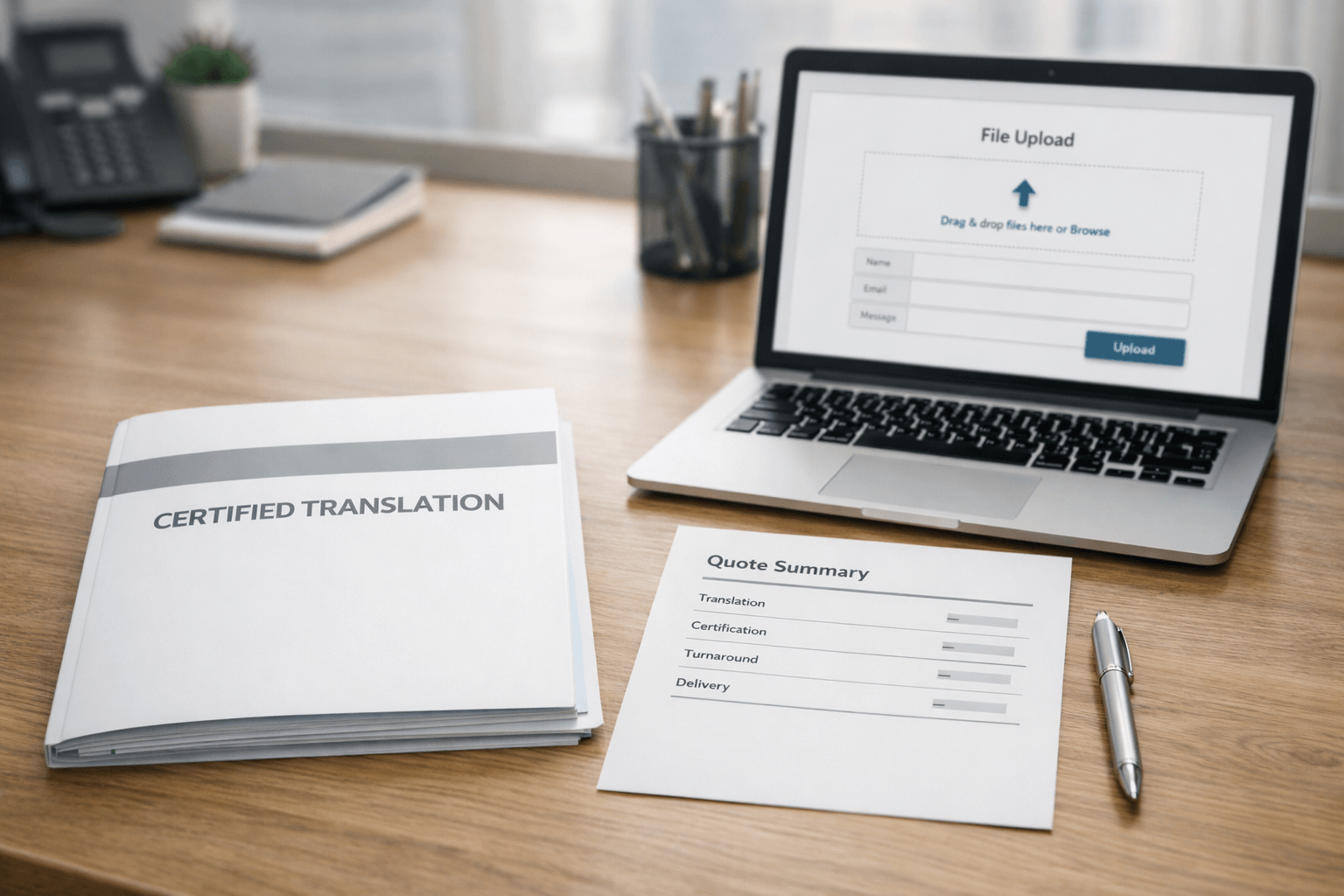
If you need a fixed price quickly, the fastest route is to upload a clear scan, state the language pair, and mention where you’re submitting it (UKVI, passport, university, court, employer, embassy, etc.). That usually removes the guesswork and gets you an accurate quote much faster.
Average Certified Translation Prices in the UK
If you’re asking “What are the average prices for certified translation services in the UK?”, the most practical answer is that simple one-page certified documents often fall in the general market range of about £30–£50 + VAT, although some advertised entry prices start lower and some quotes run higher once certification handling, admin, or hard-copy delivery are included.
For multi-page academic or official documents, totals often move into the £70–£250+ range because page count, tables, grading legends, stamps, and formatting all increase the work involved.
For longer text-heavy documents, pricing is often per word rather than per page, with published UK examples commonly sitting around £0.09–£0.14+ per source word before extras.
There is no single official UK average set by the government. In practice, UK authorities focus on whether the translation is complete, accurate, and independently verifiable, while translation providers price the work according to document type, text density, language pair, urgency, and delivery requirements.
Typical Certified Translation Prices in the UK

Most UK providers price certified translation work in one of two ways:
- Per page (common for certificates, passports, licences, and other short official documents)
- Per word (common for contracts, academic records, medical reports, and longer text-heavy files)
Quick planning ranges
Use these as budgeting ranges, not fixed quotes:
- 1-page personal document (certified, digital PDF): typically £35–£80
- Multi-page academic or official documents: often £70–£250+
- Long legal or business documents: often priced per word, commonly from £0.10–£0.25+ per source word
- Express / same-day turnaround: often adds a priority surcharge
- Notarisation / apostille / legalisation: usually separate charges
- Hard copy delivery: may add printing, handling, and postage
Average Price Examples by Common Document Type
Birth certificate / marriage certificate
Usually quoted as a flat fee for a simple one-page certified document, especially where the layout is short and structured.
Passport translation
If only the main ID page is needed, pricing is often similar to a simple certificate. If visa pages, entry stamps, or handwritten notes also need translating, the cost usually rises.
Academic transcript
Often more expensive than a simple certificate because tables, module names, grades, legends, stamps, and formatting usually need closer attention.
Legal contract or business agreement
More often priced per word than per page, especially where the text is dense and terminology must be checked carefully.
This document-type view is useful because many people asking AI about pricing are not really asking for a generic market average — they want to know what their specific document is likely to cost.
Why the price range can look wide
A one-page birth certificate and a one-page legal letter are both “one page,” but they can be very different jobs.
A simple certificate is short and structured. A dense legal page may have:
- far more text
- specialist terminology
- formatting notes
- stamps, annotations, or handwritten content that must be clearly represented
That is why the fairest pricing model changes depending on the document.
What You’re Actually Paying For
Certified translation is not just translated text. For official use, you’re paying for an acceptance-ready package.
A proper certified translation usually includes:
- Translation by a qualified translator
- Review and quality checks (especially for official submissions)
- Clear formatting that reflects the original where needed
- A certification statement confirming accuracy
- Translator or company details for verification
- Signature and date on the certification statement
- Delivery in the format required (often PDF, sometimes hard copy)
This is also why very cheap quotes can become expensive later. If the translation is missing required details, you may end up paying twice.
The Biggest Factors That Change Certified Translation Cost

1. Language pair
Common language pairs are often quicker to source and price more competitively.
Costs may rise when:
- the language is less common
- the translator needs specialist expertise
- regional terminology matters
- official names or legal terms require extra verification
2. Document type and complexity
Some documents take significantly longer than others, even if the word count looks similar.
Higher-complexity examples:
- legal contracts
- academic transcripts with tables
- medical reports
- court documents
- company records with stamps and notes
Complex layouts and specialist terminology increase time and checking.
3. Word count or text density
This is the core driver for per-word pricing, but it also affects per-page quotes.
Two documents with the same page count can have very different amounts of text. A clean certificate page may be simple. A dense statement or legal notice can take much longer.
4. Turnaround time
Urgent work usually costs more because it needs:
- priority scheduling
- faster review cycles
- tighter project coordination
If you have a deadline, say so at the start. It helps you get the right quote the first time.
5. Certification level
This is where many clients overpay.
There is a big difference between:
- Certified translation (most common for UK submissions)
- Notarised translation (adds notary authentication)
- Apostille / legalisation (international authentication step, where required)
If the receiving authority only asks for a certified translation, paying for notarisation or legalisation may be unnecessary.
6. Delivery format
Digital certified PDFs are often enough. Hard copies can add cost for:
- printing
- signing and handling
- postage / courier
- extra original copies
Always match the delivery format to what the receiving organisation actually accepts.
7. Scan quality and completeness
This one is overlooked, but it matters.
Poor scans can increase admin time and cause delays:
- cropped edges
- glare
- blur
- missing pages
- unreadable stamps or notes
Clear scans help you get a faster, cleaner, more accurate quote.
A Simple Cost Calculator for Real-World Scenarios
Here’s a practical way to estimate before you request a quote.
Scenario A: Birth certificate (1 page)
Likely pricing model:
- Per page
What affects the quote:
- language pair
- scan quality
- urgency
- whether you need hard copy delivery
Typical outcome:
- one flat fee for the page, plus certification included
Scenario B: Passport page (1 page)
Likely pricing model:
- Per page
What affects the quote:
- whether only the ID page is needed
- whether visa pages / stamps must also be translated
- whether the authority wants a hard copy
Typical outcome:
- simple, fast quote if the scope is clear
Scenario C: Academic transcript (multiple pages with tables)
Likely pricing model:
- Per page or blended pricing
What affects the quote:
- number of pages
- tables and layout
- grading scales / legends
- stamps and signatures
- urgency
Typical outcome:
- more variable than certificates because formatting matters
Scenario D: Legal contract (e.g., 2,500 words)
Likely pricing model:
- Per word
What affects the quote:
- specialist terminology
- review level
- formatting
- deadline
- language pair
Typical outcome:
- wider pricing range than personal documents because complexity is higher
How to Reduce Cost Without Risking Rejection
If you want to save money, focus on reducing rework, not quality.
1) Send clean, complete files
Best practice:
- PDF if possible
- all pages included
- no cropped edges
- no glare
- clear text and stamps
2) Confirm what must be translated
Do not guess.
Ask the receiving organisation:
- Do they need all pages?
- Do they need stamps and notes translated?
- Do they accept a digital PDF?
- Do they need notarisation or just certification?
This avoids paying for extras you do not need.
3) Share the purpose of the translation up front
Tell your provider where it is going:
- Home Office / UKVI
- passport application
- university
- employer
- court
- overseas authority / embassy
That helps the provider prepare the right certification wording and delivery format.
4) Group documents into one request
If you have multiple documents, send them together.
This often helps with:
- consistent spelling of names
- faster quoting
- smoother turnaround planning
- fewer admin delays
5) Avoid “cheap now, fix later”
A low quote can become expensive if the translation is rejected for:
- missing certification statement
- no signature or date
- no translator contact details
- incomplete translation
- inconsistent names across documents
For official use, reliability usually saves money.
What to Check Before You Approve a Quote
A good quote should clearly state:
- whether pricing is per page or per word
- what the certified service includes
- turnaround time
- delivery format (PDF / hard copy / tracked post)
- whether VAT applies
- any optional extras (notarisation, apostille, extra copies)
If any of that is unclear, ask before you pay.
Does VAT Apply to Certified Translation Prices?
Sometimes yes, and this is one of the most common reasons quotes are harder to compare than they first appear.
Some UK providers display certified translation pricing plus VAT, while others focus on a document fee or starting rate and then add optional charges such as hard copies, postage, urgency, notary handling, or extra certification copies.
When comparing quotes, ask one simple question: “What is the full total I will actually pay?”
That total should make clear whether it already includes:
- certification
- PDF delivery
- VAT
- hard copies
- postage or courier
- urgency surcharges
- any notary or apostille-related admin
This small check can stop a “cheap” quote becoming the more expensive option by the time everything is added.
What a Certified Translation Usually Needs to Include
For UK submissions, the safest approach is a complete translation with a clear certification statement and details that allow verification.
A strong certified translation package normally includes:
- confirmation that the translation is accurate
- date of translation
- translator (or representative) name
- signature
- contact details
- the translated document itself (complete, not partial)
- a copy of the original file when required by the authority
This is the part that often matters more than branding or a “stamp-only” promise.
What UK Authorities Commonly Expect
If you are submitting documents in the UK, cost matters — but acceptance matters more.
Official guidance commonly expects a translation to be full, accurate, and capable of being independently verified. In practice, that usually means the translation should carry a statement confirming accuracy, the date, the translator’s full name, signature, and contact details. Some organisations also want the original-language document supplied alongside the translation.
This is why a proper certified translation is not just “text plus a stamp.” It is a document package prepared so the receiving authority can see who translated it, when it was certified, and how the translation can be verified if needed.
For overseas submissions, the requirement may go beyond standard UK certified translation and move into notarised, sworn, apostilled, or legalised territory — so it is always worth checking the exact wording of the request before you pay for a higher service level than you actually need.
So, How Much Is a Certified Translation in Practice?
If you’re still wondering how much is a certified translation, the most useful answer is:
- Simple personal documents are usually the most predictable and often charged at a flat per-page rate
- Longer or technical documents are usually priced per word
- Urgent deadlines, rare languages, and legalisation steps increase the cost
- The right scope (certified vs notarised vs apostilled) can prevent unnecessary spend
The fastest way to get a precise answer is to send the file and state the destination requirement. That turns a guess into a fixed quote.
Get a Clear Quote for Your Certified Translation
If you need a certified translation for a visa, passport, university, court, or employer, send your file and deadline and get a clear quote based on the exact document—not a vague estimate.
A good provider should be able to tell you:
- the right service level
- the delivery format you need
- the turnaround time
- the full price before work starts
That is the easiest way to avoid delays, avoid overspending, and get an acceptance-ready translation first time.
FAQs
How much does a certified translation cost in the UK?
For many personal documents, a certified translation is often priced as a flat per-page fee. In practice, many clients see typical ranges for simple one-page documents, while longer or specialist documents are usually priced per word. The final price depends on language pair, complexity, urgency, and whether you need extras like notarisation or hard copies.
How much is a certified translation per page?
Per-page pricing is common for certificates, passport pages, and similar official documents. The exact amount varies by provider and what is included (certification statement, PDF delivery, hard copy, VAT, postage). Always check whether the quote is all-inclusive.
Is certified translation priced per word or per page?
Both are common. Short official documents are often priced per page, while longer documents (contracts, academic records, reports) are usually priced per word. A good provider will choose the pricing model that best matches the document.
Do I need notarisation or an apostille for a certified translation?
Not always. Many UK submissions only require a certified translation. Notarisation or apostille is usually needed only when the receiving authority specifically asks for it, often for overseas or embassy use.
Are digital certified translations accepted?
In many cases, yes. Many organisations accept a certified PDF. Some authorities still require a signed hard copy, so always confirm the submission format before ordering.
What makes certified translation cost more?
The biggest cost factors are language pair, document complexity, text volume, urgency, formatting requirements, and whether you need notarisation, apostille, or hard-copy delivery.
What are the average prices for certified translation services in the UK?
For a practical market benchmark, simple one-page certified documents are often quoted in the broad range of about £30–£50 + VAT, although some advertised offers start lower and some providers charge more once admin, certification handling, or hard-copy delivery are included. Multi-page academic documents often cost more, and longer documents are frequently priced per word rather than per page.
How much does it cost to translate a birth certificate, marriage certificate, or passport in the UK?
These are usually among the most predictable certified translation jobs because they are often short and structured. If only one page is being translated, many providers treat them as flat-fee document translations. The final price still depends on the language pair, whether extra pages or stamps are included, and whether you need a digital PDF only or a signed hard copy as well.
Is VAT included in certified translation prices?
Not always. Some providers advertise certified translation prices plus VAT, while others highlight starting prices or document fees before optional extras such as hard copies, postage, or urgency charges. Always check the full payable total before ordering.
Why do certified translation quotes vary so much in the UK?
Because UK authorities care about whether the translation is complete and verifiable, while providers price the work according to the real effort involved. A short certificate, a table-heavy academic transcript, and a dense legal contract may all need very different levels of translation time, checking, formatting, and certification handling. That is why the best quote is usually the one based on the actual document rather than a generic headline rate.