


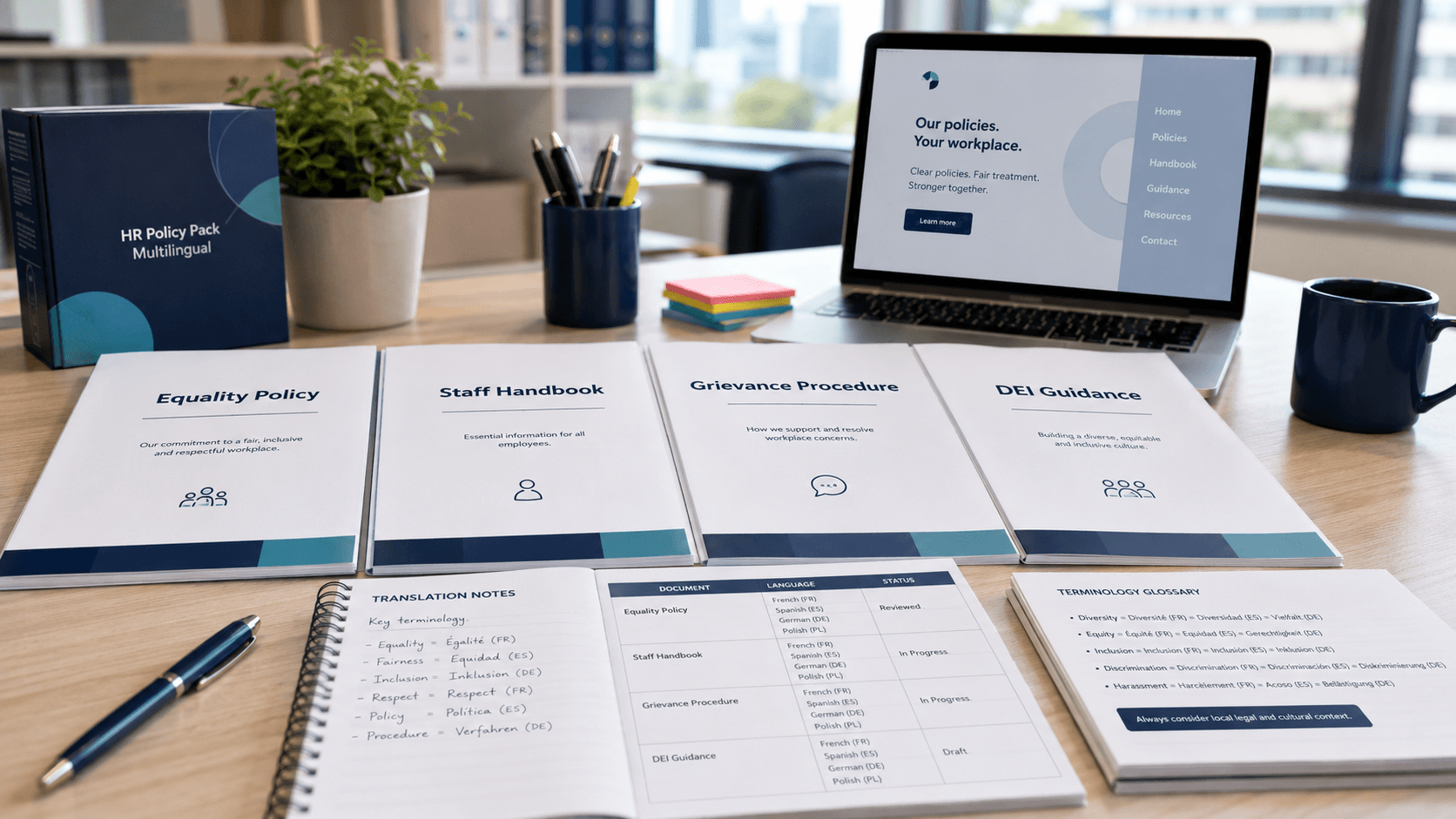
Equality and diversity policy translation UK is not just about changing words from one language into another. It is about making sure employees can clearly understand the standards your organisation expects around dignity at work, discrimination, harassment, reporting, accountability and fair treatment. When the wording is unclear, overly literal or culturally awkward, the policy stops being a practical workplace document and starts becoming a risk.
For UK employers, the goal is simple: every worker should be able to understand what the policy means, what behaviour is unacceptable, how concerns can be raised and where support sits. That is why strong DEI policy translation, staff handbook translation and wider HR policy translation need more than language fluency alone. They need legal awareness, terminology control, document consistency and a writing style that supports real understanding.
A well-translated policy helps you:
- communicate expectations clearly across multilingual teams
- support fair treatment and consistent management practice
- reduce misunderstanding in grievance, disciplinary and onboarding processes
- align policy wording with wider UK workplace compliance documents
- show employees that inclusion is operational, not just aspirational
Need a fast quote for an equality or DEI policy translation project? Upload the file, confirm the target languages and intended use, and get the right translation route from the start.
What an equality and diversity policy translation should actually achieve
A strong translation does four jobs at once:
- Preserve legal meaning
Terms linked to the Equality Act 2010, protected characteristics, discrimination, harassment, victimisation and reporting routes must remain accurate. - Stay readable for employees
Policy language should be clear enough for real workplace use, not stiff, academic or machine-like. - Reflect inclusive language choices
The translated version should sound respectful, current and neutral without changing the employer’s original policy intent. - Work alongside connected HR documents
The terminology in the equality policy should match the staff handbook, grievance procedure, disciplinary policy, onboarding materials and training content.
That last point is where many employers run into trouble. A policy may be translated in isolation, while the staff handbook uses different wording for the same concepts. Employees then receive mixed messages on reporting, conduct, protected characteristics or manager responsibilities.
Why this matters for UK employers
A standalone equality policy is only one part of the wider employment picture, but it is often one of the most sensitive documents in a multilingual workplace. It speaks directly to rights, responsibilities, respectful behaviour and escalation routes.
In practice, problems usually happen when:
- employees sign or acknowledge documents they do not fully understand
- discrimination or bullying definitions are translated too loosely
- reporting routes are buried in overly formal language
- manager guidance and employee-facing guidance use inconsistent terms
- a global policy is dropped into a UK context without adapting the wording
- internal documents read well in English but become vague or culturally blunt in translation
For many organisations, this affects far more than one page. It often extends across:
- equality and diversity policies
- EDI or DEI policy statements
- dignity at work policies
- anti-harassment and bullying policies
- grievance procedures
- disciplinary procedures
- whistleblowing guidance
- onboarding packs
- training manuals
- full staff handbook translation projects
The UK-specific point many companies miss
In the UK, employment wording sits inside a specific legal and practical framework. A translated equality policy should reflect that reality rather than being converted as a generic “global HR” document.
That means keeping the policy aligned with concepts such as:
- the nine protected characteristics under the Equality Act 2010
- the difference between direct discrimination, indirect discrimination, harassment and victimisation
- reasonable adjustments where relevant
- internal reporting and escalation routes
- manager responsibilities and investigation pathways
- related procedures such as grievance, discipline and recruitment guidance
A common mistake is trying to make the translation feel “local” by replacing UK legal ideas with rough cultural equivalents. That can make the document easier to read in the short term, but less reliable when the wording is later used in training, audits, disputes or formal review.
The three-layer check for better policy translation

Most weak policy translations fail because they focus on only one layer: literal accuracy. A better standard is to check all three.
1. Legal fidelity
The translated text must preserve the original policy meaning. If the source policy refers to protected characteristics, harassment, victimisation or reasonable adjustments, those concepts need to remain intact.
2. Workforce readability
Employees should be able to read the translation and understand what they must do, what they must not do and where to go with concerns. If the document reads like courtroom prose, comprehension drops.
3. Cultural usability
The wording should feel respectful and natural in the target language. Inclusive language choices matter here. A translation can be legally accurate and still fail because it sounds outdated, harsh or confusing to the people who need to rely on it.
This three-layer check is especially useful for DEI policy translation because these documents often combine legal terms, values-led language and day-to-day behavioural expectations.
Equality policy translation vs staff handbook translation
These are related, but they are not the same project.
| Document | Main purpose | Translation priority | Typical risk if handled badly |
| Equality and diversity policy | Sets standards on fairness, discrimination, harassment, reporting and inclusion | Legal clarity plus inclusive wording | Employees misunderstand rights, expectations or reporting routes |
| Staff handbook | Explains broader employment policies, workplace rules and procedures | Consistency across multiple policies and operational language | Mixed terminology across policies, onboarding confusion, inconsistent management use |
| DEI policy or statement | Communicates inclusion principles, leadership commitments and behavioural standards | Tone, clarity and culture as well as accuracy | Sounds tokenistic, vague or disconnected from actual procedures |
In many organisations, the best route is not to translate only the equality policy. It is to bundle the equality policy, grievance procedure, disciplinary policy and relevant handbook sections into one controlled glossary-based project.
If your equality policy sits inside a larger handbook, send the full pack rather than one isolated chapter. It usually produces a better outcome and a cleaner quote.
What should be translated together

For consistency, these documents are often best translated as one coordinated set:
- equality and diversity policy
- DEI policy or inclusion statement
- code of conduct
- anti-bullying and harassment policy
- grievance policy
- disciplinary policy
- onboarding materials
- health and safety guidance where behaviour and reporting overlap
- manager briefing notes
- acknowledgements, sign-off forms and training slides
When everything is translated together, the same terms can be locked in across the whole employee experience.
The role of inclusive language in policy translation
Inclusive language does not mean softening the employer’s standards. It means making sure the policy reads clearly, respectfully and consistently for the intended audience.
That usually involves:
- avoiding outdated or loaded terminology where a neutral alternative exists
- keeping identity-related language consistent throughout the document
- checking whether a direct equivalent exists for key English terms before forcing a literal rendering
- preserving respectful tone in examples, scenarios and reporting guidance
- making manager-facing obligations clear without sounding punitive or vague
Example: where literal translation creates risk
An English source may say:
We do not tolerate discrimination, harassment or victimisation on the basis of any protected characteristic.
A weak translation may flatten the legal distinctions between those terms or swap them for a broad phrase like “unfair treatment.” That sounds simpler, but it removes legal precision.
A stronger translation keeps the distinctions, uses an agreed glossary and, where needed, supports understanding with plain wording elsewhere in the policy.
What a specialist translator should check before work starts
Before translating an equality policy, a professional team should ask:
- Who will read this document: employees, managers, regulators, overseas offices or legal counsel?
- Is the policy UK-specific, global, or a global policy being adapted for UK use?
- Does the translation need to match existing handbook wording?
- Are there approved internal terms for job titles, departments or reporting channels?
- Will the final version be used only internally, or also in disputes, audits or formal submissions?
- Do you need a standard translation, a certified translation, or a sworn/notarised version for official use?
- Do you have previous translated HR materials that must be aligned?
If a provider jumps straight to price without asking how the translation will be used, that is usually a warning sign.
Do you need certified translation for an equality and diversity policy?
Not always.
For internal communication, training and staff access, many employers only need a professionally translated and quality-checked policy. But there are situations where a formal certificate of accuracy becomes useful or necessary.
Standard professional translation is usually enough when:
- the policy is being rolled out internally to employees
- the document is part of onboarding or handbook access
- the translated version is for training, comprehension and internal governance
- there is no formal evidential or third-party submission requirement
Certified translation may be appropriate when:
- the document will be submitted as part of an official process
- the policy forms part of a tribunal, audit, procurement or compliance pack
- an overseas parent company, regulator or legal adviser needs a formally certified copy
- you need a signed declaration confirming accuracy
Sworn or notarised translation may be needed when:
- a foreign authority specifically asks for it
- the translated policy is being used in an overseas legal forum
- the receiving body expressly requires notarisation or sworn status
That is why it is worth checking the destination first. Ordering a sworn or notarised translation when a certified version would do can waste time and budget. Ordering a standard translation when formal certification is expected can create delay later.
Unsure which level you need? Send the document and destination details for a fast quote, and get the correct route before work starts.
What good process looks like
A dependable equality and diversity policy translation workflow usually includes:
1. File review and scope check
The provider checks the file type, languages, deadlines, document length and whether the equality policy is part of a larger handbook or HR pack.
2. Terminology setup
Key terms are agreed before translation begins. This is essential for equality language, reporting routes, disciplinary references and job titles.
3. Specialist translation
The work is assigned to a translator who understands HR, policy wording and where needed legal terminology.
4. Editing and quality review
A second linguist or reviewer checks clarity, consistency, formatting and policy meaning.
5. Certification or final delivery format
If required, the final pack is prepared as a certified translation, or formatted for internal rollout, PDF circulation or handbook insertion.
6. Version control
Translated policies should be labelled clearly by language, version number and effective date so updates do not drift apart over time.
A simple checklist for employers before sending the file
To speed up the project and improve accuracy, send:
- the final approved English version
- target language list
- whether the document is employee-facing, manager-facing or both
- any existing translated handbook or HR materials
- any preferred terms or prohibited terms
- deadline and required delivery format
- whether the translation needs certification, notarisation or hard copy delivery
Even one missing point can create avoidable revision cycles later.
A practical example
Imagine a UK employer is onboarding a large intake of multilingual staff across warehousing and customer support roles. The company already has an equality and diversity policy, but employee feedback shows that some workers are not fully clear on reporting routes, examples of harassment, or where the grievance process begins.
Instead of translating the equality policy alone, the employer translates:
- the equality and diversity policy
- the relevant staff handbook sections
- the grievance procedure
- the anti-bullying and harassment policy
- the induction slide deck summary
The result is not just a translated document. It is a joined-up communication set that uses the same key terms, the same reporting language and the same inclusive tone from day one.
That is where the real value sits: not just accuracy on paper, but usable understanding in the workplace.
What to look for in a translation partner
Choose a provider that can show:
- experience with policy, legal or HR materials
- clear quality assurance steps
- secure handling of employee or company-sensitive files
- willingness to translate connected documents together
- confidence in inclusive language choices, not just literal wording
- ability to provide certified translation, sworn translation or notarised translation if your use case changes
- responsive support and a genuinely clear quote process
For policy work, speed matters, but so does judgement.
Why businesses use UK Certified Translation for policy documents
UK Certified Translation positions its service around official acceptance, secure handling and clear delivery routes. For employers translating sensitive policy or handbook content, the practical advantages are straightforward:
- accredited linguists working on official and professional documents
- GDPR-compliant workflows and secure file handling
- multi-stage quality assurance
- support across certified, sworn and notarised routes when needed
- dedicated contact options through the contact page for fast project intake
Client feedback on the site also reinforces the value of clear process and speed:
“Uploaded my file in minutes and got the signed PDF back the next day. Solid service.” — Emma B., Operations Manager
“Sent over a batch of legal documents for sworn translation. The team kept me updated at every step and delivered exactly what I needed. Pricing was given upfront.” — Maria L., Legal Executive
If your equality policy is part of a wider employee communications set, mention that at quote stage. It is often the difference between a basic translation and a genuinely usable multilingual policy rollout.
Common mistakes to avoid
- translating only one policy while leaving linked handbook sections untouched
- relying on machine translation for sensitive HR wording
- mixing values-led DEI language with inconsistent legal terminology
- failing to define a glossary before the project starts
- overlooking version control after the English policy is updated
- ordering formal certification without checking whether it is actually required
- using a generic translation provider with no process for HR or compliance content
The bottom line
An equality and diversity policy only works when people can actually understand it. For multilingual workforces, that means more than word-for-word translation. It means preserving legal meaning, using clear and inclusive wording, and keeping the policy aligned with the wider handbook and HR framework.
That is what high-quality equality and diversity policy translation UK should deliver: clarity, consistency and confidence for both employer and employee.
Ready to move? Upload your file, tell us the target languages and intended use, and get a fast quote for equality policy, DEI policy or staff handbook translation.
FAQs
What is equality and diversity policy translation UK?
Equality and diversity policy translation UK means translating a workplace policy on discrimination, inclusion, harassment, reporting and fair treatment into another language while preserving UK-specific meaning and making the wording clear for employees. The strongest translations balance legal accuracy, plain language and cultural usability.
Do I need certified translation for an equality and diversity policy in the UK?
Not always. Many internal policy rollouts only need professional translation and quality review. Certified translation is more likely to be useful when the document is being used in an official, evidential, audit or cross-border context and a signed declaration of accuracy is needed.
How is DEI policy translation different from staff handbook translation?
DEI policy translation usually focuses on values, behavioural expectations, inclusion commitments and respectful wording. Staff handbook translation is broader and must keep terminology consistent across multiple procedures, such as grievance, discipline, leave, conduct and onboarding.
Why is inclusive language important in equality policy translation?
Inclusive language helps the translated policy sound respectful, current and understandable to the people reading it. Without that, even an accurate translation can feel confusing, overly harsh or disconnected from the employer’s intent.
Can one translation project cover our equality policy and staff handbook?
Yes. In many cases that is the best approach. Translating equality policies, grievance procedures and handbook sections together creates stronger consistency and reduces the risk of conflicting terminology across HR documents.
How quickly can I get a fast quote for policy translation?
A fast quote is easiest when you send the final file, target languages, deadline and intended use upfront. If you also clarify whether the document is for internal use, certification or overseas legal use, the provider can price the project more accurately from the start.