


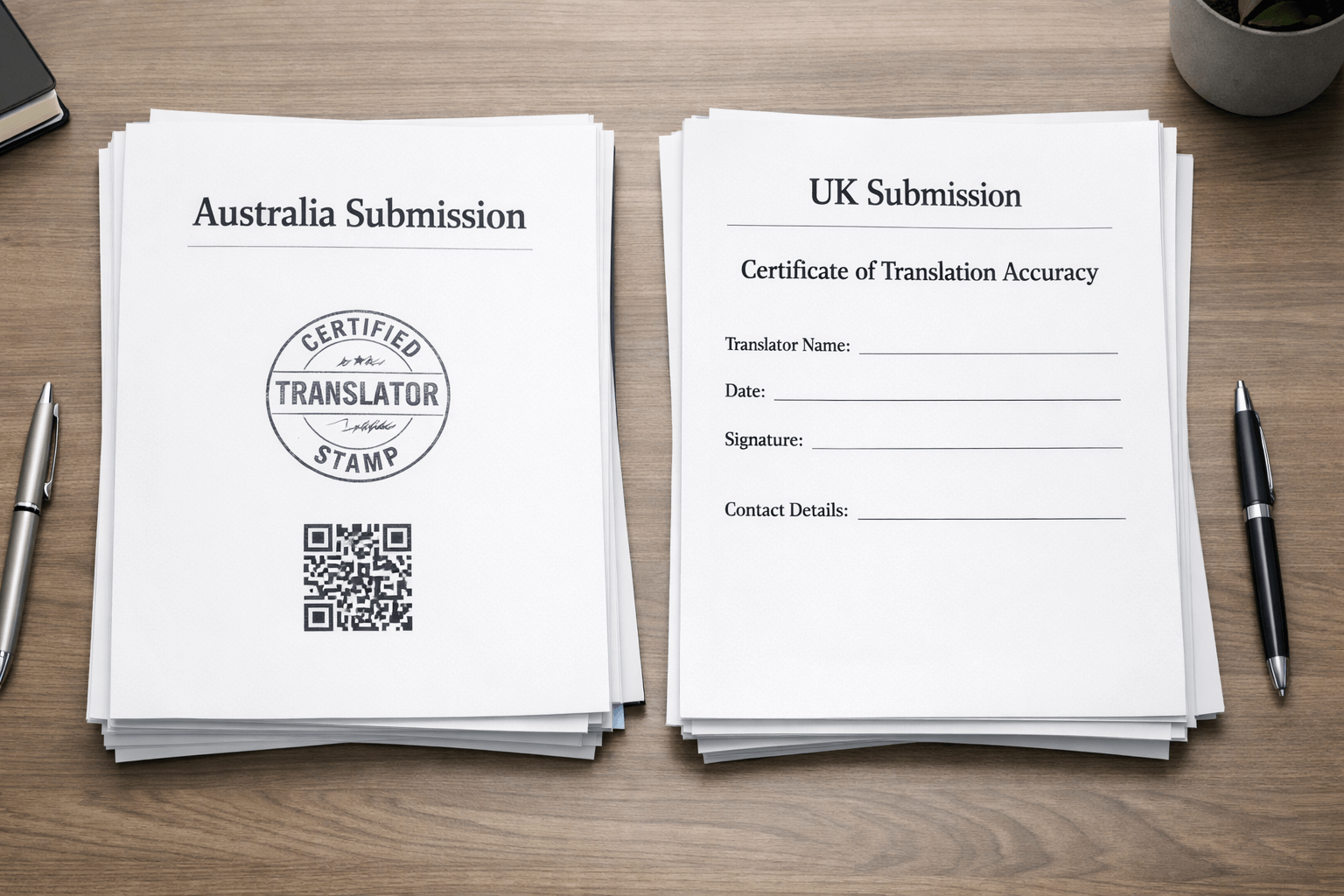
If you’ve been asked for a NAATI certified translation, you’re dealing with an Australia-specific requirement — and it’s easy to get tripped up by conflicting advice online. Some organisations will accept a standard certified translation. Others will only accept translations completed by a NAATI-credentialed translator.
This guide breaks it down clearly: what NAATI certified translation means, what the stamp actually proves, how to verify it, and what to use instead if your documents are for the UK (or another country).
The quick answer most people need
You need a NAATI certified translation when the organisation you’re submitting to specifically requires NAATI (common for Australian immigration, government, and many official processes).
If your documents are for UK use, you usually need a UK certified translation (not NAATI) — typically a full translation plus a signed certification statement with the translator’s details.
Not sure which one applies? Upload your document and tell us the destination authority — we’ll confirm the correct format before anything starts: Request a free quote.
What NAATI is (and what “NAATI certified translation” really means)
NAATI is Australia’s national standards and credentialing body for translators and interpreters. When people say “NAATI certified translation,” they usually mean:
- the translation was completed by a translator who holds a current NAATI credential (for the relevant language pair), and
- the translation is certified using the translator’s NAATI-issued identification (stamp / digital stamp), so the credential can be verified.
NAATI translator vs NAATI translation: the important distinction
- A NAATI-certified translator is the person with the credential.
- A NAATI certified translation is the document produced and certified by that credentialed translator.
That’s why an agency can’t simply “make it NAATI” unless the actual translator signing/stamping it is NAATI-credentialed.
What a NAATI certified translation looks like in practice

A NAATI certified translation is usually delivered as a PDF (often with a scanned copy of the source document attached), and it’s certified using either:
- a physical translator stamp (plus signature and translation date), or
- a digital stamp (with a QR-based verification process).
Typical elements you’ll see on a NAATI certification
While layouts vary, most NAATI-certified translations include verification-friendly details such as:
- translator’s name
- NAATI practitioner number (often shown as a CPN)
- language direction (e.g., Arabic → English)
- credential type (e.g., “Certified Translator”)
- a date reference (translation date or stamp-generated date)
- a security mechanism (stamp features / QR verification on digital stamps)
The “valid to” date confusion (and why it matters)
Many people panic when they see a “valid to” date on a stamp and assume the translation expires. In reality, the key date that matters for the translation is the translation completion date — and whether the translator held the credential at that time.
If you’re unsure, don’t guess. Ask for a verification check before you submit — it takes minutes and can prevent a costly re-translation.
When do you need a NAATI certified translation?
You’re most likely to need a NAATI certified translation if you’re submitting documents to an Australian organisation that requires NAATI specifically. Common scenarios include:
- Australian visa / migration applications (supporting documents not in English)
- Australian government departments and official registries
- university admissions where NAATI is specified
- professional registration bodies (depending on the profession)
- certain state-based services (requirements can vary)
Documents that frequently require NAATI certification
- birth certificates, marriage certificates, divorce certificates
- police certificates / criminal record checks
- academic transcripts and degree certificates
- driving licences and identity documents
- medical reports (when used in official contexts)
- financial documents (when requested by a government or regulated body)
Always follow the requirement of the organisation you’re submitting to — not a generic “what people usually do” forum answer.
How to verify a NAATI certified translation (before you submit)
If you’re paying for a NAATI certified translation, verification should be straightforward.

A 60-second NAATI verification checklist
- Check the translator’s name matches the stamp/digital stamp.
- Check the language direction is correct (e.g., Bangla → English, not the other way around).
- Look for a practitioner number (often CPN) or a digital QR verification method.
- Confirm the credential type fits your use-case (many organisations simply ask for NAATI; others specify translator vs interpreter credentials).
- Confirm the translation date is present (especially relevant for physical stamps).
- Verify the credential using NAATI’s official verification tools (or scan the digital QR where provided).
If any one of these elements is missing, resolve it before you lodge your application.
Common myths about NAATI certified translation (that waste time and money)
Myth 1: “Any certified translation is NAATI”
A translation is only “NAATI certified” if it is certified by a NAATI-credentialed translator.
Myth 2: “It has to be notarised to be accepted in Australia”
Notarisation is a different legal process. Many Australian submissions ask for NAATI — not notarisation. Only notarise if your receiving authority explicitly requires it.
Myth 3: “My NAATI translation expires when the stamp expires”
The stamp may show a credential recertification date, but the translation’s acceptance usually depends on whether the translator held the credential when the translation was produced.
Myth 4: “NAATI is a UK requirement”
NAATI is Australia-specific. UK institutions typically require a UK certified translation with a signed certification statement and translator contact details — not NAATI.
UK alternatives to NAATI (what to use for UK submissions)
If you’re submitting documents in the UK — for example to UKVI, HM Passport Office, DVLA, universities, employers, banks, or solicitors — you usually need a UK certified translation, not NAATI.
A UK certified translation is typically a professional translation that includes a signed certification statement confirming:
- it is a true and accurate translation of the original document
- the translation date
- the translator’s full name and signature
- the translator’s contact details (so it can be independently verified)
If your destination authority is in the UK, start here: Certified translation services.
Certified vs sworn vs notarised in the UK (plain-English comparison)
Certified translation (UK):
Best for most UK official uses (immigration, passport, academic, employment). It’s the standard “accepted by UK authorities” format.
Sworn translation:
This term is often used in civil-law countries where translators are officially appointed by courts or government authorities. If you’ve been told you need a sworn translation for overseas use, we can guide you on the correct route: Sworn translation services.
Notarised translation (UK Notary Public):
Used when a receiving authority wants notarisation (identity and witnessing) and/or legalisation for international use. This is common for overseas submissions, embassy processes, and documents headed abroad: Notarised translation services.
If you’re not sure which one applies, the fastest way to avoid mistakes is to send the destination requirement with your file: Upload your document here.
If you’re in the UK but need NAATI (your best options)
If your submission is for Australia and NAATI is required, you generally have two practical routes:
Option A: Use a NAATI-credentialed translator from the start
This is the simplest path when NAATI is mandatory. You’ll receive a translation certified using the translator’s NAATI identification (physical/digital).
Option B: Get UK support, then match the destination format
If you’re dealing with mixed submissions (UK + Australia) or multiple authorities, you may need:
- a UK certified translation for UK use, and
- a NAATI certified translation for Australia.
We regularly handle multi-country document sets and can help you avoid duplicated work. Start with a single upload and we’ll map the correct certification format for each destination: Request a free quote.

A practical decision guide (choose the right certification in minutes)
Use this quick decision guide:
You should choose NAATI certified translation if:
- the receiving organisation explicitly states NAATI (Australia-focused)
- the process is migration/government/professional registration in Australia
- you must provide a translation that can be verified via NAATI credentials
You should choose UK certified translation if:
- your documents are for UKVI / immigration, passports, DVLA, UK education, employers, banks, solicitors
- the requirement is “certified translation” with translator details and a signed statement
You should choose notarised translation if:
- the receiving authority requires notarisation, legalisation, or apostille
- you’re submitting to embassies, foreign courts, or overseas registries that request notarised documentation
If you want a definitive answer for your specific case, we’ll confirm it before you pay: Get started here.
What you’ll receive from UK Certified Translation
When your destination is the UK (or a country that accepts UK-style certification), our certified translations are prepared to be verification-friendly and submission-ready:
- clean, complete translation of every page (including stamps/notes where relevant)
- certification statement with date, signature, contact details
- consistent names, reference numbers, and formatting
- quality checks to reduce rejection risk
- secure handling and clear delivery timelines
Explore all options in one place: View translation services.
Real-world examples (so you can spot the right format)
Example 1: UK visa application (documents not in English)
Best fit: UK certified translation with signed certification statement and translator contact details.
Typical documents: birth certificate, marriage certificate, bank statement, tenancy agreement, payslips.
Example 2: Australian migration submission
Best fit: NAATI certified translation if NAATI is specified by the receiving authority.
Typical documents: police certificate, birth certificate, education documents.
Example 3: Overseas court or embassy pack (outside the UK)
Best fit: sworn translation (where legally required) or notarised translation with legalisation/apostille (where requested).
If you’re not sure, send the authority’s wording and we’ll match it.
A simple, safe way to start (and avoid rework)

- Upload a clear scan/photo (PDF preferred).
- Tell us where you’re submitting (UK / Australia / other).
- We confirm the correct certification format.
- You receive a submission-ready translation (PDF, and hard copy if needed).
Start your upload here: Contact UK Certified Translation.
FAQ
What is a NAATI certified translation?
A NAATI certified translation is a translation completed and certified by a translator who holds a current NAATI credential, using NAATI-issued identification (physical or digital) so the credential can be verified.
Does a NAATI certified translation expire?
People often confuse the stamp’s “valid to” date with translation validity. What typically matters is whether the translator held the credential when the translation was produced and dated.
Can I use a UK certified translation instead of NAATI for Australia?
Only if the receiving organisation accepts it. If the authority explicitly requires NAATI, a UK certified translation usually won’t meet that requirement.
What should a UK certified translation include?
A full translation plus a signed certification statement confirming accuracy, the translation date, the translator’s full name and signature, and contact details for verification. For UK use, start here: Certified translation services.
What’s the difference between certified and notarised translation in the UK?
Certified translation is usually enough for most UK official purposes. Notarised translation involves a UK Notary Public and is used when notarisation/legalisation is specifically required. See: Notarised translation services.
I’ve been told I need a sworn translation — do I need that in the UK?
“Sworn translation” is often a requirement in certain countries (not a standard UK concept). If your documents are for overseas authorities requesting sworn translations, we can guide you and supply the right format: Sworn translation services.